The Shroud of Turin · Chapter 15 of 21
The empty wrappings: the linens in the tomb
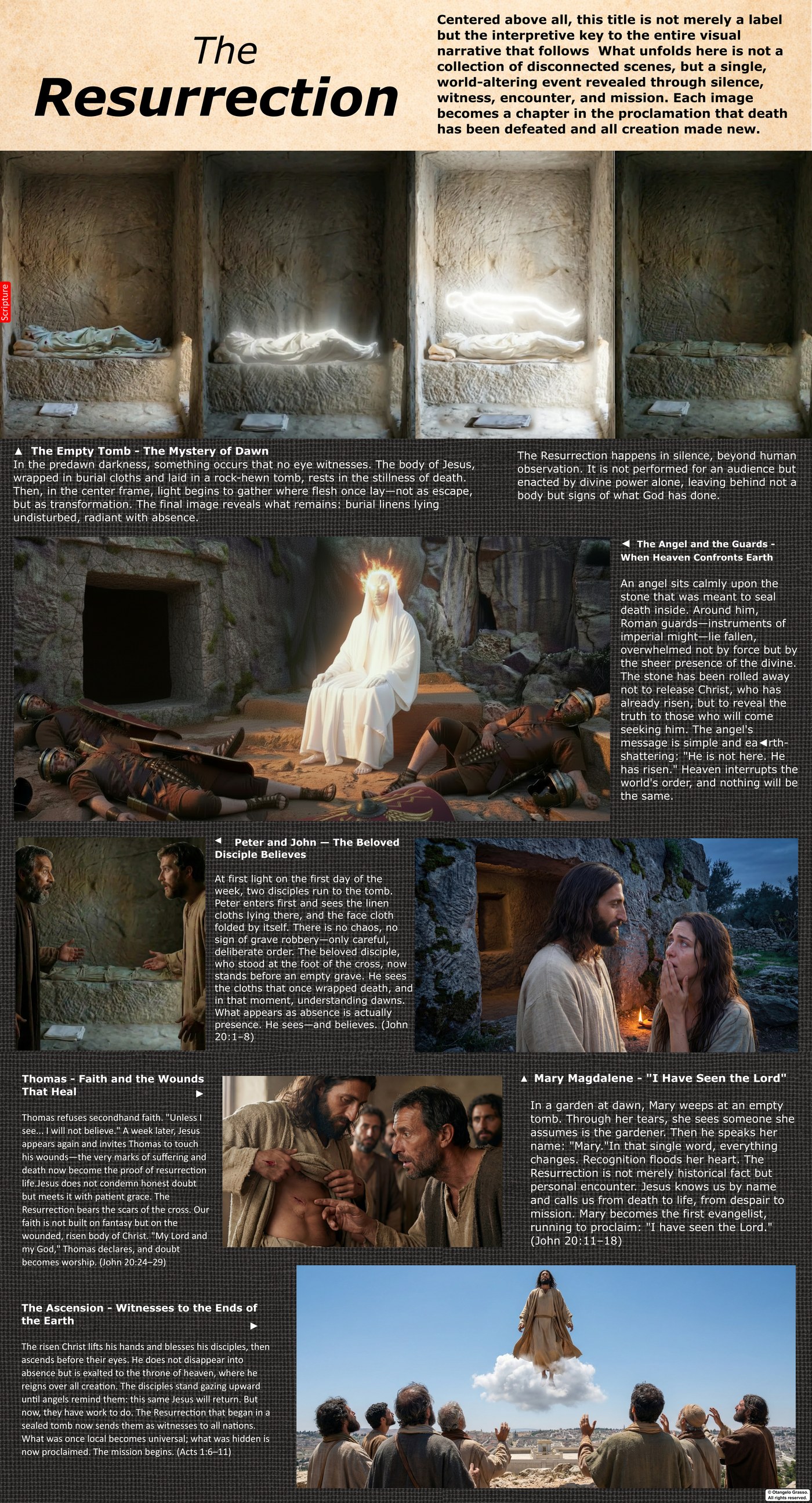
On the first day of the week, before dawn, the women came to the tomb with spices and found the stone rolled away. Mary Magdalene ran to tell Peter and the other disciple. Peter and John ran to the tomb, and John, arriving first, looked in and saw the linen cloths lying there. Peter went in, and he saw them too, together with the face cloth, folded and set apart. The Gospel of John says that the other disciple then saw and believed. The account is short, and it is one of the few places in the Gospels where the physical arrangement of an object is described with care. That care has made the linen cloths the object of a long argument. This chapter sets out what the Gospels say about the cloths, what the key Greek words mean, how the arrangement has been read, what the Shroud is said to add to that reading, and where the argument is firm and where it is inference.
What the Gospels say
Each of the four Gospels describes the empty tomb, but only John describes the linen. Mark says that the women found the stone rolled back, entered the tomb, and saw a young man in a white robe, who told them that Jesus had risen (Mark 16:1–6). Matthew says that an angel rolled the stone away and sat on it, and that the guards became as dead men (Matthew 28:1–4). Luke says that two men in dazzling clothes stood beside the women, and that Peter ran to the tomb, stooped, and saw the linen cloths by themselves, and went home amazed (Luke 24:1–12).1
John gives the most detailed account. Mary Magdalene came while it was still dark and saw the stone removed. She ran to Simon Peter and the disciple whom Jesus loved, and said that they had taken the Lord out of the tomb. Peter and the other disciple ran together, and the other disciple outran Peter and reached the tomb first. He bent down and saw the linen cloths lying there, but did not go in. Peter came up behind him, went into the tomb, and saw the linen cloths lying, and the face cloth that had been on his head, not lying with the linen but folded up in a place by itself. Then the other disciple went in, and saw, and believed (John 20:1–8).2
The Gospel of John does not say what the disciples believed, beyond the single word believed, and it does not say that they understood the scripture. The verse that follows says that they did not yet know that Jesus must rise from the dead (John 20:9). The sequence of seeing and believing is therefore not a simple one, and the chapter returns to it below.
The Greek words
The Gospel of John uses specific words for the cloths, and the words are the basis of the argument. The main term is othonia, which is translated as linen cloths, or as bandages. It is the plural of a word for a linen wrapping, and it is the term used for the cloths in which the body was bound. The word is used in John 19:40 for the spices and the cloths in which Joseph and Nicodemus wrapped the body, and in John 20:5–7 for the cloths left in the tomb.3
The second term is soudarion, the face cloth, which is a Greek word derived from the Latin sudarium, a sweat cloth. The word is used only in the account of the burial and the empty tomb (John 11:44; 20:7). In John 11:44 the word refers to the cloth bound around the face of Lazarus, and in John 20:7 it refers to the cloth that had been on the head of Jesus. The use of a single word in both places is one of the links that have been drawn between the two accounts.
The verb John uses for the cloths lying there, keimena, means lying or placed, and John uses it three times in the account, describing the linen as lying and the face cloth as not lying with the linen. The third term describes the folding: the face cloth was rolled up, or folded, in a place by itself, with the Greek phrase eis hena topon, into one place. The word translated as rolled up or folded is a participle from a verb meaning to wind or roll, and the Gospel uses it of the cloth alone.
The cloths in the account of Lazarus
The Lazarus account gives a point of comparison. In John 11:44, Lazarus came out of the tomb bound hand and foot with strips of cloth, and his face was wrapped with a cloth. Jesus told the bystanders to unbind him and let him go. The contrast with the empty tomb of Jesus is one of the central points of the argument. Lazarus came out bound, and the bindings had to be removed. Jesus left his wrappings behind, and they lay in the tomb in a configuration that did not suggest that anyone had unwound them.2
The Gospel writer uses different words for the wrappings in the two accounts, and the difference has been noticed. The strips that bound Lazarus are called keiriai, which are bands or strips, and the cloths left in the tomb of Jesus are the othonia. The writer seems to be marking the difference between a body that was bound and carried out, and a body that left its wrappings behind. The distinction is literary and theological, and it is also relevant to the physical reading of the cloths.
The arrangement of the cloths
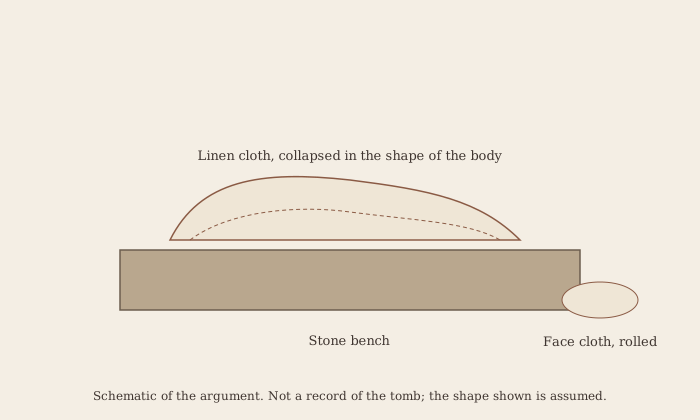
The arrangement John describes is the centre of the argument. The linen cloths are said to be lying in the same place, and the face cloth is said to be separate, rolled, and set apart. A body that had been unwound by thieves, or by anyone in haste, would not leave the cloths lying in this arrangement. A body that had left the cloths without disturbing them would leave them lying in something like the shape of the body, collapsed. That is the reading that the Gospel writer seems to intend, and it has been developed in the modern literature on the resurrection.
The reading has two parts. The first is that the cloths had the shape of the body, and that they collapsed when the body left them. The second is that the face cloth was folded or rolled deliberately, and was not part of the collapse. Each part has been argued, and each has been questioned. The first part depends on the reading of the Greek and on the assumption that the cloths were wrapped in a regular way. The second part depends on the reading of the participle and on the assumption that the folding was done by a person and not by the collapse.
Theft as an alternative
The Gospel of Matthew reports a rumour that the disciples had stolen the body (Matthew 28:13). The rumour is answered in the Gospel, and it is also a classical alternative in the historical reading. If the disciples took the body, they would have had to unwind it or to carry it away in its wrappings. The unwinding would take time and would leave the cloths in disorder, and the carrying away would leave the cloths behind or take them along. The arrangement John describes does not fit either act of theft in a simple way.
The argument has a psychological side. John says that the disciples were in hiding, with the doors locked, for fear of the Jewish leaders (John 20:19). A group in fear, who had just seen their leader executed, would be unlikely to take the risk of a theft and then to pause in the tomb to fold a face cloth. The argument is that the folding is inconsistent with haste, and that the haste of a theft would leave the cloths in disorder. The argument is plausible, though it depends on the assumption that the thieves would behave as the Gospel describes.
The gardener and the grave clothes
The Gospel of John then describes Mary Magdalene standing at the tomb, weeping. She saw two angels in white, sitting where the body had been, one at the head and one at the feet. They asked her why she wept, and she said that someone had taken her Lord away. She turned and saw Jesus standing there, and thought him to be the gardener (John 20:11–15). The scene is among the most striking in the Gospels, and it reinforces the point that the tomb was empty before any vision. The angels mark the place of the body, which is consistent with the linen having been left in place.
What the Shroud can add
The Shroud is a linen cloth of the size needed to wrap a body. It bears the image of a man, with marks on the head, the back and the limbs, and it has been read as the cloth in which the body was wrapped. If that reading is right, the cloth would be one of the linens described in the Gospel. The argument is that the Shroud is the largest of the cloths, and that it is the cloth that would have collapsed when the body left it.
The argument has several limits. The Shroud does not identify itself as the linen of John, and no text in the Gospels names it. The image on the cloth has been read in many ways, and the reading that it is the image of a body that left the cloth is an inference, not a measurement. The collapse of the cloth is not visible in the image, because the cloth is flat and the image is a record of contact, not of shape. And the Shroud, if it was the Gospel linen, would have had to be separated from the face cloth, which is a separate tradition.
The image and the wrappings
The image on the Shroud has been read as a record of contact with the body, not a painting. The contact would have marked the cloth where it lay against the body, and the marks would show the front and back of the body in the places the cloth covered. If the body left the cloth, the marks would remain, and the cloth would show the shape of the body at the moment of contact. That is the principle of the argument, and it has been used to connect the image with the empty tomb.
The principle has difficulties. The image is not clear about the moment of contact, and the image may have been formed by a process that is not yet understood. The image does not show that the body left the cloth, only that the cloth had been in contact with it. The Gospel account of the empty tomb is a claim about what happened after the contact, and the cloth does not directly record it.
The sequence of seeing and believing
The Gospel of John says that the other disciple saw and believed, and then adds that they did not yet understand the scripture (John 20:8–9). The words suggest a process, in which seeing the cloths led to belief before understanding. The process is important for the reading of the account, because it shows that the empty linen was not itself the proof of the resurrection in the writer’s view. It was one of the signs that led to a larger recognition.
The Gospel writer does not claim that the cloths proved anything by themselves. The reader is left to weigh the cloths, the tomb and the later appearances together. The later appearances in John 20 include the meeting in the locked room, the showing of the hands and the side, and the doubt of Thomas. The cloths belong to a sequence, and the sequence is not a demonstration.
The face cloth and its place
The face cloth was not with the linen. It was rolled up and set apart, and the Gospel writer marks the difference carefully. Some interpreters have read the separation as evidence of deliberate care, and others as a practical detail of the burial. The separation is consistent with the burial practice of folding the face covering, and it is also consistent with a deliberate act at the tomb. The text does not say which.
The face cloth has its own history, which is discussed in Chapter 14. The tradition of the Sudarium of Oviedo is one of the claims made about it, and the claim is disputed. The face cloth in the empty tomb and the Oviedo cloth are different objects, if the tradition of Oviedo is taken at face value, and the question of their relation is open.
Forensic readings of the empty tomb
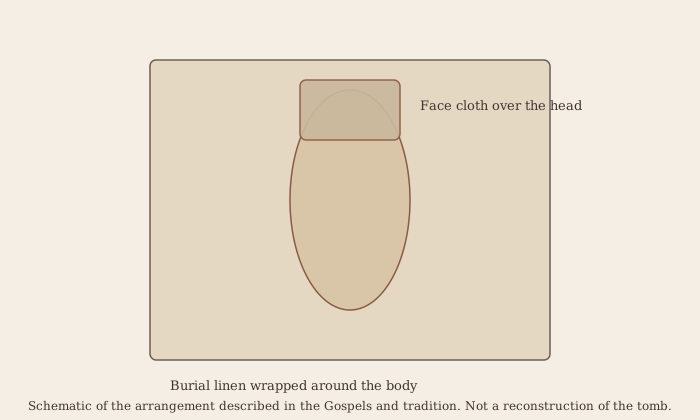
The forensic readings of the Shroud have addressed the empty tomb in several ways. Some have argued that the image shows a body that was wrapped and then removed without unwinding the cloth, which would be consistent with the Gospel account. Others have argued that the image was formed by a process that does not require a body to leave the cloth, and that the empty tomb is not supported by the cloth. The readings differ in their assumptions, and the series treats them as competing interpretations.
The forensic claims about the collapse, the unwinding and the removal are not directly testable in the cloth. The cloth can be examined for signs of folding, creasing, and the transfer of marks from the body. Those signs would be consistent with several histories, and the series does not treat them as decisive.
What is firm and what is open
Several points are firm. The reading of the burial and the empty tomb as one continuous account has a long scholarly history, and the reading is set out in detail by Brown.4 The four Gospels agree that the tomb was found empty, that the stone was moved, and that the women and the disciples went to it. John records the linen and the face cloth, and the words used for them are specific. The arrangement of the cloths is described, and the description is consistent with the account of a body that left its wrappings. The Lazarus contrast is in the text.
Several points are open. The meaning of the arrangement, the exact physical state of the cloths, the reading of the Greek participles, the reason for the folding, and the relation of the Gospel linen to the Shroud all remain matters of interpretation. The Shroud does not settle them, and the series does not claim that it does.
Questions a reader can test
A reader who wants to test the empty-tomb argument can begin with the Greek. The words for the cloths, the participles, and the phrase for the place should be read in their contexts. The reader can then compare the Lazarus account, and can ask whether the difference between the bindings is literary or physical. The reader can ask whether the collapse argument depends on a model of the cloth, and whether the model is tested. And the reader can ask whether the Shroud, if it were the Gospel linen, would show signs of a body that left it, and whether those signs are present.
Each question has an answer that the reader must judge for themselves. The series sets out the evidence and the arguments, and it leaves the judgement open.
The earliest witness: Paul and the tradition
The earliest written witness to the resurrection is not a Gospel. In the First Letter to the Corinthians, Paul writes that he passed on what he had received: that Christ died for our sins according to the scriptures, that he was buried, and that he was raised on the third day according to the scriptures (1 Corinthians 15:3–4). The letter was written in the middle of the first century, earlier than the Gospels as they are now known. The burial is named as part of the tradition, and that is the reason it matters for the empty tomb. Paul does not describe the tomb or the cloths, but he treats the burial as an element of the story that was handed on.
The creed Paul quotes also lists the appearances, first to Cephas, then to the twelve, and then to more than five hundred at once (1 Corinthians 15:5–6). The list is a form of testimony that gives the names of living witnesses, and it is not a physical description. The absence of the tomb from the creed is consistent with the idea that the empty tomb was a shared fact, and that the appearances were the matter in dispute.5
Peter, the other disciple and the running
John’s account has the two disciples run to the tomb, and the other disciple arrives first. The running is a small detail, and it is one of the places where the Gospel writer gives the scene a physical sense of haste. The other disciple stops at the entrance and looks in. Peter goes in first. The order of entering has been read as a sign of respect, as a sign of the other disciple’s hesitation, and as a literary device for the priority of Peter in the tradition. The text does not say which.
The Gospel writer identifies the other disciple as the one whom Jesus loved, a phrase used elsewhere in the Gospel. The identity of that disciple has been argued since the early church, and it is not needed for the reading of the cloths. What matters is that two witnesses were present, and that they saw the same arrangement. The two witnesses are a point in the account that a historian can test against the Gospel’s own internal consistency.
The first day and the calendar
The Gospels say that the women came on the first day of the week, after the Sabbath. The day is the first of the Jewish week, and the Gospels link the discovery of the tomb to that day. The timing is significant for the Christian tradition, and the Sunday observance of the resurrection follows from it. The historian must note that the calendar of the period was based on the Jewish reckoning, and that the day of the week was counted from the Sabbath.
The Gospels also agree that the burial took place before the Sabbath began, and that the women waited through the Sabbath before returning. The sequence of the two days, the day of preparation and the Sabbath, is the frame in which the empty tomb is discovered. The frame is consistent with the Jewish calendar of the period, and it gives the reader a fixed point for the events.
Objections from the early period
The empty tomb was disputed from an early date. Matthew records the story that the disciples stole the body while the guards slept, and that the chief priests paid the soldiers to spread the story (Matthew 28:11–15). The story is an answer to the claim of resurrection, and it shows that the emptiness of the tomb was not denied by the opponents. The question was who had removed the body, not whether it had gone.
The second-century Christian writer Justin, in his Dialogue with Trypho, refers to the same charge, that the disciples had stolen the body from the tomb (Dialogue 108). The charge recurs in the early literature, and it shows that the empty tomb was a matter of public dispute, not only of later devotion. The opponents of the early Church did not need to deny the emptiness of the tomb in order to argue against the resurrection.6
The disciples in hiding
John says that the disciples were in a room with the doors locked, for fear of the Jewish leaders (John 20:19). The fear is a fact that the Gospel writer records, and it is consistent with the danger faced by the followers of a man who had been executed as a rebel. The fear bears on the theft argument, because a frightened group would be unlikely to plan a theft and then to pause in the tomb to fold a face cloth. The argument depends on a view of psychology, and it is a plausible view, though it is not a proof.
The fear also bears on the testimony. The disciples who later preached the resurrection had been in hiding, and their change in conduct is one of the things the Gospels and the early letters report. The historian has to decide whether the change is best explained by the appearances, by the empty tomb, or by something else. The question is one of the central problems of the historical study of the resurrection.
What a historian can test
The empty tomb can be approached as a historical question, separate from the theological one. The historian can ask whether the burial account is consistent with the Jewish and Roman practice. The historian can ask whether the location of the tomb was known to the disciples, and whether the women could have found it. The historian can ask whether the tradition of the empty tomb appears early and in more than one form. And the historian can ask whether the opponents of the Church accepted the emptiness of the tomb while disputing its meaning.
Each question has partial answers. The Jewish and Roman practice fits the burial account in outline. The tomb is identified in a tradition that goes back to the fourth century, and its location in the early period is uncertain. The tradition of the empty tomb appears in several sources, including Paul’s creed, which mentions the burial. The opponents accepted the emptiness and disputed the explanation. The historian’s conclusions are therefore provisional, and the series presents them as such.
The cloths and the historian
The cloths are a physical element in a historical argument, and they are not directly testable as a text. The historian can examine the account of the cloths for its consistency, its details and its sources. The Shroud, if it is linked to the cloths, is a physical object whose evidence must be assessed separately from the text. The two kinds of evidence meet at the point of identification, and the identification is not made by either alone.
The historian should therefore avoid two errors. The first is to treat the Shroud as a proof of the Gospel account, because the cloth is a physical object. The second is to dismiss the Shroud, because it cannot be proved to be the Gospel linen. The correct approach is to hold the two kinds of evidence in parallel, and to ask what each contributes.
Methods and limits
The methods used to study the empty tomb include textual criticism, which compares the manuscripts, philology, which studies the Greek, and historical reconstruction, which places the events in their setting. The methods used to study the Shroud include image analysis, chemistry, and the history of the object. Neither set of methods can settle the question of the resurrection, because that question lies beyond the methods. They can settle the narrower questions of what the cloths were, how they were arranged, and whether the Shroud can be connected with them.
Mary Magdalene as the first witness
In John, Mary Magdalene is the first to reach the tomb, and the first to report that it is empty. The Synoptic Gospels also name her among the women, and Mark says that she was the first to whom the risen Jesus appeared (Mark 16:9). Her role is unusual, because the testimony of women was not generally accepted as legal evidence in the Jewish courts of the period. The Gospel writers nevertheless place her at the centre of the story of the empty tomb, which is a point that many historians have noticed as a sign of its authenticity. A later invented tradition would have been more likely to give the discovery to male disciples.4
Mary’s weeping and her conversation at the tomb form a bridge between the discovery and the appearance. She is the one who sees the angels and then the risen Jesus, whom she takes at first for the gardener. Her recognition, when he calls her by name, is one of the most personal moments in the Gospels. The reader who looks for the cloths in her story will find that they are present but not central. The emphasis is on the person and the voice, and the cloths are part of the setting.
The endings of Mark
The Gospel of Mark ends at the words of the young man in the tomb, who tells the women to go and tell the disciples that Jesus has risen and will meet them in Galilee. The women flee, and say nothing to anyone, for they were afraid (Mark 16:8). The earliest manuscripts end at that point, and the longer endings that follow in some manuscripts are later additions. The shorter ending is therefore the most probable original, and it leaves the reader with fear and silence rather than with the appearances.7
The textual history matters for the cloths, because Mark does not mention them. The empty tomb is described in Mark without the linen. The absence of the cloths in Mark is one of the reasons that the John account has been read as a separate and later witness to the physical details. The reader should not conclude that Mark is hostile to the cloths; the writer simply does not describe them.
The silence of the women
The Markan ending is strange for many readers, because the women are told to speak and instead say nothing. The silence has been read as a literary device, as a mark of fear, and as a sign of the incomplete nature of the first testimony. The silence bears on the question of how the empty tomb was first reported. If the women were silent, the report of the empty tomb must have reached the disciples by another route, and the John account of Mary’s running to Peter is one way that could have happened.
The silence also suggests that the empty tomb was not, in the Gospel writer’s view, a self-sufficient sign. It was a fact that needed a witness, and the witness was in the appearances and in the message. The reader should not assume that the cloths were meant to be read as proof, since the writer of Mark does not mention them at all.
A note on the historical reading
The historical reading of the empty tomb has been advanced by many scholars, and it is not the property of any single school. The reading accepts that the tomb was found empty by women, that the disciples went to it, and that the opponents disputed the explanation. It is more cautious about the physical details, including the arrangement of the cloths, and it treats the John account as a separate witness with its own purposes. The series follows this reading, and it treats the cloths as a point of the account that needs particular care.
What the empty tomb contributes to the series
The empty tomb is the point at which the burial and the resurrection accounts meet, and the linen is the physical object that links them. The Gospel account gives the cloths a place and an arrangement, and the Shroud is read as one of them. The chapter that follows takes up the history of the cloth before 1355, the period in which the Shroud, if it is the Gospel linen, must have passed from the tomb to the places where it is recorded.
The empty tomb thus rests on several witnesses, each with its own emphasis. Mark gives the discovery and the silence of the women. Matthew gives the rumour of theft and the guard. Luke gives the running of Peter and the cloths by themselves. John gives the arrangement of the cloths and the face cloth folded apart, and the sequence of seeing and believing. Paul gives the burial and the creed. None of the witnesses offers a complete physical account, and each leaves questions that the others do not settle. The cloths are part of that testimony, and the Shroud, whatever its origin, can only be read against it. A reader who keeps the witnesses distinct will find the account richer and the questions clearer than in a single, harmonised version. That is the approach the series takes to every claim about the cloth, and the chapters that follow return to it whenever a physical reading depends on a text, or a text on a physical reading.
References
- Mark 16:1–6; Matthew 28:1–4; Luke 24:1–12. Luke 24:1–12.
- John 20:1–9; John 11:44. John 20:1–9.
- The Greek terms othonia, soudarion and keiriai, as discussed in the critical lexica and in the commentaries on John. Specific entries to be confirmed before publication.
- 1 Corinthians 15:3–8. 1 Corinthians 15:3–8.
- Justin Martyr, Dialogue with Trypho, 108. Translations are widely available. Publication details to be confirmed before publication.
- Mark 16:8, and the textual history of the longer ending of Mark. Discussed in the critical commentaries on Mark. Publication details to be confirmed before publication.
- Brown, R. E. (1994). The Death of the Messiah: From Gethsemane to the Grave. 2 vols. New York: Doubleday (Anchor Bible Reference Library).