The Shroud of Turin · Chapter 14 of 21
From the cross to the tomb: the burial and the face cloth
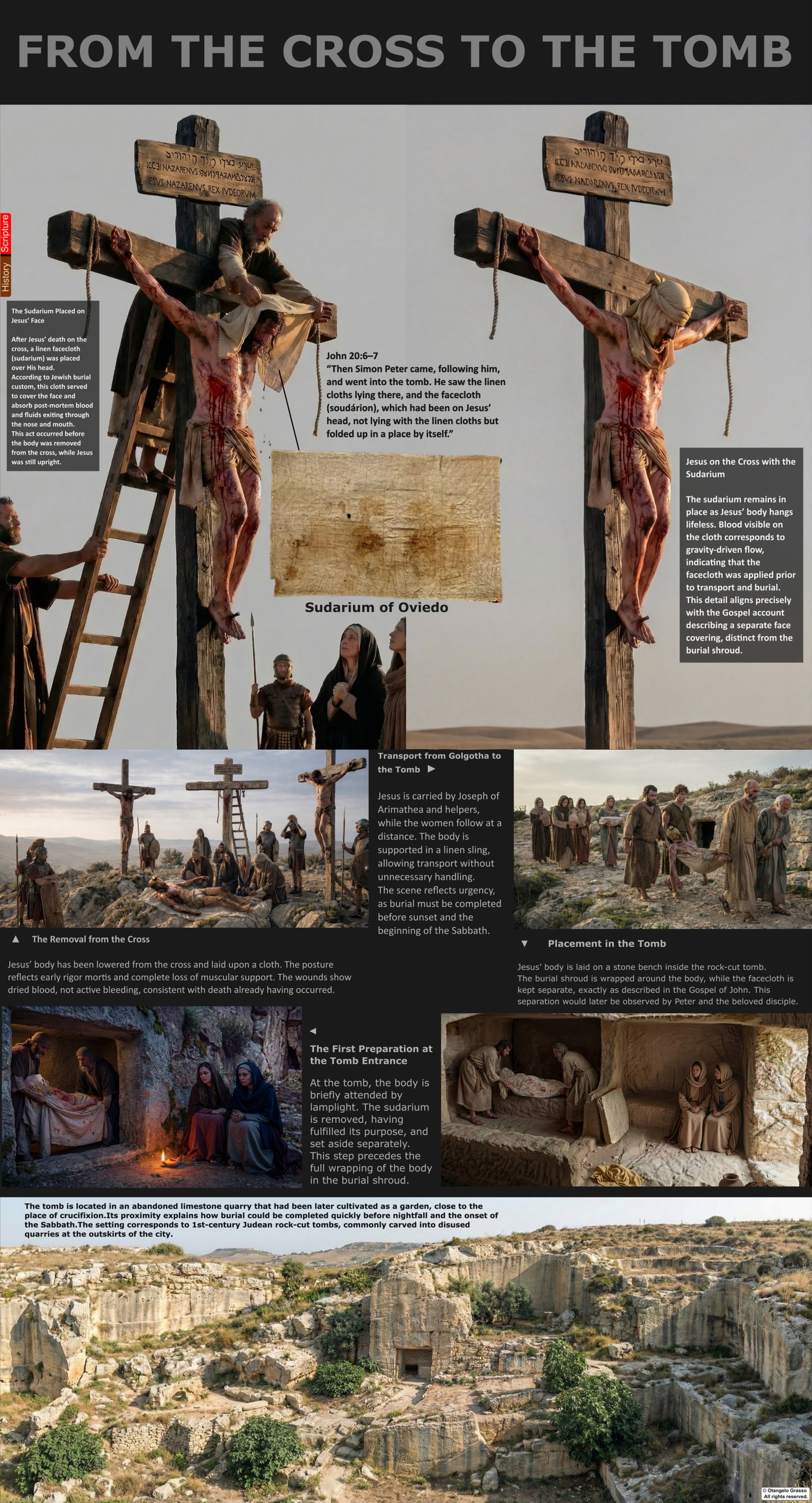
Before the Sabbath began, the body of Jesus was taken down from the cross, wrapped in linen, and laid in a tomb cut in the rock. The Gospels describe the events quickly, and they describe them as a hurried work. A member of the council, Joseph of Arimathea, asked Pilate for the body. A second man, Nicodemus, brought a large quantity of spices. The women who had followed Jesus from Galilee watched where the body was laid. Then the stone was rolled across the entrance, and the Sabbath began. The burial was short, and it was carried out in haste. Within the short account the Gospel writers record one detail that bears directly on the cloth: the linen cloths were lying in the tomb, and a separate cloth, the napkin, was folded apart from them. This chapter sets out the Gospel accounts, the Jewish practice of burial, the separate face cloth and its history, and the evidence the cloths can give about the burial.
The legal and religious setting
The Gospels place the burial within the Jewish law. Deuteronomy says that a man hanged on a tree must not remain on the tree overnight, but must be buried the same day, because a hanged body is cursed (Deuteronomy 21:22–23). The rule is applied in the Gospels to the crucified men, and it explains the urgency. The Sabbath was about to begin at sunset, and the bodies had to be taken down and buried before then. The rule did not require a full burial rite, but it required a burial on the same day.1
The Gospels also describe the Jewish practice of preparing the body with spices and linen. The practice was a part of the rites of burial, and it was carried out by the family or by close friends. The Gospels say that Nicodemus brought a large mixture of myrrh and aloes, weighing about a hundred pounds, and that the body was wrapped with the spices in linen cloths (John 19:39–40). The quantity is large, and the reader should note that the Gospel writer is describing a rite of honour and not a standard embalming.2
Joseph of Arimathea
Joseph of Arimathea is described in all four Gospels. Mark calls him a respected member of the council, who was himself waiting for the kingdom of God (Mark 15:43). Luke says that he had not agreed with the council’s decision (Luke 23:50–51). John says that he was a secret disciple, out of fear of the Jewish leaders (John 19:38). Matthew says that he was a rich man and a disciple (Matthew 27:57). The four accounts agree that Joseph asked Pilate for the body, and that he laid it in his own new tomb.
The request to Pilate was a bold one, and the Gospels say that Pilate was surprised that Jesus was already dead. The governor summoned the centurion, asked whether Jesus had died, and granted the body when the centurion confirmed it (Mark 15:44–45). The Roman practice was to leave the bodies of the executed on the cross for scavengers, and to release them only on request. The request therefore required the governor’s permission, and the Gospel account records it.
Nicodemus and the spices
Nicodemus appears in the Gospel of John, where he first came to Jesus by night and asked about new birth (John 3:1–21). He returns in the account of the burial, and he brings the spices. The quantity is one of the most discussed details in the account. The reader who wants to understand it should note that large amounts of spices were used in some Jewish burials of the period, and that the quantity may have been a mark of honour, not a practical necessity.
The spices have a bearing on the cloth. Myrrh and aloes are resinous substances, and they leave residues on the linen. The forensic readings have looked for such residues, and some have reported finds consistent with aloe and myrrh, though the reports are disputed. The spices are a useful test, because their presence or absence can be checked by chemistry and by pollen analysis, and the results can be compared with the Gospel account.3
The removal from the cross
The Gospels describe the body being taken down from the cross, and laid on the lap of the mother, in a scene that the artistic tradition has called the Pieta. John says that Joseph and Nicodemus took down the body, and that they wrapped it in linen with the spices, as was the Jewish custom of burial (John 19:38–40). The removal would have been difficult, because the nails had to be drawn or the body had to be lowered with the nails still in place. The Gospels do not describe the method.
The removal from the cross is a point at which the body was handled roughly. The arms would have had to be released, the feet freed, and the body lowered to the ground. Each movement would have disturbed the wounds and the blood, and the stains on the cloth would have been affected. The forensic readings have considered whether the marks on the cloth are the product of the removal, and they have argued that some of the stains were laid down at this stage.

The linen and the tomb
John describes the linen cloths in the tomb, and says that Peter entered it after the women reported that the body was gone. He saw the linen cloths lying there, and the napkin that had been over the head, folded and set apart from the linen (John 20:5–7). The detail is among the most discussed in the Gospels, because it describes the cloths after the body had left them. The linen cloths were lying in their shape, and the napkin was rolled up in a place of its own.4
The Gospel description has been used in two ways. One reading is that the body had left the cloths without disturbing them, which is taken as a sign of the resurrection. Another reading is that the cloths were left in the tomb after the body had been removed by others, which is a practical explanation. The forensic readings have added a third question, which is whether the Shroud is the linen described in the tomb. That question is discussed in the next section.
The face cloth
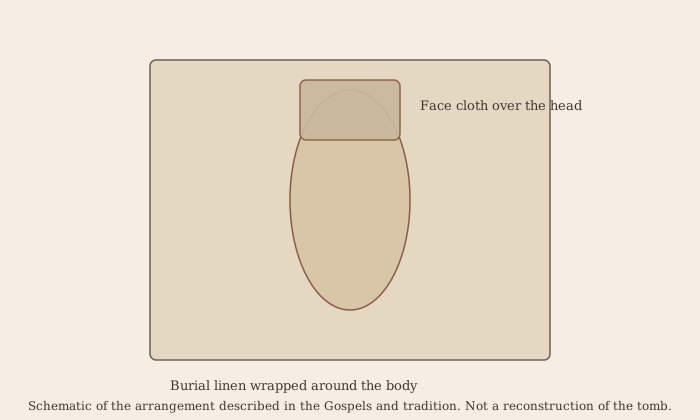
The face cloth, the sudarium in Latin and the napkin in the Gospels, is a separate piece of linen. It covered the head, and it was removed from the face and rolled up apart from the other cloths. The Gospels mention it only once, in the account of Peter and John at the tomb. Its place in the burial is different from that of the burial linen, and the difference has led some readers to treat it as a separate object.
The face cloth in the tradition
Tradition identifies the face cloth with a cloth held in a number of churches. The best-known of these is the Sudarium of Oviedo, a cloth kept in the cathedral of Oviedo in Spain. The tradition says that it was the face cloth of the Gospel, and that it was brought to Spain in the early Middle Ages. The cloth carries stains of blood, and some researchers have reported that the stains are consistent with a face that had been struck and bled.5
The Oviedo claim is a tradition with a history, and its evidence is disputed. The stains have been studied, and their blood group has been reported, but the historical link to the Gospel face cloth cannot be proved. The series treats the Oviedo cloth as a comparison, and not as a proof of the burial account.
The face in the forensic readings
The forensic readings have used the face cloth to read the face of the Shroud. The face on the Shroud shows bruising, swelling and marks consistent with the injuries described in the Gospels. The face cloth, if it covered the face in the tomb, would have carried a stain pattern that could be compared with the face on the Shroud. The comparison has been made, and the results have been reported as consistent. The comparison is complicated by the fact that the face cloth was removed from the face, and by the uncertainty about its position.
The argument has been developed in detail, and its supporters claim a close match between the two sets of stains. The critics answer that the match depends on the choice of points and on the reconstruction of the face, and that the Oviedo cloth cannot be proved to be the Gospel napkin. The argument is open, and the series does not settle it.
The pollen and the burial
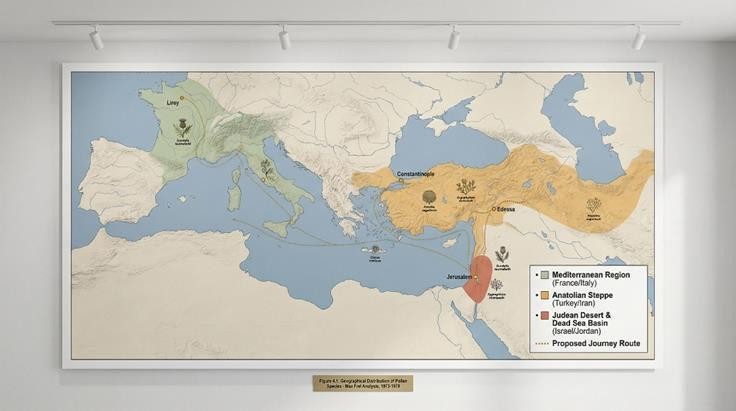
The pollen on the cloth has been studied by palynologists, and the results have been used to argue for a burial in the Near East. The pollen grains found on the cloth are of plants that grow in the region, and the reports have listed species consistent with a Palestinian origin. The argument is that the cloth was in the region of the Gospel burial. The argument depends on the identification of the grains, and on the assumption that the grains were not picked up later.6
The burial in the Jewish practice
The Jewish practice of the period included the burial of the body in a tomb, where it was laid on a bench and left to decompose. After about a year, the bones were collected and placed in an ossuary, a stone box. The practice is well documented in the archaeology of Jerusalem. The burial in the Gospels was not the full practice, because the Sabbath prevented the full rite, and the women intended to return after the Sabbath to complete the anointing (Mark 16:1; Luke 23:56).
The temporary burial fits the Gospel account. The body was laid in a tomb cut for the purpose, wrapped in linen with the spices, and left for the Sabbath. The women returned on the first day of the week and found the tomb empty. The practice gives the context of the burial, and it explains the detail of the spices and the cloths.
What the cloths can and cannot show
The burial cloths can show the marks of the body, the stains of blood and fluid, the pollen and the residue of the spices. They can show that the body was wrapped in a large linen cloth, and that a smaller cloth covered the face. They can show the flow of blood and fluid through the body and onto the linen, and they can suggest the position of the body in the tomb.
They cannot show the identity of the man, the date of the linen, or the exact order of the burial. They cannot say whether the cloth in the tomb was the cloth now in Turin, or whether the face cloth in Oviedo was the one described in the Gospel. Each of those questions needs evidence beyond the cloth itself, and the series treats them separately.
The argument for the Gospel burial
The argument for the Gospel burial rests on several points. The Shroud shows marks consistent with a body that was wrapped in linen and laid flat, with the head covered by a separate cloth. The pollen and the spices, if identified correctly, are consistent with the region and the practice. The tradition of the Oviedo cloth gives a historical thread. And the form of the burial, with a large cloth and a face cloth, matches the Gospel account. The argument is consistent, and it depends on several separate points, each of which can be tested.
The argument against the Gospel burial
The argument against the Gospel burial is that the Shroud could have been made in a later period, by a person who knew the Gospel account and who wished to represent it. The pollen could have been introduced by handling, by contamination or by the environment of the storage place. The spices could have been applied in the Middle Ages as part of a devotional object. The Oviedo tradition is later than the Gospel. Each point can be answered, and each answer is a separate argument. The series does not settle the matter, and it notes the points on each side.
The burial as a sequence
The burial can be read as a sequence of acts. The body was taken down, wrapped, anointed with spices, laid in the tomb, and the stone was rolled across the entrance. The women watched, and they planned to return. The face cloth was removed and set apart, and the linen was left in its place. Each act has a physical effect on the cloth, and each can be connected with the marks and stains the cloth shows. The sequence is plausible, and it fits the Gospel account, but the cloth alone cannot establish the order of every act.
The women and the watch
Several women are named in the burial accounts. Mark names Mary Magdalene, Mary the mother of Joses, and Salome, who had followed Jesus from Galilee and had served him (Mark 15:40–41). Luke says that the women who had come with him from Galilee followed Joseph, saw the tomb, and saw how the body was laid (Luke 23:55). Their presence matters for the Gospel account, because they become the witnesses of the empty tomb. Their careful watching of the burial is the reason the place was known to them later.
The women also planned their return. Luke says that they went home and prepared spices and ointments, and rested on the Sabbath according to the commandment (Luke 23:56). Mark says that they bought spices after the Sabbath, and came to the tomb early on the first day of the week (Mark 16:1–2). The two accounts agree on the plan and on the Sabbath rest, and they differ in the detail of the preparation. The plan shows that the burial was regarded as temporary, and that the anointing was to be completed.
Matthew adds a further detail, that the chief priests and the Pharisees asked Pilate to secure the tomb, because they feared that the disciples would steal the body and claim a resurrection. Pilate gave them a guard, and the tomb was sealed and watched (Matthew 27:62–66). The passage is unique to Matthew, and its historical basis is debated. It shows that the tomb was guarded and sealed, and that the authorities regarded the body as something that could be claimed or removed.7
The Sabbath and the rest
The Sabbath, as the Gospels describe it, was a day of rest in which work was forbidden. The burial could not be completed after sunset, because the rite involved the handling of the body and the preparation of the spices, and both were work. The burial was therefore made before the Sabbath, and the full rite was postponed. The postponement is the reason for the haste of the account, and it explains why the women waited until the first day of the week to return.
The Sabbath also marks the time between the death and the discovery. The Gospels say nothing about the body during that time. The reader who wants to understand the gap should note that the tomb was closed, that the body was wrapped, and that the cloths were in place. The physical state of the body in the tomb during the Sabbath is a matter of inference, and the forensic readings have considered it in connection with the stains.
Jewish burial linen
The linen used in Jewish burials of the period is attested in the archaeological record and in the literature. The Mishnah and later rabbinic texts describe the burial garments and the wrappings of the dead, and they describe the practice of wrapping the body in cloths. The practice varied with wealth and with the local tradition. Wealthy families used fine linen and spices, and poorer families used plain cloth. The Gospels describe a rich burial, with a costly linen and a large quantity of spices, and the account is consistent with the practice of a wealthy family.
The archaeology of the period includes textile finds from tombs in Judea. Some of these finds are of linen wrappings, and some are of cloths that covered the face or the head. The finds show that linen was used in burial, and that the cloths were wrapped in various ways. The Gospel account is one of many accounts of such burials, and it is consistent with the material record.8
Methods of wrapping
The wrapping of a body in a single long cloth, from head to foot, is known from the Roman and Jewish worlds, and it is the form that the Shroud’s image is read as preserving. The wrapping of the arms and the legs separately is also known. The Gospel account does not describe the method of wrapping in detail, and its words for the linen are general. The reader who wants to know how the body was wrapped should look to the archaeological finds, and should note that the finds are varied.
The wrapping has an effect on the cloth. A long cloth wrapped around the body and laid over the head would bear the marks of the front and the back, and the marks would be arranged according to the wrapping. The forensic readings of the Shroud use the front and back images to argue for a single long cloth, and they consider the positions of the arms and the feet in the wrapping. The argument depends on the reading of the images, and on the assumption that the cloth was a single piece.
The face covering and the Lazarus narrative
The face covering is described in the Lazarus narrative of John. When Lazarus came out of the tomb, he was still bound with linen cloths, and his face was wrapped in a cloth (John 11:44). Jesus told the bystanders to unbind him. The passage shows that the face covering was a normal part of the wrapping, and that a face cloth could be used separately from the body cloths. The narrative is a point of comparison for the burial of Jesus, though the Lazarus burial was a special case.
The face covering in the burial of Jesus was separate, and it was folded and set apart. The Gospel writer gives the detail to show that the body had left the tomb without disturbing the cloths, which is the key to the resurrection argument in John. The forensic reader can take the detail as a fact about the tomb, and can ask whether the cloths show evidence of that fact.
The face in the forensic readings
The face on the Shroud has been the object of study for more than a century. The forensic readings have identified bruising around the cheeks and the eyes, a swelling of the nose, and marks on the forehead and the scalp. The bruising has been connected with the blows of the household and the mockery before Pilate, and the marks on the scalp have been connected with the crown. The readings are consistent with the Gospel account of violence, and they are disputed in detail.
The face is also the most studied part of the image for other reasons. Its features have been reconstructed, and its proportions have been compared with the faces of the period. Those reconstructions are discussed in Chapter 6 and Chapter 7, and the reader should note that the face is the part of the image most open to interpretation.
The fluid on the face
The face is the place where the fluid from the head would run down, and the stain patterns on the face have been read as evidence of the position of the head after death. If the head was tilted forward or to one side, the fluid would run in a particular direction. The forensic readings have used this to argue that the body lay in a particular position in the tomb, and that the face cloth was placed over the face while the fluid was still moving.
The argument depends on the model of the head, the position of the body and the drying of the fluid. Each of these is an assumption, and each can be varied. The reader should test the argument by asking whether it holds when the model is changed, and whether the fluid pattern is consistent with more than one position.
Testing the burial claims
The burial claims can be tested in several ways. The Gospel account can be compared with the Jewish and Roman practice of burial, and with the archaeological record of tombs and cloths. The pollen and the spices can be checked by replicated analysis, using clean sampling and independent laboratories. The face cloth tradition can be examined through the Oviedo cloth, and the historical link can be investigated. The stain patterns on the face and the cloth can be mapped with explicit criteria. And the sequence of the burial can be compared with the timing of the Sabbath and the hours recorded in the Gospels.
Each test has a condition of failure. A pollen claim that could not be replicated would fail. A face cloth link that could not be documented would weaken the tradition. A stain reading that depended on one model would be provisional. The series asks its readers to state those conditions and to apply them.
Burial as a gap in the record
The burial is a gap in the record. The Gospels describe the events up to the placing of the body, and then describe the discovery of the empty tomb. The period in between is not recorded, and the cloths are the only physical witness to it. That gap is the reason the burial cloth is important, and it is the reason the claims about it must be stated with care. The cloth fills part of the gap with physical evidence, and it leaves other parts open.
The Oviedo cloth in more detail
The Sudarium of Oviedo is kept in a chapel of the cathedral of Oviedo, in the north of Spain. It is a linen cloth of about eighty-five by fifty-five centimetres, and it bears stains that are read as blood. The tradition holds that the cloth was brought to Spain in the early eighth century, when the city was threatened by an invasion, and that it had been kept in Jerusalem before that. The tradition is not documented in a continuous line, and the early history of the cloth is partly lost. The reader should treat the early claims with care.
The stains on the Oviedo cloth have been studied since the late twentieth century. Investigators reported that the blood was of a type found in the Near East, and that the stains were consistent with a face that had been struck and had bled. Some reported that the stain pattern on the cloth matched the stains on the face of the Shroud. The claim has been disputed, and the methods of the studies and their results have been criticised. The reader should note that the Oviedo tradition is independent of the Shroud’s own history, and that the two can be compared without either being proved by the other.
The Oviedo cloth is a useful comparison because it is a second cloth from the same supposed burial. The two cloths can be compared for their stain patterns, their weave, and their chemistry. If they were used together in a single burial, their stains would be expected to show similar features. The comparison has been made, but the results are contested, and the series does not claim that the comparison settles the question.
Anointing and the body in the tomb
The Gospels say that the body was anointed with spices before it was wrapped, and that the women intended to anoint it again after the Sabbath. The anointing involved the application of oils and resins to the skin and to the wrappings. The residues of such substances could remain on the cloth, and their presence is one of the points tested by the chemical and palynological studies. The absence of a residue would weaken the claim of a Gospel burial, and its presence would strengthen it, though neither result would be decisive on its own.
The anointing also changed the body. The resins would have dried on the skin and in the wounds, and they would have affected the stains. The stains on the cloth are therefore not only the product of blood and fluid, but also of the substances applied. The forensic readings have recognised this, and they have considered the chemistry of the stains with the spices in mind.
The first day of the week
The Gospels say that the women came to the tomb early on the first day of the week, and found the stone rolled away and the tomb empty (Mark 16:2–4; Luke 24:1–3). The empty tomb is the subject of Chapter 15, and the burial cloths are part of its story. John says that the cloths were left in the tomb, and that the face cloth was folded apart. The detail is the link between the burial and the resurrection narrative, and it is the reason the cloths are read as evidence about the events after the burial as well as before.
The stone and the sealing
The tomb was closed with a stone, which was rolled across the entrance. The Gospels say that Joseph had cut the tomb in the rock, and that the entrance was a low opening that a man had to stoop to enter. Rock-cut tombs of the period often had a rolling stone set in a groove, or a stone door that was pushed into place. The stone protected the body from animals and from robbers, and it marked the place for later visits.
The sealing of the tomb is mentioned only in Matthew, where the authorities place a seal on the stone and a guard at the entrance. The seal would have been a mark of official authority, and it would have made any opening of the tomb an offence. The Matthean account shows the anxiety of the authorities, and it shows that the body was regarded as a claim that had to be guarded. The historical reading of the sealing is debated, and the reader should not take it as a detail that the other Gospels confirm.
A closing note on the burial
The burial is the most intimate of the events in the series, because it is the moment when the body is wrapped and laid away by those who loved it. The Gospels record the care with which the body was handled, and the haste with which it was placed. The cloth preserves the marks of that care and that haste, and the forensic reader must hold the physical evidence in the same spirit as the Gospel account. The reader should not take the burial as a reconstruction to be proved, but as an event to be understood as far as the evidence allows.
What the burial contributes to the series
The burial is the point at which the cloth enters the story as a burial object, and the point at which the Gospel account and the cloth are most closely linked. The Gospels describe the linen, the spices and the face cloth, and the cloth records the body that was wrapped in them. The burial therefore frames the cloth’s role in the series. The next chapter turns to the question of what the cloth shows about the body after death, and to the face in the image.
Taken together, the burial accounts give a sequence with clear points and open ones. The body was taken down, the request was granted, the body was wrapped with spices in linen, a separate cloth covered the face, and the tomb was closed before the Sabbath. The women watched and planned to return. Each of those points can be read against the Gospel texts, the Jewish and Roman practice, and the physical traces on the cloths. The open points are the exact handling of the body, the exact wrapping, the identity of the face cloth and the chemistry of the spices. The series keeps those open points visible, and it does not close them by assumption.
References
- Deuteronomy 21:22–23; Mark 15:42–47; Luke 23:50–56. Mark 15:42–47.
- John 19:39–40. The quantity of spices and the Jewish practice of burial are discussed in the commentaries on John and in the historical literature on Jewish burial. Publication details to be confirmed before publication.
- The residues of aloe and myrrh reported on the cloth, and the disputes over them. See the chapter 4 discussion and the original reports. Publication details to be confirmed before publication.
- John 20:5–7. John 20:5–7.
- The Sudarium of Oviedo and its blood stains. The historical tradition and the scientific reports are discussed in the literature on the cloth. Publication details to be confirmed before publication.
- Palynological reports on the Shroud and the pollen types identified. See the chapter 4 discussion. Publication details to be confirmed before publication.
- Matthew 27:62–66. The historical basis of the guard account is debated in the commentaries on Matthew. Publication details to be confirmed before publication.
- The textile finds from Jewish tombs of the Second Temple period, as summarised in the archaeological literature on Judean burial. Specific excavation reports to be confirmed before publication.