The Shroud of Turin · Chapter 16 of 21
The hidden thread: from Jerusalem to Lirey
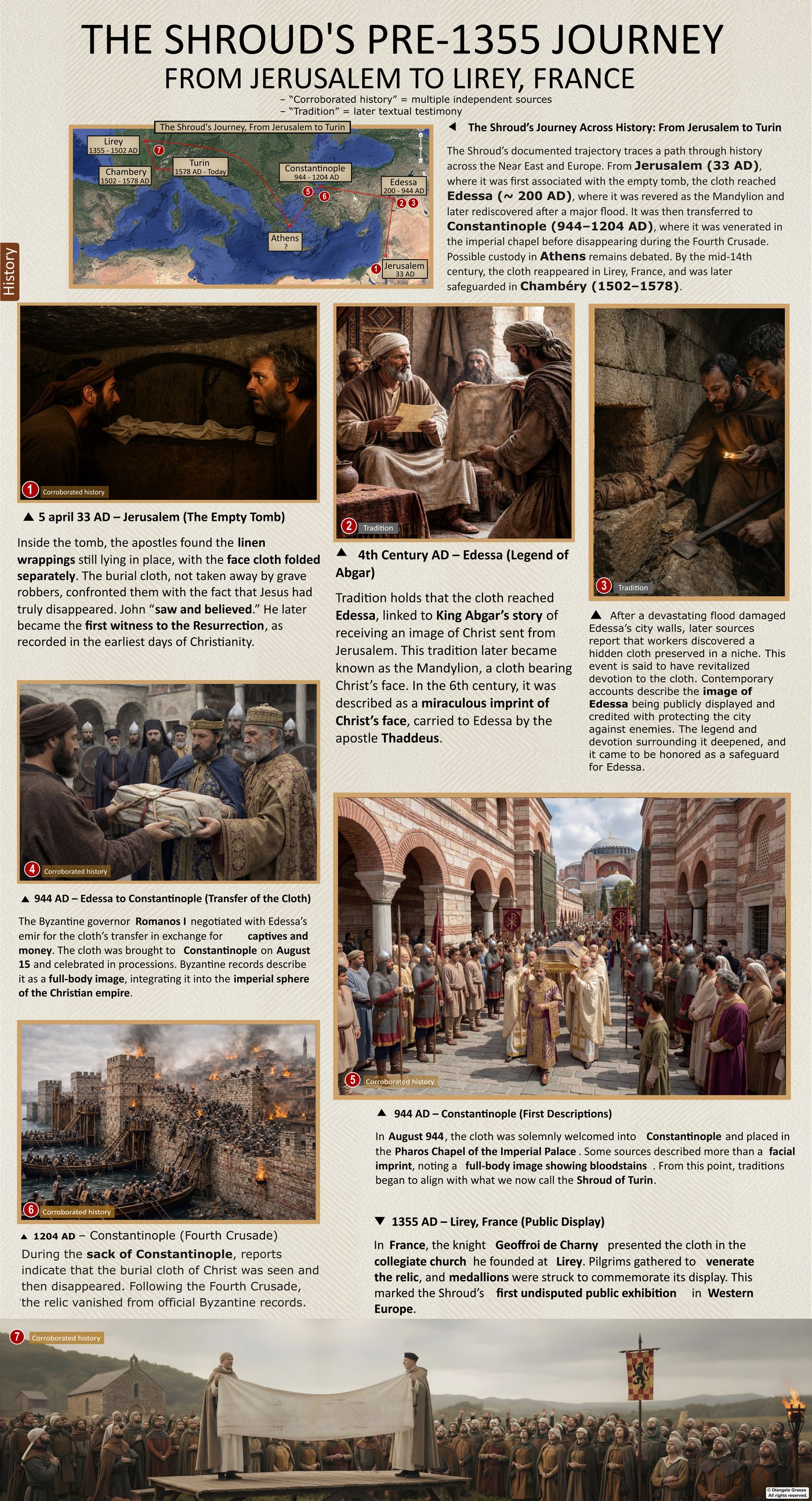
The first clear record of the Shroud in the historical sources dates from the middle of the fourteenth century, when it was shown in the parish church of Lirey, in the diocese of Troyes, in France. A bishop of Troyes wrote in 1389 that a local canon had obtained the cloth and that it was being exhibited as the burial cloth of Christ, and the bishop objected to the claim. Before that date the record is thin. The cloth is not named in the Gospels, and no source before the fourteenth century describes it with the detail of the Turin object. Yet a series of earlier sources, from the sixth century onward, describe a cloth or a face image that some scholars have identified with the Shroud. This chapter sets out those sources, the strength of the identifications, the Constantinople years and the Fourth Crusade, and the gap that separates the earlier records from the Lirey record. The chapter treats the identifications as hypotheses that must be tested against the documents.
The history below is summarised as a dated timeline, with each event linked to a full treatise: open the timeline.
The first problem: a gap of centuries
The gap between the Gospel period and the fourteenth century is wide. The sources for the first three centuries of Christianity mention the burial cloths and the empty tomb, but they do not describe a surviving cloth with the image of a man. The Eusebian history of the fourth century mentions a legendary image of Jesus sent to King Abgar of Edessa, and it describes the image as a painting or a drawing, not a shroud.1 The earliest sources for the burial cloth as a physical object come later, and the identifications rest on a chain of witnesses that are sometimes indirect.
The historian must therefore ask what counts as a record of the Shroud. A source that names a cloth in which a body was wrapped is a candidate. A source that describes an image of a face on cloth is a candidate of a different kind. A source that describes a relic of the Passion, without describing its form, is weaker still. The series distinguishes these kinds of records, and it assigns each a different weight.
Edessa and the Mandylion
The city of Edessa, in northern Mesopotamia, was for centuries a centre of Christianity in Syriac. The city’s tradition describes a letter from Jesus to King Abgar, who was ill, and an image of Jesus sent to heal him. The story is preserved in a Syriac text of the early Christian period and in the Eusebian history, and it became a foundation legend of the city. The image sent to Abgar was later known as the Mandylion, from a Greek word for a towel or a cloth, and the object was revered as a relic.2
The Mandylion is described in several later sources, and the descriptions differ. Some describe a face on a cloth, folded so that only the face was visible. Others describe a cloth of larger size, with the figure of a whole body. The difference is central to the identification of the Mandylion with the Shroud, because if the Mandylion was a face cloth only, it is not the Shroud of Turin, which shows a full figure. The argument for the identification depends on the reading of the later descriptions, and some scholars have argued that the Mandylion was originally a larger cloth that was folded.
The sixth century and the image in the city
The Mandylion is said to have protected Edessa during a Persian siege in the sixth century, and the city’s chroniclers attribute the defence to the image. The account is in a Christian history of the period, and it is the earliest clear reference to the object as a protecting relic. The image was placed on the walls, and it was carried in procession. The attribution of the defence to the image is a religious claim, and the historian can record it without accepting it.
The sixth-century reference is important for the identification because it shows that the image was known and venerated in a specific place. It does not show what the image looked like, and it does not show that the image was a cloth of the Shroud’s size. The reader should note the distinction between the existence of the relic and the description of it.
The Evagrius reference
The Byzantine historian Evagrius, writing at the end of the sixth century, records the image of Edessa as one not made by human hands, and he says that it was the cloth on which Jesus had wiped his face. His account is an important witness, because it places the image in a Christian history and attaches to it a specific miraculous origin.3 The description is consistent with a face cloth, and it does not describe a full figure.
The image in the Byzantine period
The Mandylion remained in Edessa for several centuries, and it was venerated by Byzantine and Syrian Christians. Its cult flourished in the period of icon veneration, and the image was used as a model for later icons. The Byzantine writers who discussed the Mandylion were aware of the controversy over images, and they treated the object as a relic whose origin distinguished it from ordinary icons. The image was not made by human hands, and its claim to authority rested on that.
The image was also a political object. Its possession was valuable to the city, and its loss or transfer was a matter of significance to the empire. The history of the image is therefore shaped by the history of the wars and treaties of the region, and the sources reflect those interests.
The transfer to Constantinople, 944
In 944 the Byzantine army took Edessa, and the Mandylion was transferred to Constantinople. The transfer is described in Byzantine sources, which record a formal reception of the image in the capital and its placement in the imperial chapel. The description of the reception is a ceremonial account, and it presents the transfer as a triumph. The Byzantine accounts are the main source for the event, and they were written by people with an interest in the success of the transfer.
The Byzantine sources also describe the Mandylion as the image of a face. Some sources say that it was a cloth folded to show the face, and others describe a larger cloth. The Constantinople record is therefore ambiguous about the form of the object. The reader should note that the form is not stated in a single consistent description, and that the identification with the Shroud depends on the reading of the ambiguity.
The Constantinople years
The Mandylion was kept in Constantinople for about two centuries, and it was venerated in the imperial chapel. The period brought the object into the heart of Byzantine devotion, and the feast of its reception was celebrated in the liturgy. The image was displayed on feast days, and its presence was a mark of imperial piety. The sources for the period include liturgical texts, chronicles and documents, and they show a steady interest in the object.
The Byzantine documents also contain references to a sindon, a burial linen, that appears in lists of relics distinct from the Mandylion. The separate listing has been read as evidence that the Constantinople relics included both a face cloth and a burial cloth, and that the Shroud may have been the burial cloth. The argument is strong in outline, but it depends on the interpretation of the lists, and it has been disputed.
The Fourth Crusade, 1204
In 1204 the army of the Fourth Crusade took Constantinople and sacked it. The city’s churches and treasures were plundered, and many relics were carried west. The French knight Robert de Clari wrote an account of the crusade, which describes a linen cloth with the image of Christ shown in the church of Saint Mary of the Blachernae, the church where some of the relics were kept. The cloth was shown upright and was taken away after the sack.4
De Clari’s account is one of the few eyewitness descriptions of the period. It is vivid, and it is isolated: no Byzantine source records the same cloth, and the description of the upright display is difficult to reconcile with the Mandylion as a small face cloth. The historian must decide how far the account can be trusted, and how far it fits the later identifications. Scholars disagree on its meaning. Madden and Queller treat the upright cloth as a confusion with the sudarium, while Nicolotti reads it as a confused description of a weekly elevation of a cloth before an icon of the Virgin at Blachernae. The series treats it as a significant but contested witness.
The relics after 1204
After the sack of 1204, the relics of Constantinople were distributed among the crusaders and carried to the West. The fate of the Mandylion and the sindon is uncertain. Some sources report that the Mandylion was in the hands of the Templars, and others report that it was lost. The uncertainty is the gap that the identifications must cross, and the series does not claim that the gap has been closed.
The dispersal of relics in 1204 is well documented in general, but the specific records of the Mandylion and the burial cloth are thin. The reader should note that the period was one of confusion, and that many claims to possess relics were made after the sack. The identification of any particular cloth with a Constantinople relic must be tested against the records of its possession.
The Templar hypothesis
Some historians have proposed that the Shroud passed to the Knights Templar after 1204, and that it was kept in secret until it reappeared in France. The hypothesis explains the gap in the records, and it accounts for the Templar connections that some writers have drawn. The evidence for the Templar possession is indirect, and the hypothesis has been criticised for its reliance on inference. The series records the hypothesis as one of several possible accounts of the gap.
The Lirey record, 1355
The first clear record of the Shroud in France is connected with Lirey, a village in the diocese of Troyes. A knight named Geoffroy de Charny founded a collegiate church there in the 1350s, and the cloth was shown in the church. The bishop of Troyes, Henri de Poitiers, raised objections to the display in 1389, and a memorandum of the period, written by his successor Pierre d’Arcis, stated that the cloth had been shown as the burial cloth of Christ, and that the claim was false.5
The Lirey record is the earliest specific documentation of the Shroud as a physical object. It names the cloth, describes its display, and records the controversy. It does not describe the cloth’s earlier history, and the claim that it had been the Mandylion or a Constantinople relic is not in the Lirey documents. The historian must therefore treat the Lirey record as a starting point and not as an endpoint.
The bishop’s memorandum
The memorandum of 1389 is the most important single document in the early history of the cloth. Its author, Pierre d’Arcis, wrote that the cloth had been painted by an artist who had confessed to the act, and that the cloth was being shown for profit. The claim of confession is part of the document, and it is used by some writers to argue that the cloth is a painting. The reader should note that the memorandum is a polemical document written by an opponent of the display, and that its claims must be evaluated with that in mind.
The memorandum also shows that the display was public and that it attracted pilgrims. The bishop objected to the display because it drew crowds, and because he believed the claim was false. The objection is significant, because it shows that the cloth was already a centre of devotion in the late fourteenth century, and that the question of its authenticity was already a question.
The pope and the display
In 1390 the antipope Clement VII issued a bull that permitted the display of the cloth, provided that it was described as a representation or a copy of the burial cloth and not as the cloth itself. The bull shows that the Church was aware of the dispute, and that it chose a middle course. The later history of the cloth is shaped by that compromise, and the description used in the bull has been repeated in later documents.
The gap and the identifications
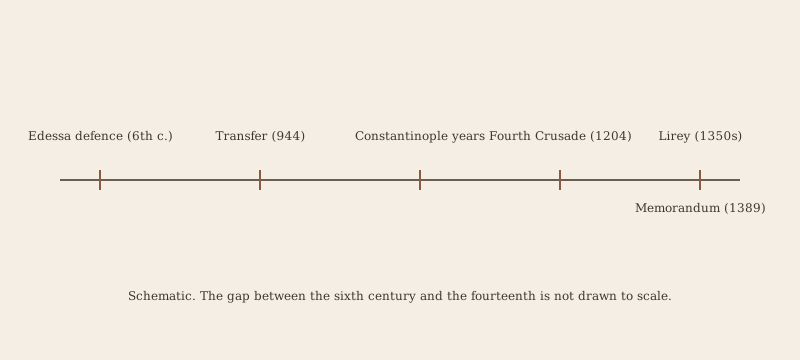
The identifications of the Shroud with the Mandylion and the Constantinople relics depend on the gap. The Lirey record is clear, but the period before it is thin, and the identifications require the reader to accept a chain of inferences across the gap. Each link in the chain can be tested, and each has been tested by historians with varying results. The strongest links are the Byzantine lists of relics, which separate the sindon from the Mandylion. The weakest are the claims about the Templars and the lost history of the cloth.
The sources for the identification
The sources for the identification of the Shroud with the Mandylion include the Byzantine texts, the Edessa legend, the sixth-century defence, the Constantinople lists and the de Clari account. Each of these sources has been used in the identification, and each has been read in several ways. The historian must weigh the sources individually, and then ask what the combination shows. The combination is stronger than any single source, but it is not decisive.
What is firm and what is not
Several points are firm. A cloth was displayed at Lirey in the 1350s and attracted controversy. A bishop of Troyes objected to the display in 1389. A pope permitted the display in 1390 on condition that it was described as a representation. Byzantine sources record a face image at Edessa and at Constantinople, and the Fourth Crusade took relics from Constantinople in 1204.
Several points are not firm. The identification of the Lirey cloth with the Mandylion is not documented. The identification with the sindon of the Constantinople lists is an inference. The fate of the relics after 1204 is uncertain. The Templar hypothesis is a hypothesis. The gap between the sixth century and the fourteenth is not filled by a continuous record, and the series does not claim that it is.
Testing the identifications
The identifications can be tested in several ways. The Mandylion descriptions can be compared for their consistency with a full-length cloth. The Constantinople lists can be read for their separation of the face cloth and the burial cloth. The de Clari account can be checked against the other Byzantine sources for the church and the display. The Lirey documents can be examined for any mention of earlier history. And the physical evidence of the cloth, including its folds and its weave, can be compared with the descriptions of the Mandylion.
The folds deserve particular attention. A face cloth folded to show only the face would show a pattern of folds consistent with that use. A full-length cloth that had been folded for display would show a different pattern. The physical evidence of the Shroud includes folding marks, which the series discusses in Chapter 2, and those marks have been compared with the folded display described in the Mandylion accounts.

The argument for the continuity of the cloth
The argument for the continuity of the cloth from Jerusalem to Lirey rests on several points. The Edessa tradition gives a cloth with a face. The Constantinople lists separate a burial cloth from the face cloth. The de Clari account describes a linen with the image of Christ in Constantinople. The Lirey cloth is shown as a burial cloth. The argument is that these sources describe the same object at different stages, and that a folded burial cloth could be shown as a face image.
The argument against the continuity of the cloth
The argument against the continuity is that the sources do not describe a single consistent object. The Mandylion is described as a face. The Lirey cloth is described as a full figure. The de Clari cloth is described as upright. The Constantinople lists are ambiguous. The gap is wide, and the identifications rest on the reader’s willingness to fill it with inference. The argument is that the continuity is attractive but unproved.
The Abgar letter and its text
The Abgar story is told in several forms. In the earliest version, King Abgar of Edessa, who was ill, wrote to Jesus asking him to come and heal him. Jesus replied in a letter, promising that a disciple would be sent after his ascension. The letter and the reply were preserved in Syriac, and later in Greek, and they became part of the foundation legend of Edessa. In a later version, an artist was sent to paint Jesus, and was unable to do so because of the brightness of his face. Jesus then wiped his face with a cloth, and the image was impressed on the cloth.
The versions differ in their details, and the differences matter for the identification. The letter version concerns a healing and a promise. The artist version concerns a portrait. The cloth version concerns a miraculous image that appears on a cloth in contact with the face. The Shroud is a full-length cloth, and its image is of a body. The cloth version of the story is closest to the Shroud in its material, and the portrait version is closest to a painting. The reader should not assume that the legends describe a single object without examining each version.
Iconoclasm and the image of Edessa
From the 720s to 843 the Byzantine Empire was divided by a controversy over the veneration of images. The iconoclasts argued that images of Christ and the saints were idolatrous, and they removed or destroyed many of them. The iconophiles defended the veneration of images, and they used the Mandylion as a leading example of an image not made by human hands, and therefore of an authentic representation. The controversy shaped the way the Mandylion was described in the period.
The iconophile writers have a particular interest in the Mandylion, because it was an image that could not be dismissed as the work of a painter. The writers used it to argue that the image of Christ had a divine origin, and that veneration of such an image was legitimate. Their descriptions are therefore shaped by an argument, and the historian must read them with that in mind. The description of the Mandylion as a face is consistent with the argument, and it does not require the object to have been a full-length cloth.
The Western knowledge of the image
The Mandylion was known in the West before 1204. Western pilgrims and visitors to Constantinople wrote about the relics of the city, and some of them mentioned the cloths. In the twelfth century William of Tyre, the chronicler of the crusades, recorded an official visit to the Byzantine emperor, and his account shows that the Constantinople relics were part of the diplomatic and religious life of the period. The Western knowledge of the image was therefore not confined to the Byzantine sources.
The Western knowledge is important because it shows that the Shroud’s predecessor, if it was one, was not a secret object. It was known, described and venerated, and the descriptions were circulated. A cloth that was known in the West before 1204 would have left traces in Western sources, and the historian can look for those traces. The absence of such traces for a full-length burial cloth before the Lirey record is one of the arguments against the continuity.
The Pharos chapel
The Mandylion was kept in the Pharos chapel, the private chapel of the Byzantine emperors in the Great Palace of Constantinople. The chapel was a reliquary, and it held a collection of holy objects that the emperors used in their devotion and their ceremonies. The placing of the Mandylion in the Pharos gave it an imperial status, and it made the object the property of the state as well as of the Church.
The Pharos is described in several Byzantine sources, and the descriptions give an impression of a rich and carefully managed collection. The historian can use these descriptions to test the claim that the burial cloth was kept in the same place. If the sindon was listed separately from the Mandylion in the Pharos inventories, the separation would support the claim that there were two objects. The inventories are the best evidence on this point, and the series discusses their limits.
The Constantinople lists and the sindon
The Constantinople lists of relics are one of the strongest pieces of evidence for the separation of the face cloth and the burial cloth. The lists mention the Mandylion and the sindon, and they treat them as distinct objects. The sindon is the word for a linen cloth, and in the context of a burial it is the word for a burial cloth. The separate listing is consistent with the existence of two cloths, one of the face and one of the body.
The lists have been disputed. Some historians argue that the sindon and the Mandylion were two names for the same cloth, used in different contexts. Others argue that the lists are incomplete or that they were compiled for different purposes. The argument depends on the interpretation of the Greek and of the list format, and it is not settled. The reader should note that the lists are a documentary witness, and that they do not describe the appearance of either cloth.
Dating the sources
The sources for the early history of the cloth differ in their date, their author and their purpose. Some were written close to the events they describe, and others were written centuries later. Some were written by people with an interest in the object, such as the iconophile writers and the imperial chroniclers, and others were written by critics or by neutral observers. The historian must weigh each source for its date, its author and its purpose, and must avoid treating a later source as a direct witness to an earlier event.
The Byzantine sources are particularly important because they are the most numerous. They include chronicles, liturgical texts, inventories and theological writings. Each type of source has its own strengths and weaknesses. The chronicles give narrative detail but may be shaped by politics. The liturgical texts show the devotional life but may be formulaic. The inventories give lists but not descriptions. The historian must read them together, and must not assume that any single type is complete.
The Lirey years and the death of Charny
Geoffroy de Charny, the founder of the Lirey church, died in 1356 at the Battle of Poitiers. His widow, Jeanne de Vergy, continued the display of the cloth after his death, and it was shown to pilgrims in the church. The display brought the cloth into a period of public devotion, and it attracted the attention of the church authorities. The death of the founder and the continuation of the display are the next documented events after the first records.
The Lirey documents show that the cloth was shown in return for offerings, and that the family and the canons of the church had an interest in the display. The commercial element was one of the grounds of the bishop’s objection, and it is a feature of the early history that the series treats with care. The display was a form of devotion, and it was also a source of income.
The sources and the reader
The reader who wants to follow the early history of the cloth should begin with the Lirey record, which is the most specific, and then move backward through the sources, asking at each stage what the source can and cannot show. The reader should keep the Mandylion, the sindon and the Lirey cloth distinct until the evidence links them. The series asks for that discipline, and it is the basis of the chapter’s argument.
The feast of the Mandylion
The Byzantine liturgy celebrated a feast of the Mandylion, commemorating its reception in Constantinople. The feast is recorded in liturgical books and calendars of the period, and it shows that the object was part of the regular devotional life of the city. The feast was celebrated in the summer, in the days after the reception, and it included processions and readings that retold the Abgar legend. The liturgical texts describe the image as made without hands, and they praise its power.
The feast matters for the historian because it shows continuity in devotion. The object was celebrated annually, and its celebration was recorded in writing. A burial cloth that was celebrated separately would have had its own feast, and the historian can look for evidence of such a feast. The liturgical sources do not, so far as the surviving texts show, include a feast of a burial cloth distinct from the Mandylion, and that absence is one of the points that bears on the separation argument.
How continuity could be tested
Continuity between the Mandylion, the Constantinople sindon and the Lirey cloth could be tested by several means. The first is a chain of documents, in which each record refers to the one before. The Lirey record does not refer to Constantinople, so the chain is broken at that point. The second is a chain of physical features, in which the folds, the stains and the weave of the Lirey cloth match a description in an earlier source. The descriptions of the Mandylion do not give enough physical detail for such a match, and the Lirey descriptions give only a general account. The third is a chain of custody, in which the object passes from one hand to another with records of each transfer. The custody after 1204 is the weakest point.
A fourth test is the direct examination of the cloth for signs of earlier use, such as the marks of a reliquary, the traces of a case or the damage of a long display. Such signs would be consistent with an object that had been venerated for centuries. The series discusses the physical history of the cloth in Chapter 2, and the reader should note that the signs of age are present, but that they do not identify a particular place or period.
The tests show what is known and what is not. The documents give a clear record from 1355, a partial record from the twelfth century, and a thin record from the sixth century. The physical evidence is consistent with a long history, and it does not fix that history. The continuity is therefore a reasonable hypothesis, not a demonstrated result, and the series treats it as such.
What the hidden thread contributes to the series
The history before Lirey is the least certain part of the documentary story, and it is the part that matters most for the claim of an early date. The series does not decide the question of continuity, and it presents the sources and their weaknesses. The next chapter takes up the image on the cloth as a medieval object, and the question of how the image could have been made or known in the period of the Lirey record.
The history of the cloth before 1355 is therefore a history of several strands that may or may not join. One strand is the Edessa image, known from the sixth century and celebrated in Byzantine liturgy. A second is the burial linen listed separately in the Constantinople inventories. A third is the cloth taken from Constantinople in 1204 and described by Robert de Clari. A fourth is the Lirey cloth, first documented in the 1350s and opposed by the bishop of Troyes. Each strand has its own sources and its own weaknesses, and the join between them is an inference that the reader must weigh. The series holds that inference with care. It does not treat the thread as proved, and it does not treat the gap as closed. The question of continuity remains one of the central open questions in the history of the cloth. A reader who wants to take it further should read the Byzantine sources in their original languages where possible, and should compare the translations for the words used of the cloth, since a single Greek or Latin term can carry different meanings in different centuries. The historian who keeps those differences in view will be better placed to judge each link in the chain, and to say exactly where the evidence stops. The series returns to this point in the chapters on the image and on the dating of the linen. The next chapter turns to the image itself.
References
- Eusebius of Caesarea, Ecclesiastical History, 1.13. The Abgar legend. Translations are widely available. Publication details to be confirmed before publication.
- The Syriac Abgar legend and its later forms, as discussed in the literature on Edessa and the Mandylion. Specific editions to be confirmed before publication.
- Evagrius Scholasticus, Ecclesiastical History, 4.27. The account of the Edessa image as not made by human hands. Publication details to be confirmed before publication.
- Robert de Clari, La Conquête de Constantinople, c. 1205–1216. The description of the linen in the church of Saint Mary of the Blachernae. Translations and editions to be confirmed before publication.
- The memorandum of Pierre d’Arcis, bishop of Troyes, dated 1389 or 1390 in different sources. The text was published by Ulysse Chevalier in 1900. Its status as a sent letter is disputed. To be checked against the original before publication.