The Shroud of Turin · Chapter 13 of 21
The final hours: the cause of death and the side wound

The Gospels say that Jesus cried out and died, and that the death came sooner than expected. Pilate was surprised to hear that he was already dead, and a centurion confirmed it. A soldier pierced his side, and blood and water came out. The brevity of the account is one of its marks, and it has invited centuries of speculation about the cause of the death. The Shroud bears on the question through the side of the cloth, which shows a stain pattern that has been read as blood and serum, and through the body, whose condition is read as evidence of the physiology of crucifixion. This chapter sets out the Gospel accounts, the medical debate over the cause of death, the side wound, the reading of the stains, and the limits of the argument.
What the Gospels say
The Gospels describe the hours on the cross in several short passages. Mark says that Jesus was crucified at the third hour, that darkness covered the land from the sixth to the ninth hour, and that at the ninth hour he cried out and died (Mark 15:25, 33–37). Luke gives a final saying, “Father, into your hands I commit my spirit,” and says that he breathed his last (Luke 23:46). John gives a different set of sayings, and says that Jesus said “It is finished” and gave up his spirit (John 19:30).1
Mark also records that Pilate was surprised that Jesus was already dead, and asked the centurion to confirm it before he released the body to Joseph of Arimathea (Mark 15:44–45). The centurion confirmed the death, and the Gospel uses this to underline the completeness of the death. The surprise of Pilate is part of the Gospel account, and it is the only indication in the text of how quickly the death came.
John alone records the piercing of the side. The soldiers came to break the legs of the men, but found Jesus already dead, so they did not break his legs. One soldier pierced his side with a spear, and blood and water came out at once (John 19:31–34). John adds a statement of testimony, saying that the writer saw it and that his testimony is true, so that the reader may believe (John 19:35). The passage has been read as a claim of eyewitness, as a theological claim about the sacraments, and as a medical observation. Each reading is possible, and the text does not decide between them.
The duration of the crucifixion
The Gospels give the time from the third hour to the ninth as the duration of the crucifixion, and the death at the ninth hour. That is about six hours on the cross, if the Markan reckoning is taken. The duration is short by the standards of the Roman sources, where crucifixion could last for days. The Roman writers describe victims who lived for long periods on the cross, and who died of exposure, thirst and exhaustion. The short duration in the Gospels has been discussed since the early church, and it has been the basis of the claim that Jesus’s death was unusually quick.2
The short duration has several possible explanations. The scourging may have weakened the body so much that death came sooner. The stress of the night, and the loss of blood, may have hastened the collapse. The victim may have been held in a position that made breathing difficult, and the strain may have increased. None of these explanations is certain, and the medical literature disagrees about which factor was dominant. The question is central to the chapter, because the cause of death determines how the side wound is read.
The cause of death: four possibilities
The medical literature has proposed several causes of death for crucifixion. The first is asphyxia, in which the body cannot breathe because the chest is held in an unnatural position and the muscles of breathing are exhausted. The second is hypovolaemic shock, in which the loss of blood from the scourge and the nails reduces the blood pressure and the flow to the organs. The third is cardiac failure, in which the heart fails under the stress of pain, shock and electrolyte imbalance. The fourth is pleural and pericardial effusion, in which fluid collects around the lungs or the heart and restricts their function.3
These causes are not mutually exclusive. A man on the cross may have been suffering from several of them at once, and the causes may have acted in sequence. The medical debate has been about which cause was dominant, and about whether the death was primarily respiratory or circulatory. The answer depends on the physiology of the body on the cross, and on the timing and the severity of the earlier injuries.
Asphyxia and the cross
The asphyxia theory has a long history. Pierre Barbet argued in his book A Doctor at Calvary that the crucified man died of asphyxia, because the position of the body made it difficult to breathe. A man on the cross could breathe only by pushing up on the feet and pulling up on the arms, and the effort would tire him until he could no longer lift himself. The breathing would become shallow, the carbon dioxide would build up, and the heart would fail.4
Later researchers have accepted the mechanics of the breathing difficulty and disputed the conclusion. The argument is that the difficulty would not by itself cause death within the time recorded, and that other causes would have been needed. The Edwards review of 1986 argued that the death was a result of the combination of the scourge, the nails and the position, and that the cause was probably a failure of breathing together with shock.5 The disagreement is about emphasis and about the relative importance of the causes.
Hypovolaemic shock
The shock theory emphasises the loss of blood. The scourge tore the skin and the muscles of the back. The nails caused bleeding at the hands and the feet. The scalp wounds bled freely. The cumulative loss could have been large, and the reduction in blood volume would have reduced the pressure and the flow to the organs. A man who had lost a significant volume of blood would be weak, cold, and confused, and his heart would beat faster to compensate. In time, the compensation would fail.
The shock theory fits the physiology of the scourge and of the scalp wounds, and it explains the relative speed of the death. It does not fit the cloth as neatly, because the amount of blood visible on the cloth is not easy to convert into a volume. The reconstructions of the blood loss vary widely, and the estimate depends on assumptions about the blood that stayed in the wounds and the blood that was absorbed by the linen. The shock theory is plausible, and its quantitative claims are uncertain.
Cardiac failure and the electrolytes
The cardiac theory emphasises the heart. Under the stress of pain, shock and low oxygen, the heart can develop irregular rhythms. The potassium in the blood can rise if muscle is damaged, and high potassium can disturb the electrical activity of the heart. A severe flogging, which tears muscle, would release potassium into the blood, and that release could contribute to a fatal arrhythmia. The argument has been developed in the medical literature on the death of Jesus, and it is one of the more recent theories.
The cardiac theory has the advantage of explaining a relatively quick death. It also fits the Gospel account of a sudden death after the cry. Its weakness is that the evidence for the electrolyte imbalance depends on assumptions about the amount of muscle damage and the speed of the release, and those assumptions are hard to test. The theory is a hypothesis, and it should be treated as one.
The side wound and the pleural space
The side wound is the most discussed single detail of the death. John says that the soldier pierced the side with a spear, and that blood and water came out. The wound would have entered the chest, and the question is which structures it reached. A lance entering between the ribs on the right side would traverse the lung and the pleural cavity before reaching the heart, and the distance to the heart is substantial. A lance entering lower, below the ribs, would reach the abdomen and not the heart.
The question of the water is the focus of the medical argument. The “water” in John has been read as serum, the pale fluid that separates from clotted blood, or as fluid from the pleural space, or as fluid from the pericardium around the heart. The pleural fluid in a dying man can be clear and watery, and it can be produced by inflammation. The argument is that the water came from the pleural cavity, and that the blood came from the heart or the vessels. The argument was made by Anthony Sava in 1957, a source not yet located for this series, and it has been developed by later writers.6
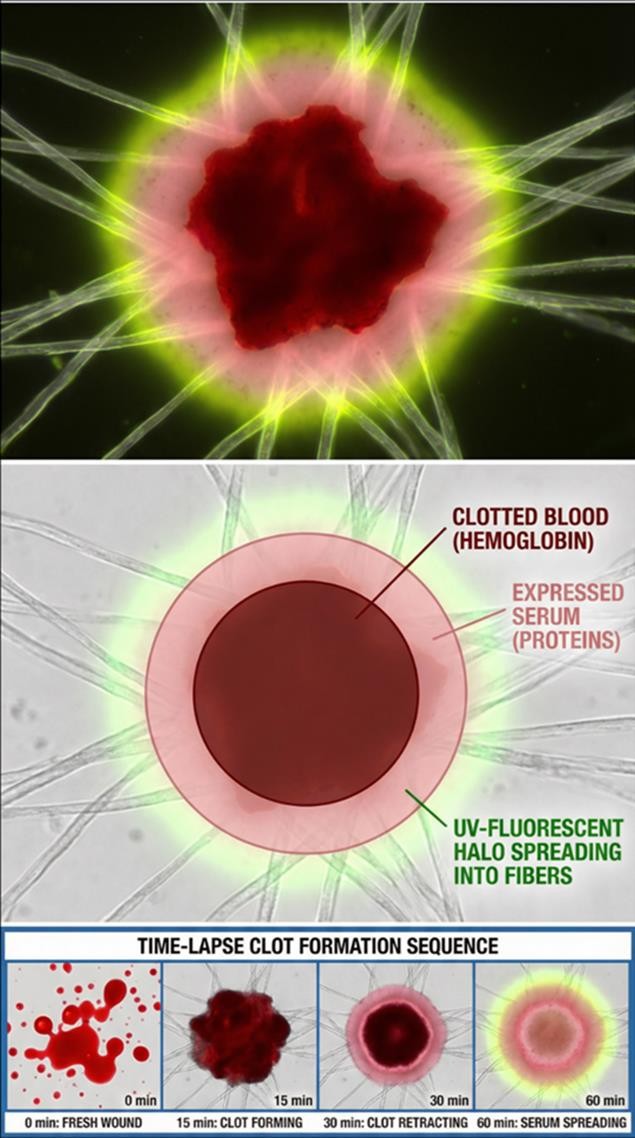
The two-phase stain on the side
On the side of the cloth, the forensic readings identify a stain with two phases: a darker red clot and a paler serum ring around it. The two-phase pattern is the one produced when blood separates after leaving the body, and it has been read as evidence that the blood and the serum came from different sources and at different times. The pattern has been used to argue that the side wound was made after death, when the blood had separated, or that it was made in a dying man whose pleural fluid had collected.
The argument depends on several assumptions. It assumes that the pale ring is serum and not some other material. It assumes that the separation occurred on the cloth and not in the wound before the cloth was applied. It assumes that the two phases came from different sources. Each of these assumptions has been questioned, and the chemistry of the stain has been disputed since the investigations of the 1970s and 1980s.7
The death as a sequence
The death on the cross can be read as a sequence. The scourge and the night weakened the body. The nails and the position strained the breathing and the circulation. The blood loss reduced the reserves. The cry at the ninth hour may mark the point at which the body could no longer compensate. The side wound followed, and it released the fluid that was visible on the cloth. The order is plausible, and it fits the Gospel account, but the medical sources cannot fix the exact time of each stage.
A reader should note that the sequence is an inference from the Gospel text and the physiology, and that it depends on the model chosen. A model that puts the cardiac failure first would give a different sequence, and a model that puts the asphyxia first would give another. The series does not claim that the sequence is known with certainty.
The argument for a rapid death
The argument for a rapid death rests on the Gospel account, on Pilate’s surprise, and on the physiology of the scourge and the night. The Gospels consistently describe the death as sudden, and the cry before death is a feature of several accounts. The physiology of a man weakened by the scourge, the night and the blood loss could explain a sudden collapse. The argument is consistent, and it is the reading most often adopted in the medical literature on the death of Jesus.
The argument against a rapid death
The argument against a rapid death is that the Gospel accounts are brief, that Pilate’s surprise may reflect a literary device, and that the medical literature shows that crucifixion could last for many hours. The argument is that the death may have been slower than the Gospel account suggests, and that the side wound was made to confirm a death that had already happened. The argument has force, and it is one of the reasons the series treats the cause of death as contested.
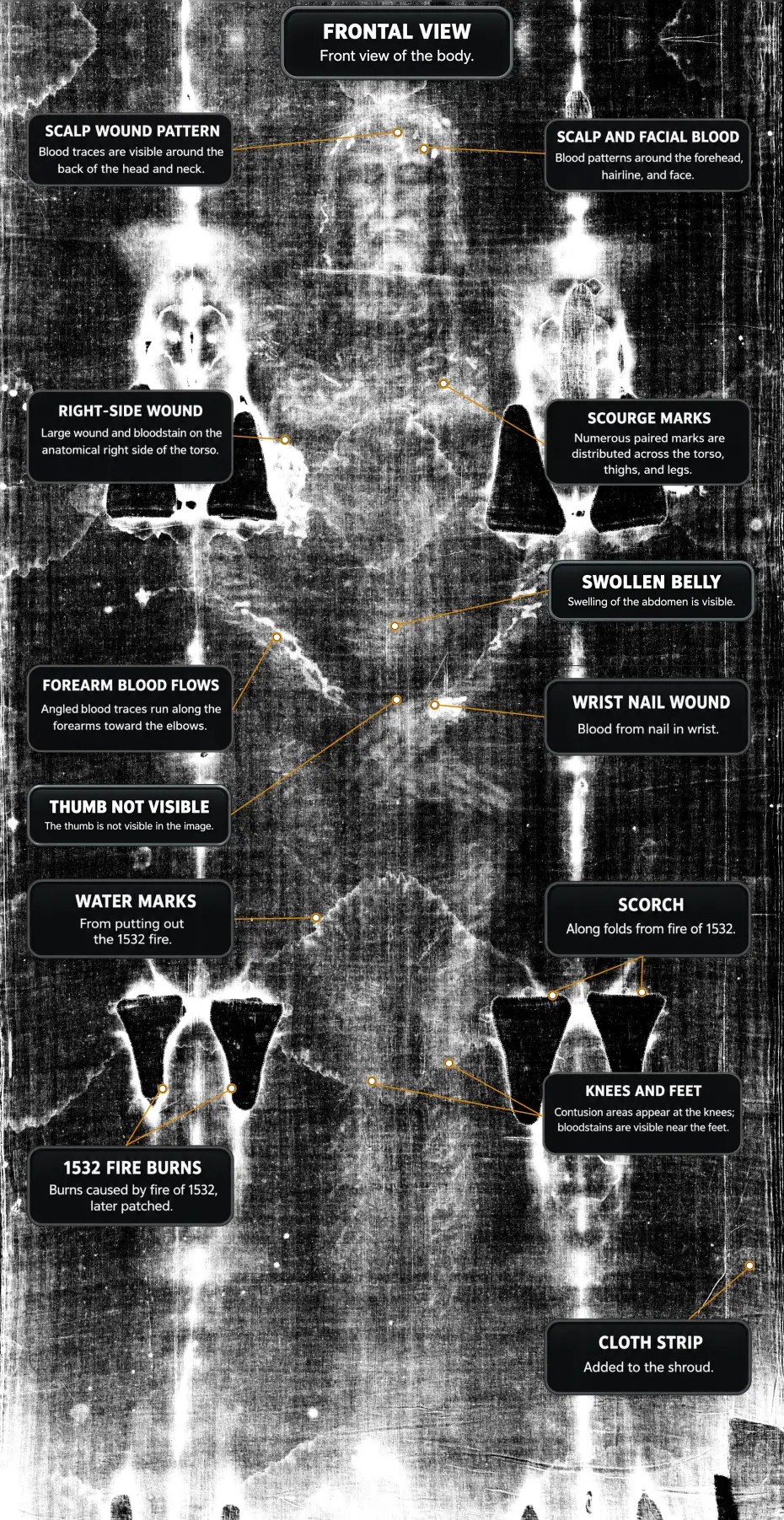
The medical debate over time
The medical debate on the death of Jesus has a long history. Medieval writers commented on the death and its causes, mostly in theological terms, and some of them discussed the physical effects of the wounds. The modern medical debate began in the nineteenth and early twentieth centuries, when physicians began to apply the physiology of their own period to the Gospel accounts. Barbet’s work in the 1930s and 1950s brought the physiology of crucifixion into the wider debate, and it set the terms for the later discussion.
Later work in the 1980s and 1990s, including the 1986 review by Edwards and his colleagues, offered a more systematic analysis. The review considered the scourge, the nails, the position and the side wound, and it argued that the death was the product of several factors acting together. The review was widely cited, and its conclusions have been revised by later writers, who have emphasised different factors. The debate continues, and the series reports the disagreements rather than declaring a winner. A reader who compares the reviews side by side will notice that they agree on the outline of the death, namely a body weakened by the scourge, held in a position that strained the breathing, and bleeding from several wounds. They disagree on which of those factors ended the life, and on how quickly. That agreement on the outline is the most secure result of the medical literature, and the disagreement over the final cause is where the evidence is thinnest.
The limits of the physician’s reading
A physician who reads the Gospel account brings a set of assumptions. The physician assumes that the body behaves according to modern physiology, that the wounds can be described in clinical terms, and that the sequence of events can be reconstructed from the medical evidence. Those assumptions are reasonable for many purposes, but they have limits when applied to a death in the first century, where the clinical details are not recorded and the sources are brief.
The physician also brings a set of expectations. A physician who expects asphyxia will read the evidence for asphyxia, and a physician who expects shock will read the evidence for shock. The best practice is to state the expectations, to test them against the evidence, and to report the results even when they cut against the expectation. The medical literature on the death of Jesus has not always met that standard, and the series asks its readers to hold the medical claims to it.
The Gospel reader and the question of trust
The Gospel account of the death is a theological text, and its writers wrote to show the meaning of the event. The reader who trusts the account accepts its statements about the death, including the cry, the surprise of Pilate and the side wound. The reader who doubts the account may treat its details as literary. Neither position is required by the evidence, and the medical reading does not settle the question of trust.
The series takes the Gospel account seriously as a source, and it treats its details as evidence where they can be tested. It does not treat the account as a medical record, and it does not treat the medical reading as a substitute for the account.
The death in the sequence of the Passion
The death is the point at which the sequence of the Passion turns from suffering to burial. Each stage before the death has been a preparation for it, and each stage after the death is a response to it. The Gospel writers marked the death with the darkness, the cry and the centurion’s words, and they marked the side wound with the testimony of John. The forensic writers have marked it with the physiology and the stain. A complete account of the death would need both sets of marks, and it would need to show how they fit together.
What the cloth can and cannot show
The cloth can show the stains left by blood and serum, the shapes of the wounds, the flow patterns, and the distribution of the fluid. It can show that the side was wounded, and that a fluid of mixed composition came from it. It cannot show the cause of death, the sequence of the physiological failures, or the time of each event. The reconstructions of the cause of death depend on the medical model, and the cloth can test the model only at the level of the stain pattern.
The cloth also cannot show how the body was handled after death. The Gospels describe the removal of the body from the cross and its preparation for burial, and the handling would have affected the stain pattern. A stain that was made by handling would look different from one made by the wound. The chapter on the burial, Chapter 14, takes up this point.
A checklist for the cause of death
The following questions help when assessing a claim about the death. Which cause is proposed, and which evidence supports it? Is the claimed sequence consistent with the Gospel account? Is the reading of the side wound based on a clear chemical test, and is the two-phase pattern shown in the original cloth or only in a reproduction? Are the quantitative estimates of blood loss stated with their assumptions? And does the claim survive the alternative causes?
Breathing on the cross
The mechanics of breathing on the cross are central to the asphyxia argument. A body hanging by the arms has to lift itself to exhale, because the weight of the body pulls the chest down and makes the normal exhalation harder. The lift is made by pushing up on the feet and pulling on the arms, and it is a painful and tiring effort. The muscles of the shoulders, the arms and the legs are used, and each lift costs energy and causes pain in the wounds. The breathing is therefore intermittent and shallow, and it depends on the strength left in the body.
The physiology is clear in outline. A healthy person can breathe easily in an upright or a sitting position. A person hanging by the arms cannot easily expand the chest, and the diaphragm and the intercostal muscles work against the weight. The oxygen in the blood falls, and the carbon dioxide rises. The acidity of the blood increases, and the body responds with faster breathing, which uses more energy. In a body already weakened by the scourge and the blood loss, the cycle could end in exhaustion and in failure of breathing.
The question is how long the cycle could last, and what happens at the end of it. The medical literature agrees that the crucified body would have been struggling for breath, and that the struggle would have been severe. It disagrees about whether the struggle was the cause of death or a symptom of another failure. The answer depends on the state of the circulation and of the heart, and on the speed with which the body’s reserves were used.
The blood volume estimates
The blood volume of an adult is roughly five litres, and the loss of a significant fraction of it can cause shock. The scourge, the nails, the scalp wounds and the side wound together could have caused a large loss. The question is how large, and the estimates in the literature vary widely. The estimates depend on the number of wounds, the size of each, the time the bleeding lasted, and the fraction of blood that stayed in the wounds or was absorbed by the linen.
The cloth gives some information about the blood, but it does not give a volume. The stains show the areas where blood reached the linen, and they show the flow patterns. They do not show how much blood left the body, because blood that was absorbed by the body’s tissues or dried in the wounds would not appear on the cloth. A reconstruction that converts the stains to a volume therefore has to make assumptions about the unseen blood, and those assumptions dominate the result.
The honest conclusion is that the blood loss was probably large enough to contribute to shock, and that the exact amount cannot be known from the cloth. The reader who sees a precise figure for the blood loss should ask how it was derived, and what assumptions it rests on.
The heart and the rhythm
The heart responds to the stresses of the cross in several ways. Pain and fear raise the heart rate and the blood pressure. Blood loss lowers the pressure and makes the heart beat faster to compensate. Low oxygen and high carbon dioxide alter the electrical activity of the heart. Damaged muscle releases potassium and other substances into the blood, and high potassium can disturb the rhythm of the heart. The combination of these effects can lead to an arrhythmia that stops the heart.
The medical literature on the death of Jesus has developed the cardiac theory in detail, and it has connected the cardiac effects with the flogging and the nails. The theory explains a sudden death, and it fits the Gospel description of a death after a cry. Its weakness is that the evidence for the electrolyte changes is indirect, and that the timing of the changes is hard to establish from the sources. The theory is therefore a strong hypothesis, not a demonstrated cause.
The chest and the lance
The chest is the area in which the side wound and the pleural fluid meet. The pleural space is the thin gap between the lung and the chest wall, and it normally contains a small amount of fluid. In inflammation, injury or heart failure, the fluid can increase, and blood can collect in the space. A lance that entered the chest between the ribs would pass through the chest wall and into the pleural space, and it could reach the lung, the pericardium and the heart, depending on its angle and depth.
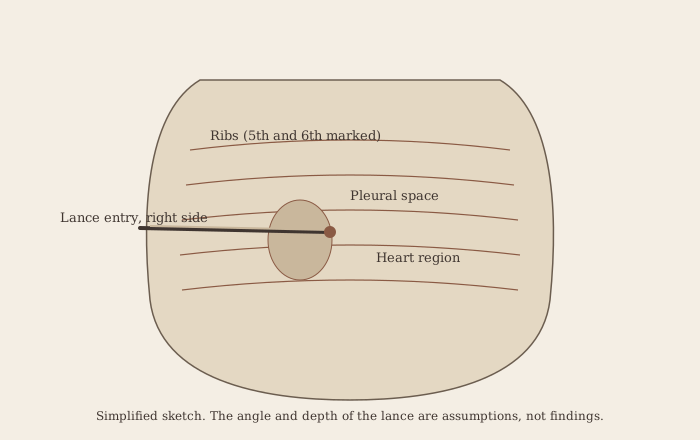
The argument that the water came from the pleural space rests on the anatomy. If the lance entered the right side between the fifth and sixth ribs, it would pass through the pleural cavity on its way to the heart. Fluid in that cavity would be released as the lance went in, and it would come out before the blood from the heart. The argument is anatomically plausible, and it has been used by several writers. Its weakness is that the anatomy of the chest varies between individuals, and that the path of the lance cannot be fixed from the wound alone.
The side wound in the historical readings
The side wound has been read in many ways across the centuries. Early Christian writers used the water and the blood as signs of the sacraments, and the passage was read as a symbol of baptism and the Eucharist. Medieval writers used the wound in devotion, and the wound of the side became a centre of the devotion to the Sacred Heart in later centuries. The medical reading is a more recent development, and it has been added to the earlier readings rather than replacing them.
The reader should note that the symbolic readings are not in conflict with the medical ones, but they answer different questions. A symbolic reading asks what the wound means, and a medical reading asks what the wound did. The series treats the medical question, and it does not deny the force of the symbolic reading.
The soldiers and the procedure
The soldiers who carried out the execution were trained to confirm death. The Roman sources describe the practice of breaking the legs to hasten death, and the Gospel account describes the soldiers checking Jesus and finding him dead already. The spear thrust was a further confirmation, and it was made by a soldier whose task was to be sure. The soldier would have had some experience of death, and his judgement that the man was dead was practical and not medical. The Gospel account gives the outcome of his action without giving his reasons.
The procedure also explains why the legs were not broken. The soldiers saw that Jesus was already dead, and they did not need to hasten the death. The Gospel describes this as the fulfilment of a scripture about the bones of the Passover lamb (John 19:36). The reader should note that the scriptural reading is the Gospel writer’s, and that the soldiers’ decision was the practical one.
The argument from the side wound on the cause of death
The side wound has been used to argue for several causes of death. The argument for a cardiac or pleural cause is that the wound released fluid that had collected around the heart or the lung, and that the fluid was a sign of a failing circulation. The argument for shock is that the wound released blood that had pooled in the chest, which would be consistent with a low circulating volume. The argument for asphyxia is that the chest was already compromised, and that the wound did not change the outcome. Each argument uses the side wound as evidence, and each depends on the reading of the fluid.
The side wound therefore does not decide the cause of death on its own. It supports a set of hypotheses, and the cloth can help test them only at the level of the stain pattern. The reader should not take the wound as proof of one cause.
Death in the art
The death of Jesus has been shown in art in many ways. Some images show the moment of the cry, with the head bent forward and the eyes closed. Others show the body after death, with the head on the chest and the arms outstretched. The side wound is shown in many paintings, often with a clear flow of blood and water, and the detail of the flow is an artistic choice. The art gives the reader a sense of the emotional meaning of the death, and it is not evidence about the physiology.
The Shroud’s image shows a body with the head bent to one side, and the eyes closed. The posture is consistent with death, and it is also consistent with the artistic conventions of the period in which the image was known. The forensic reader must separate the convention from the evidence, and must avoid reading the image as a photograph of a dying man.
A closing note on the cause of death
The cause of death is one of the most debated questions in the medical literature on the Passion. The debate is not about whether Jesus died, because the Gospels and the sources agree that he did. It is about how he died, and about the sequence of the physiological failures. The debate is likely to continue, and the series treats it as open.
What the death contributes to the series
The death is the hinge between the suffering and the burial. The Gospels describe it briefly, and the medical literature has described it at length. The cloth carries the mark of the side wound and of the fluid that came from it, and the forensic readings use that mark to argue about the cause. The reader should keep the three sources apart, and should judge each claim on its own evidence. The next chapter takes up the removal of the body from the cross, the burial, and the face cloth.
The chapter therefore leaves the reader with three conclusions that the evidence can carry. The death followed a long and violent sequence that weakened the body. The side wound released fluid and blood that the cloth records. The precise mechanism of death, and its exact timing, remain matters of reasoned inference. A reader who holds to those three points, and who is careful about the rest, will be able to follow the argument of the next chapter, which takes the body from the cross to the tomb. The steps from the cross to the tomb are the subject of that chapter, and they are where the cloth returns to the story.
References
- Mark 15:25, 33–37; Luke 23:46; John 19:30. Mark 15:33–37.
- The duration of crucifixion in the Roman sources. Discussed in Hengel (1977) and in the medical literature on crucifixion. See Chapter 12, reference 6.
- Edwards, W. D., Gabel, W. J., & Hosmer, F. E. (1986). On the physical death of Jesus Christ. JAMA, 255(11), 1455–1463. PubMed 3512867.
- Barbet, P. (1953). A Doctor at Calvary. Translated by the Earl of Wicklow. New York: P. J. Kenedy. First published in French in 1950 as La Passion de N.-S. Jésus Christ selon le Chirurgien. Catalogue dates for the English edition vary between 1953 and 1954; to be confirmed.
- Edwards et al. (1986), as above. The conclusions of the review are summarised in the chapter text.
- Sava, A. F. (1957). The wound in the side of Christ. Catholic Biblical Quarterly, 19(3), 343–346. Not located in the checks made for this series; verify before publication.
- Schwalbe, L. A., & Rogers, R. N. (1982). Physics and chemistry of the Shroud of Turin: a summary of the 1978 investigation. Analytica Chimica Acta, 135, 3–49. doi:10.1016/s0003-2670(01)85263-6. Heller, J. H., & Adler, A. D. (1981). A chemical investigation of the Shroud of Turin. Canadian Society of Forensic Science Journal, 14(3), 81–103.