The Shroud of Turin · Chapter 12 of 21
The crucifixion: the wounds of the hands, feet and back
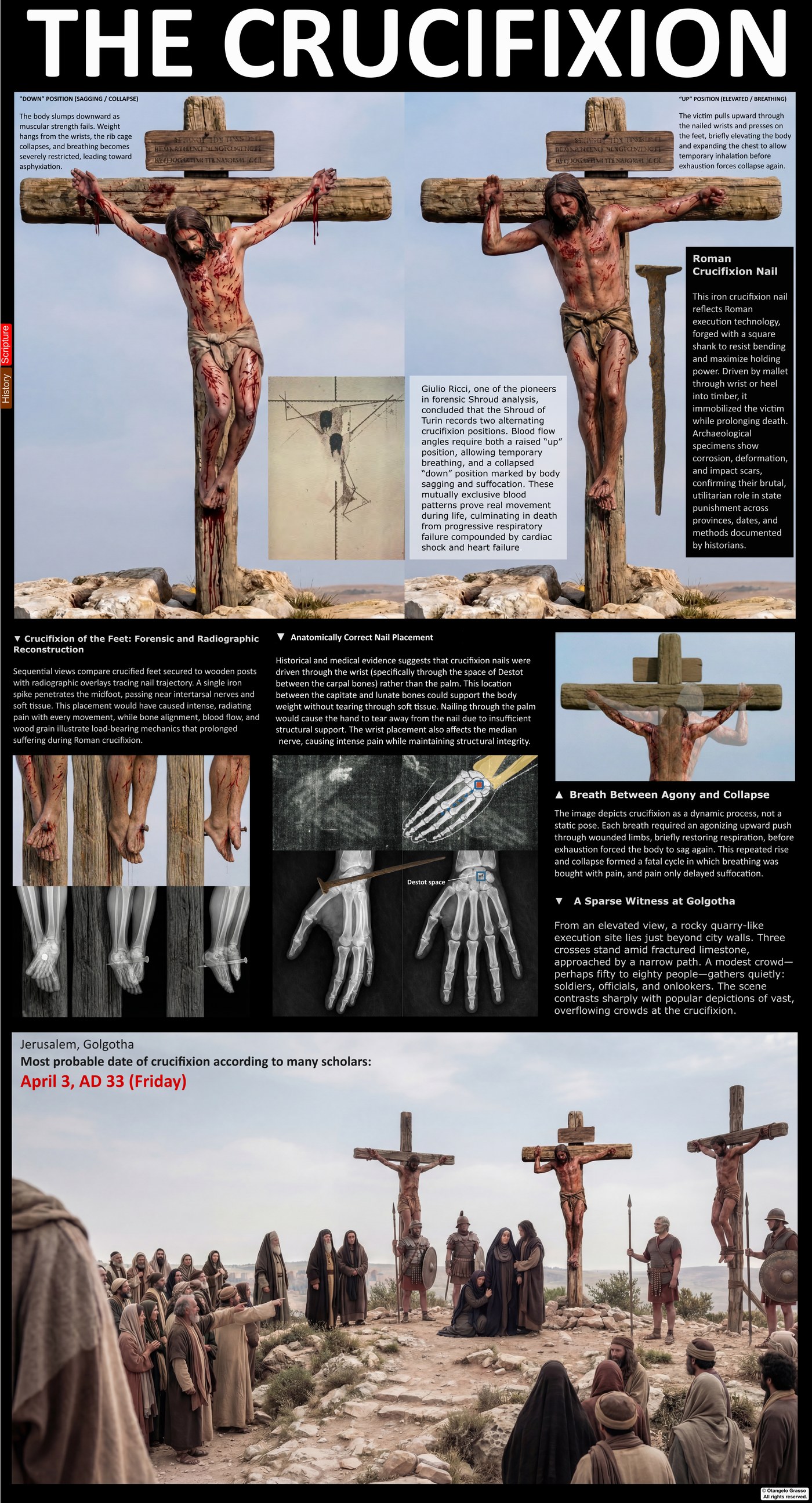
The Gospels describe the crucifixion in a few sentences. The victim is nailed to a cross, lifted up, and left to die over several hours. The text is spare, and it says nothing of the physical mechanics of the injuries. The artistic tradition filled the gap with a settled image: nails through the palms, feet set one above the other, a body hanging by its hands. The Shroud shows marks on the wrists, on the feet and on the back. Those marks have been used to argue that the tradition is wrong about the hands, and that the nails passed through the wrists. The argument is one of the most debated points in the forensic literature. This chapter sets out the Gospel accounts, the artistic tradition, the marks on the cloth, the anatomy of the wrist and the palm, the history of the argument, and the questions that remain open.
What the Gospels say
The four Gospels mention the crucifixion, and they agree that Jesus was nailed to a cross. John writes that the soldiers crucified him, and that they divided his garments (John 19:18, 23). Luke says that they crucified him and the two criminals (Luke 23:33). Mark and Matthew say that they crucified him, and that the inscription was placed above his head (Mark 15:24–26; Matthew 27:35). The Gospels do not say how the body was attached to the cross. They do not name the nails, and they do not describe the hands or the feet.1
The Gospel of John records that Jesus showed the disciples his hands and his side after the resurrection, and that Thomas asked to see the marks of the nails and to put his hand in the side (John 20:20, 25, 27). The passage is the only Gospel text that mentions the marks of the nails, and it uses the word for marks or prints in a general sense. Its meaning is that the risen body bore the wounds of the crucifixion, and it is the basis of the Christian tradition that the wounds were in the hands. The text does not say whether the nails passed through the palms or the wrists.
The Greek word translated as hands, cheir, can refer to the whole hand from the fingers to the forearm, and the word does not distinguish the palm from the wrist. The Gospels were written in Greek, and their language gives the reader no more precise information than that. The distinction between the palm and the wrist is therefore a matter for anatomy and for the forensic reading, not for the text.
The artistic tradition
From the early Christian period the crucifixion was depicted in art, and the depictions show a settled pattern. The arms are stretched out along the crossbar, and the nails are shown through the palms. The feet are sometimes nailed separately, and sometimes set one above the other with a single nail. The body is shown upright, with the head bent to one side and the eyes closed or open. The tradition is strong, and it persisted through the Byzantine, medieval and early modern periods.
The palm tradition has several sources. It may reflect a practical view that the palm was the place to nail a body, which was the common understanding in the artists’ time. It may reflect a theological emphasis on the hands as the instrument of the work of salvation. It may reflect the influence of the Gospel reading of the marks. Whatever its origin, the tradition gave the crucifixion a clear visual form, and the Shroud’s wrist marks challenge that form.
The marks on the wrists and the palms
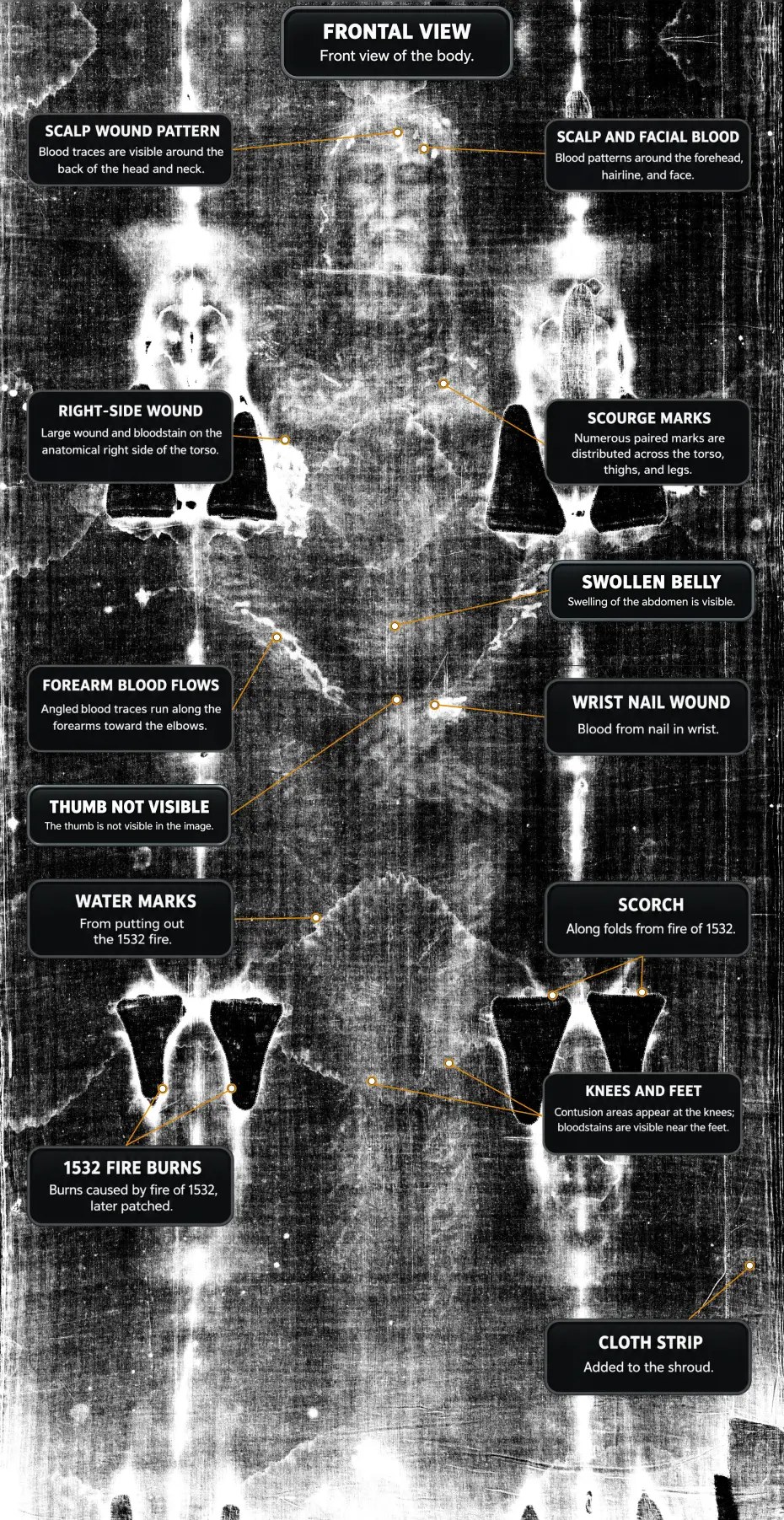
On the Shroud, the forensic readings identify bloodstains at the wrists, on the forearms and at the position of the hands. The stains are on the dorsal and frontal images, and they run down the forearms in a way that the readings connect with the arms hanging from a crossbar. The marks on the palms are less clear. Several researchers have argued that the palms show no clear wound, and that the bloodstain pattern is at the wrist rather than the palm. Others have disputed this, and have argued that the palm marks are present but hidden by the folding of the hands.
The image of the hands is therefore central to the argument. The hands are folded over the pelvis in the frontal image, and the thumbs appear to be hidden. The reading of the thumbs has been a particular focus of the argument, and it is linked to the nerve question discussed below. The absence of visible thumbs is consistent with a nerve injury that draws the thumb into the palm, and it is also consistent with the way the hands are folded in the image.
The feet
The feet on the Shroud are visible in the frontal image, and the forensic readings have considered the marks on them. The feet show marks that are read as nail wounds, and the readings have argued that the feet were nailed with a single nail or with two overlapping nails. The image is not clear enough to settle the question, and the readings differ. The feet are also shown with a wound on the upper surface, and the readings have connected this with the entry of a nail through the foot.
The Gospels do not describe the feet, and the tradition of two feet nailed separately is not in the text. The Shroud image, if the forensic readings are correct, supports the reading of a single nail through both feet, or of feet nailed in a way that the artistic tradition did not show. That reading is a point of difference between the Shroud and the tradition, and it is not decisive on its own.
The anatomy of the wrist and the palm
The anatomy of the hand explains why the palm and the wrist behave differently under load. The palm contains the bones of the metacarpals and the soft tissues between them. A nail driven through the palm passes between the bones, and the soft tissue has to bear the weight of the body. The palm tissue is not strong enough to hold a heavy load without tearing, and the nail is likely to pull through. The wrist, by contrast, contains the carpal bones, which form a solid block, and a nail driven through a gap between them can be held in place by the bones and the ligaments.
The gap between the carpal bones, through which a nail could be driven, is known in the anatomical literature as the space of Destot. The anatomical literature describes it as a passage between the bones of the wrist, through which the median nerve and the flexor tendons run. A nail through the space of Destot would pass close to the median nerve, and it could damage the nerve. The argument is that a nail at the wrist is anatomically viable, and that it has the nerve consequences the cloth may show.2
The biomechanics of suspension
The biomechanical question is whether a body can be held on a cross by nails through the palms alone. The question was studied in the twentieth century by Pierre Barbet, who drove nails through the hands of cadavers and suspended weight from them. Barbet reported that the palm tissue tore and that the nail pulled through, and he concluded that a body could not be held by the palms. His experiments are discussed in his book A Doctor at Calvary.3
Later researchers have examined the question with different methods. Frederick Zugibe, a forensic pathologist, carried out experiments in the 1990s and 2000s, and argued that the palm could support the body if the nail passed through the correct place, though he also discussed the wrist as a site.4 The experiments have been criticised for their methods, their samples and their interpretation. The biomechanical question is therefore not settled, and the reader should note that the experiments differ in their assumptions about the cadaver tissue, the load and the nail.
The median nerve and the thumb
The median nerve runs through the wrist and supplies the muscles of the thumb and the palm. Damage to the nerve would cause weakness and loss of sensation in the thumb and the first three fingers. A nail through the wrist could damage the nerve, and the damage could cause the thumb to be drawn into the palm. The thumb-drawing effect has been called thenar contraction in the literature, and it is proposed as an explanation for the absence of visible thumbs on the Shroud.
The argument has a weakness. Anatomical references describe the effect of median nerve injury as weakness and loss of thumb movement, not as contraction that pulls the thumb across the palm. The reading that the nerve injury causes the thumb to be drawn in is therefore disputed by some anatomists. Zugibe argued that the thumb falls naturally beneath the fingers when the wrist is nailed, which is a different explanation, and which also accounts for the image.4 The clinical literature on median nerve injury should be consulted directly before the reading is adopted.
The back and the scourge marks
The back of the body shows the marks of the scourge, which are discussed in Chapter 8. On the cross, the back rested against the upright, and the marks would have been pressed against the wood. The forensic readings have considered whether the pressure of the cross left additional marks on the back, and whether the shoulders bore marks from the crossbar or from the carrying of the beam. The readings are uncertain, and the marks that can be identified are consistent with the scourge, with pressure and with the abrasion of the carrying.
The position of the body on the cross would have placed great strain on the shoulders and the arms. The arms would have been held outstretched, with the weight of the body pulling down through the nails. The strain would have made breathing difficult, because the chest could not expand fully when the body hung in that position. The physiology of the cross is discussed in Chapter 13, and the back marks are part of the same picture.
The argument for the wrist
The argument for the wrist rests on several points. The cloth shows bloodstains at the wrists, and the bloodstains are consistent with a wound at the wrist rather than the palm. The anatomy supports a nail through the wrist as a stable point of suspension. The biomechanical experiments suggest that a nail through the palm would tear. The absence of visible thumbs can be explained by a median nerve injury. The argument is consistent, and each point supports the others.
The argument for the palm
The argument for the palm rests on the Gospel tradition, the artistic tradition and the possibility that the palm marks are present but hidden. Some researchers have argued that the palm marks are visible in some images, and that the wrist stains could come from blood that ran down the arm from the palm. The argument is that the nail could have passed through the palm and that the body could have been supported by the nail if it was placed in the correct region of the hand.4
The argument against the palm is that the palm tissue would tear under the load, which is the Barbet result. The argument for the palm answers that the tearing depends on the tissue and the placement of the nail, and that the experiments do not reproduce a living body. The question is open, and the series does not decide it.
What the marks can and cannot show
The marks on the wrists and the palms can show that the hands and the wrists were wounded, and that the wounds bled. They can show that the blood ran down the arms in a way that suggests the arms were hanging. They cannot identify the nail, measure its diameter, or say with certainty whether it passed through the palm or the wrist. The image of the palm is too obscured by the folding of the hands to settle the question.
The marks cannot, on their own, date the cloth or identify the victim. A wound at the wrist would have looked the same in the first century and in the Middle Ages, and a painter who knew the anatomy could produce a wrist wound. The date and the identity must be settled on other evidence.
The feet and the single nail
The feet provide a second test of the crucifixion method. If the feet were nailed with a single nail, the nail would pass through both feet, and the marks would show a particular arrangement. If they were nailed with two nails, the marks would show two separate entries. The Shroud image is not clear enough to settle the question, and the readings disagree. The feet also show the effects of the body’s weight, and the readings have considered whether the marks are compatible with a body that was supported on a small platform or a sedile on the cross.
The sedile, a small seat on the cross, is discussed in the medical and historical literature as a way of prolonging the life of the crucified and of distributing the weight. The evidence for the sedile is limited, and it is disputed. The reader should treat it as a possibility, and not as a fact of the crucifixion.
A checklist for the nail question
The following questions help when assessing a claim about the nails. Which image was used, and how far is the wrist visible? Which anatomical structures are assumed to lie at the nail site? Which biomechanical experiment is cited, and what were its tissues, loads and nail sizes? Is the thumb reading based on the clinical literature of median nerve injury, or on a single argument? Are the feet read as one nail or two, and on what evidence? And does the claim survive the alternative reading of the marks?
The archaeological evidence: the heel bone
The only physical evidence of a crucifixion nail from the period of Jesus comes from a tomb in Jerusalem. In 1968 a tomb of the first century was excavated at Giv’at ha-Mivtar, north of the city, and it contained the ossuary of a man named Yehohanan, son of Hagkol. The skeletal remains included the heel bones of a young adult man who had been crucified. A nail was still lodged in the right heel bone, bent at its point, and fragments of wood from the cross were found with it. The find was published by the anthropologist Nicu Haas in 1970.5
The Yehohanan find is important for three reasons. It shows that a nail was driven through the heel, at least in one case, and that the feet could be nailed through the side of the bone. It shows that the nail was bent, probably when it struck the wood or the bone, and that the feet were not immediately freed. It also shows that a nail could be driven through the bone of the heel rather than through the soft tissue around it. The find does not show the placement of the nails in the hands or the wrists, because the hand bones were not preserved.
The find has been used in the argument about the feet on the Shroud, and it supports the reading that a crucified man could be nailed through the feet at the heel, with the feet placed against the upright. It does not settle whether the feet were nailed separately or together, and the single case is not a sample from which general rules can be drawn. The reader should treat the find as the best available physical evidence, and as one case among many possible ones.7 A 1985 reappraisal by Joseph Zias and Eliezer Sekeles disputed several of Haas’s readings. They argued that the nail was too short to have passed through both heel bones, that some of the bone fragments were misidentified or belonged to another individual, and that the forearm marks were not traumatic. Their reconstruction placed the arms tied to a horizontal beam fixed to vertical stakes, with death by asphyxiation, so the find does not settle the question of nail placement.
Roman crucifixion procedure
The Roman sources describe crucifixion as a punishment for slaves, rebels and the lowest classes of the population. The victim was usually scourged first, as the Gospels describe, and then made to carry the crossbar, the patibulum, to the place of execution. The upright, the stipes, was usually fixed at the place, and the crossbar was attached to it. The victim was then nailed or tied to the crossbar and raised to the upright, where the feet were fixed. Martin Hengel’s study of crucifixion in the ancient world is the standard survey of the Roman sources and of the practice.6
The Roman writers say little about the nails, but they describe the effects of crucifixion in general terms. Seneca, Josephus and others describe the slow death, the exposure and the disgrace. Josephus describes the crucifixion of many Jews in Jerusalem during the siege of the city in the year 70, when the Romans crucified the captives in large numbers. The historical picture is of a punishment that was public, prolonged and cruel, and that was used to deter.
The question of the sedile, a small seat or peg on which the body could partly rest, is discussed in the historical literature. The evidence for a sedile is limited, and it is inferred from some depictions and from the practical needs of a victim who would otherwise hang from the hands. The sedile is one of the points on which the medical and historical readings differ, and it bears on the feet and the back.
The titulus and the inscription
John describes an inscription placed above the head of Jesus, which read Jesus of Nazareth, the king of the Jews, written in Hebrew, Latin and Greek (John 19:19–20). The inscription is called the titulus in the Latin tradition. The Gospels say that the chief priests objected to it, and that Pilate refused to change it. Mark and Matthew record the inscription in shorter form.1
The inscription is a Roman practice. The Roman crucifixion of a condemned man included a notice of the crime, which was carried before the victim and fixed above the cross. The practice is attested in the sources, and it fits the Gospel account. The inscription also fits the mockery of the crowd, which the Gospels record as shouting at the figure on the cross.
Crurifragium and the legs
John describes the soldiers breaking the legs of the two men who were crucified with Jesus, and not breaking his, because he was already dead (John 19:31–33). The breaking of the legs, the crurifragium, was a Roman practice that hastened death, because a victim who could no longer push up on the feet would soon suffocate. The practice explains why the soldiers did not break the legs of Jesus, and it implies that he had died earlier than the two thieves.
The Shroud shows the legs of the figure intact, which is consistent with the Gospel account of the unbroken legs. The forensic readings take this as support for the Gospel order of events, and they note that the legs carry the scourge marks and some other marks, but no sign of a break.
The garments and the division
The Gospels say that the soldiers divided the garments of Jesus among them, casting lots for the tunic (Mark 15:24; John 19:23–24). The division is a Roman custom of the execution squad, and it is recorded in the Gospels as a fulfilment of a psalm. The division has nothing to say about the nails, and it is not evidence about the wounds. It does bear on the cloth, because the burial linen is a separate cloth, and the Gospels describe it as bought and used after the death.
The time on the cross
The Gospels record the hours of the crucifixion. Mark says that it was the third hour when they crucified him, and that darkness fell over the land from the sixth hour to the ninth (Mark 15:25, 33). John says that the sentence was passed about the sixth hour. The Synoptic and Johannine times differ, and the difference has been discussed in Chapter 10. The time on the cross, from the morning to the afternoon, is the time that the physiology of the crucifixion would have acted on the body, and the duration is the key to the medical reading in Chapter 13.
The hands in the later tradition
The depiction of the hands changed over time. In the early Christian centuries, the crucified figure was often shown with the arms outstretched and without visible nails. From the sixth century the nails became more common in the art, and by the medieval period they were shown clearly, through the palms. The change reflects a growing interest in the physical details of the Passion, and in devotion to the wounds of Christ. The Shroud, whose image was known in the medieval period, may have contributed to the development of the wound imagery, though the influence is hard to measure.
The later tradition also introduced the feet nailed one above the other, a convention that is not in the Gospels and that does not fit the heel-bone find. The conventions of the art are part of the history of the image, and the forensic reader must separate them from the evidence.
The cross and the body on the cross
The body on the cross was held by the hands or wrists, and by the feet, and the position would have strained the chest and the shoulders. The arms, held outstretched, would have made breathing harder, because the chest could not expand fully. The victim would have had to push up on the feet to breathe, and that effort would have been painful and tiring. The physiology of this position is the subject of Chapter 13, and the nail question is part of it, because the nails determined the support and the strain.
The wound channel and the blood on the arms
A nail that passes through a limb leaves a channel, and the channel carries blood from the wound to the surface. The path of the blood depends on the position of the arm and the direction of the channel. An arm held outstretched, with the hand nailed to the crossbar, would carry the blood along the forearm toward the elbow, and the flow would be affected by gravity and by the movements of the body. A wound at the wrist would produce a flow that runs down the forearm more directly than a wound at the palm, which would first fill the hand and spread from there.
The forensic readings of the Shroud have used this principle to argue that the stains on the forearms are consistent with a wound at the wrist. The stains on the forearms are read as running toward the elbow, and the stains on the hands are read as less extensive. The argument is consistent with the anatomy, but it depends on the reading of the stains from the photograph, and on assumptions about the body position and the drying of the blood. Those assumptions are contestable, and they should be stated.
The wound channel also has a biomechanical aspect. A nail that passes through the wrist would pass between bones and ligaments, and it would be held in place by the surrounding structures. A nail through the palm would pass through softer tissue, and it would be more likely to move under load. The difference matters for the question of whether the body could be held, and it bears on the argument from the biomechanical experiments.
Critiques of the wrist argument
The wrist argument has been criticised on several grounds. The first is that the anatomy of the wrist is complex, and that the space through which the nail would pass is small. A nail that passed through the wrong place could fracture a bone or miss the intended path, and the readings have not always explained how the nail would avoid that. The second is that the median nerve argument depends on a clinical link between the nerve injury and the thumb position that is disputed. The third is that the biomechanical experiments are few, and that they differ in their methods, so that their results are not easy to compare.
A fourth criticism concerns the photograph. The hands are folded in the frontal image, and the palms and the wrists are partly hidden. The reading of the wrist stains depends on the reproduction, and different reproductions can show the stains differently. A reader who wants to test the wrist claim should examine the original cloth, or the highest-resolution records, and should note the areas that are hidden in the photograph.
Critiques of the palm argument
The palm argument has also been criticised. The first criticism is that the Barbet experiments are old, and that the methods used in them, including the tissue and the load, have been questioned. The second is that the Gospel and artistic tradition of the palm is not evidence about the nails, because the tradition developed later. The third is that the palm marks, where they are claimed, are less clear than the wrist marks, and that the palm argument often depends on the absence of a clear wrist mark rather than on positive evidence for the palm.
A fair reading gives each side its strongest points. The wrist argument has the anatomical and biomechanical support and the stain pattern. The palm argument has the tradition and the experimental caution. Neither has the full support of the physical evidence, and the series does not claim that either is decisive.
How the claims could be tested
The nail question could be tested in several ways. A higher-resolution study of the wrist and the palm, using the original cloth, would show the stains more clearly. A set of biomechanical experiments, using a range of tissues, loads and nail sizes, and reported with their methods, would show how the palm and the wrist behave under load. A study of the feet, using the Yehohanan find as a reference, would test the single-nail reading. And a careful study of the thumb position, using the clinical literature on median nerve injury, would test the nerve argument.
Each test would need a clear statement of what would count as failure. A wrist reading that depended on one stain pattern, or a palm reading that depended on a single experiment, would not be strong. A study that stated its assumptions in advance, and that reported results that cut against its conclusion, would be stronger. The field would benefit from such studies, and the series notes where they are needed.
What the evidence supports
The evidence supports several points. The Gospels place the crucifixion at Golgotha, with two other men, and with the inscription and the division of the garments. The Roman practice used nails through the hands or wrists and the feet, and the heel-bone find shows a nail through the heel in at least one case. The cloth shows marks on the wrists, on the feet and on the back, and the forensic readings are consistent with nails at the wrist and the feet. The legs were not broken, which is consistent with the Gospel account.
The evidence does not support a single account of the nail placement. The palm and the wrist are both possible, the feet could have been nailed separately or together, and the sedile is a possibility that is not proved. Each of these points is open, and the reader should keep them open.
What the crucifixion contributes to the series
The crucifixion is the point at which the Gospel account, the artistic tradition and the forensic readings most clearly diverge. The Gospels say little, the art says a settled thing, and the cloth shows marks that the forensic readings interpret in several ways. A reader who wants to test the claims should separate the three sources and ask what each supports. The next chapter turns to the hours on the cross and to the cause of death, which is the most complex part of the medical argument.
The crucifixion is therefore a case in which the three sources, the Gospels, the art and the cloth, must be read separately before they are combined. The Gospels fix the event and its setting, but not its mechanics. The art fixes a convention that the evidence does not clearly support. The cloth preserves marks whose interpretation depends on anatomy, biomechanics and the photograph. A reader who keeps these sources apart will find the points where they agree, the points where they conflict, and the points where the question is open, and will be better able to judge the claims that follow.
References
- John 19:18, 23; Luke 23:33; Mark 15:24–26; Matthew 27:35; John 20:20, 25, 27. John 20:20–27.
- The space of Destot and the anatomy of the wrist. See standard anatomical texts on the carpal region. Publication details to be confirmed before publication.
- Barbet, P. (1953). A Doctor at Calvary. Translated by the Earl of Wicklow. New York: P. J. Kenedy. First published in French in 1950 as La Passion de N.-S. Jésus Christ selon le Chirurgien. Catalogue dates for the English edition vary between 1953 and 1954; to be confirmed.
- Haas, N. (1970). Anthropological observations on the skeletal remains from Giv’at ha-Mivtar. Israel Exploration Journal, 20, 38–59. Publication details to be confirmed before publication. \1
- Hengel, M. (1977). Crucifixion in the Ancient World and the Folly of the Message of the Cross. London: SCM Press. Translated by John Bowden from the German of 1976. Page count to be checked against a copy in hand before publication.
- Zias, J., & Sekeles, E. (1985). The crucified man from Giv’at ha-Mivtar: a reappraisal. Israel Exploration Journal, 35, 22–27. Summary taken from secondary sources; to be checked against the original before publication.
- Zugibe, F. T. (2005). The Crucifixion of Jesus: A Forensic Inquiry. Completely revised and expanded edition. New York: M. Evans. Specific experimental details and later critiques to be confirmed before publication.