The Shroud of Turin · Chapter 11 of 21
The quarry outside the walls: Golgotha and its landscape
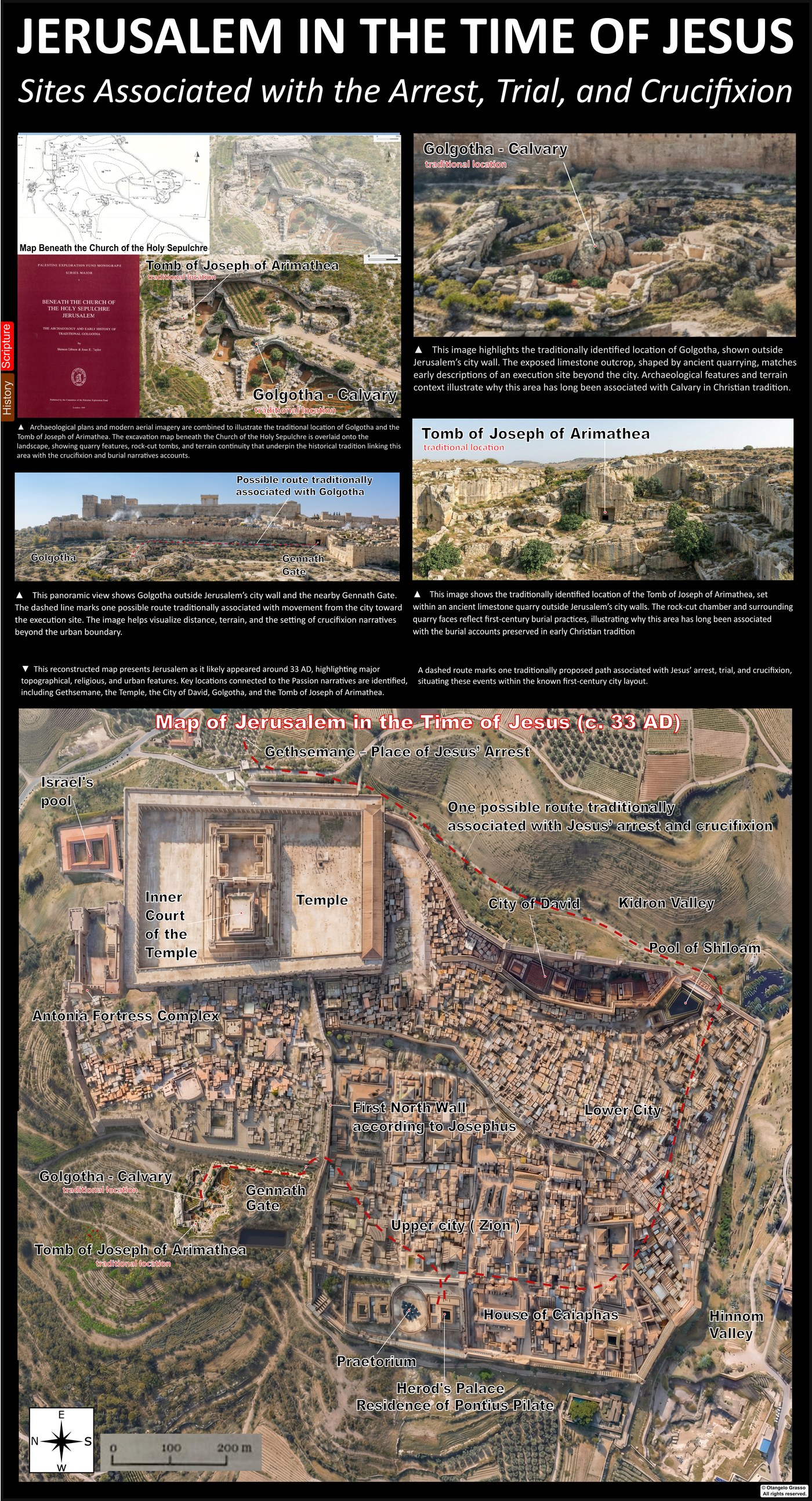
The Gospels say that Jesus was crucified at a place called Golgotha, a name they translate as the place of the skull. The place is outside the city walls of the first century, near a road, and close to a garden with a new tomb cut in rock. Two thousand years later the traditional site is inside the Church of the Holy Sepulchre in Jerusalem, a building that has been rebuilt many times since the fourth century. The Shroud, in the series’ reading, is the cloth in which the body was wrapped and placed in that tomb. The landscape of Golgotha therefore bears on the story the cloth tells. This chapter sets out what the Gospels say about the place, what the excavations have shown about the bedrock and the quarry, how the tombs fit into the topography, and where the identification is firm and where it rests on tradition.
What the Gospels say about the place
The Gospels agree on three points about the place of execution. It is called Golgotha, in Aramaic, and the Greek equivalent is the place of the skull (Mark 15:22; Matthew 27:33; John 19:17). It is outside the city, because the Letter to the Hebrews says that Jesus suffered outside the gate (Hebrews 13:12). And it is close enough to a garden with a new tomb that the body could be placed there before the Sabbath (John 19:41–42; Matthew 27:60).1
The Gospels do not describe the hill in detail. The name Golgotha is usually explained as a reference to the shape of the place, either a skull-like rounded outcrop or a place where skulls were left. The Latin name, Calvary, comes from the Vulgate and carries the same meaning. Neither explanation is certain, and the name may refer to a place used for executions, to a local feature, or to something else that is now lost. The reader should not assume that the name fixes the shape of the ground.
The Gospels also say that the tomb belonged to Joseph of Arimathea, a member of the council, and that it was new and cut in rock (Matthew 27:60; Mark 15:46; Luke 23:53; John 19:41). The tomb was close enough to the place of execution for the burial to be completed before the Sabbath. Those are the points of agreement, and they set the terms for the archaeological work.
The traditional site
The Christian tradition places Golgotha within the Church of the Holy Sepulchre, a complex of chapels that contains the traditional tomb of Jesus and the rock of Calvary. The identification goes back to the fourth century, when the Emperor Constantine ordered a church built over the site. The Roman writer Eusebius, who lived in the same period, reports that the emperor had a site cleared of a temple that had been built over it, and that the tomb and the place of execution were thereby uncovered.2 Eusebius is the earliest source for the identification, and his account is an important witness, although it is not a modern survey.
The Holy Sepulchre was damaged and rebuilt several times, most notably in the eleventh and the twelfth centuries, and again after a fire in 1808. The present building is the product of many hands, and its chapels reflect the successive traditions of the several Christian communities that share the site. A visitor who looks at the building sees medieval and later structures, and not the first-century surface. The archaeological work has been carried out beneath and around these structures, where the ancient bedrock is still preserved in places.
The excavations
The modern excavations of the site began in the nineteenth century, and they were carried out in stages. The Franciscan archaeologist Virgilio Corbo led a long programme of work in the second half of the twentieth century, and his team recorded the bedrock, the quarry cuts and the rock-cut tombs beneath the church. The excavations found that the site had been a limestone quarry in antiquity, and that the stone had been cut in stepped levels. They also found tombs cut into the quarry walls, and traces of the walls and roads of the ancient city.3
The excavation reports are the primary source for the topography. They describe the quarry faces, the trenches cut for extraction, the surviving pillars and the tombs. They are technical, and their conclusions rest on the recorded stratigraphy and on the dating of the cuts and the tomb features. A reader who wants to check the topography should consult the reports, and should note that some of the conclusions have been revised as the work has continued.
The quarry and the stepped bedrock
The bedrock beneath the Holy Sepulchre is a fine-grained limestone, which the local quarrymen call meleke, an Arabic word meaning royal, a name that refers to the quality of the stone. The stone was valued for building, and the quarries around Jerusalem supplied material for the city’s walls and buildings for centuries. The quarrying left a characteristic topography of steps, trenches and standing pillars, in which the stone was removed in blocks and the cut faces were left standing.
The companion book reports three benchmarks for the ancient topography: the summit of Golgotha at about 758.3 metres above sea level, the tomb bench at about 753.2 metres, and the lower quarry floor at about 743.7 metres. On these figures the tomb bench is about five metres below the summit, and the quarry floor about nine and a half metres below the bench. The book translates these into the experience of a visitor, and points out that a person standing on the bench would look up at the rock of Golgotha and down at the quarry floor, which is a dramatic change in level. The figures should be confirmed against the original survey before they are published.4
Golgotha as a quarry face
The reading of Golgotha as a quarry face rather than a natural hill is one of the most important results of the excavations. If the summit was the remnant of a quarry, it would have been left standing when the stone around it was removed, and it would have been a prominent feature of the landscape. Such a feature would be easy to see from the road and from the city, and it would be a suitable place for an execution. The Roman practice of crucifixion placed the victims in public places, and a visible, elevated site near a road was a natural choice.5
The reading also suggests that the place was not a natural hill in the usual sense, and that its shape is the product of human work. That point is relevant to the Gospel name, because a quarried face could be called a skull for reasons of shape, colour or position, and the name would not require a natural feature. It is also relevant to the question of whether the site was used for execution before the time of Jesus, which the archaeology has not settled.
The tombs
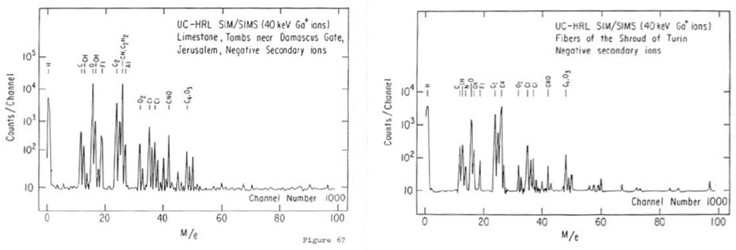
The rock-cut tombs on the site are the second part of the topography. The excavations found tombs cut into the quarry walls, with entrances, chambers and benches for the bodies. The tomb that tradition associates with Joseph of Arimathea is cut into the rock at the intermediate level, and its entrance is visible within the church. The tomb has been studied, and its features have been compared with other tombs of the period.
The style of the tomb is important for dating. Tombs of the Second Temple period have a characteristic architecture, with a vestibule, a chamber and benches cut into the walls for the bodies. Later tombs have different features. The tomb of the Holy Sepulchre has been read as a tomb of the first century, but the dating depends on the reconstructed form, which has been altered by later building. The argument is strong in parts and weak in others, and it has been revised.
The Gospel tomb and the garden
The Gospel of John places the crucifixion near a garden, and the tomb in the garden was new and unused (John 19:41). Matthew adds that the tomb was cut in rock (Matthew 27:60). The phrase “in the garden” does not fix the site, and the garden of the Gospel may have been a cemetery, a plot of land or a rocky area with trees. The identification of the tomb with the Holy Sepulchre rests on tradition and on the excavation evidence, and it is not a modern proof.
The Gospel account describes the burial as hurried, because the Sabbath was about to begin, and the body was wrapped in linen and laid in the tomb (Mark 15:46; Luke 23:53–54; John 19:40). The linen is the Shroud in the series’ reading, and the tomb is therefore the place where the cloth was placed. The landscape of the tomb is the setting of the burial, and the reader who wants to understand the Shroud’s story should understand the tomb as well.
Constantine, Hadrian and the temple
The history of the site includes a period in which a temple stood over it. Eusebius reports that the site had been covered with rubbish and paved over, and that a temple of Venus stood on it, so that the place and its memory were lost. Eusebius does not name Hadrian. The attribution of the temple to Hadrian, probably as part of the rebuilding of Jerusalem as Aelia Capitolina after 135, is an inference from the wider history. The report forms part of Eusebius’ account of Constantine’s church, and it is the basis for the claim that the temple was built deliberately over the tomb. The archaeology has found remains of a temple platform, and has supported the broad outline of the account.2
The temple and the church together make the site a palimpsest. Each period has left its traces, and the reader must separate the first-century features from the later ones. The task is difficult, and it depends on careful stratigraphy and on comparison with other sites. The identification of the Holy Sepulchre with the Gospel tomb is therefore a claim that rests on several layers of evidence, some of them strong and some of them weak.
The landscape around Golgotha
The landscape around the site in the first century was a mixture of quarries, roads, gardens and tombs. The city walls at the time enclosed a smaller area than the later walls do, and the site lay outside the walls, where the Gospels place it. The road to the north and west of the city ran past the site, and the travellers on it would have seen the execution and the tombs. The reader who imagines the scene should picture an open, rocky place, marked by quarry cuts, close to a road, and visible from the city.
The gardens and the tombs of the period were part of the same landscape. The Gospels do not describe the gardens in detail, but the tombs of the period are a clear sign that the area was used for burial. The mixture of execution, quarrying, burial and gardening is characteristic of the margins of ancient cities, and it is consistent with the Gospel setting.
What the landscape shows about the burial
The landscape supports the Gospel account of a rapid burial in a nearby tomb. The distance from the place of execution to the tomb is short, and the tomb is at a level that could be reached quickly. The tomb’s entrance faces the place of execution in some reconstructions, and the burial could have been completed in a short time. These points are consistent with the Gospel account, and they are used in the series to support the reading that the body was placed in the tomb in haste.
The landscape also shows that the burial was not an isolated event. The tomb was one of several in the area, and the burials of the period were part of a larger practice of tomb use and reuse. The Gospel account places the body in a new tomb, and that detail sets the burial apart. A reader who wants to understand the tomb should understand both its place in the landscape and its place in the Gospel narrative.
What is firm and what is not
Several points about the site are firm. The Gospels place the crucifixion outside the city, near a road and near a garden with a new tomb. The excavations have found a quarry in the area, with stepped levels and cut faces. The tradition, supported by Eusebius, places the tomb and the place of execution within the Holy Sepulchre. Tombs of the period have been found in the quarry walls.
Other points are not firm. The exact line of the first-century walls, the exact position of the road, the form of the tomb before later building, the exact levels of the summit and the tomb bench, and the identification of the Holy Sepulchre tomb with the Gospel tomb all rest on inference and tradition. The series labels these points as open, and it does not treat them as proven.
Questions the landscape raises for the cloth
The landscape raises questions about the cloth that the series does not answer. If the body was placed in a tomb cut into a quarry wall, the tomb’s floor and benches would have marked the cloth in some way, and the marks would be a record of the placing of the body. The Shroud shows marks that are sometimes read as the traces of a stone surface or of a body lying on a bench, and the readings are contested. The landscape gives a reason to look for such traces, and it does not confirm that they are there.
The landscape also raises the question of the stone itself. If the quarry stone is of a particular kind, its dust or its fragments might be found on the cloth. The chapter 4 work on pollen and limestone discusses the mineral evidence, and it is relevant here. The identification of the mineral on the cloth with the Golgotha limestone would be a strong result, and it has not been demonstrated.
What the landscape contributes to the series
The landscape of Golgotha gives the story of the burial a setting, and it gives the reader a way of testing the claims about the tomb. The quarry is real, the tomb tradition is old, and the Gospel setting is specific. The chain from the place of execution to the tomb, and from the tomb to the cloth, is the chain the series follows. The next chapter takes up the crucifixion itself, and the wounds of the hands and the feet that belong to it.
Roman crucifixion and the choice of place
The Roman practice of crucifixion has a clear pattern in the sources and in the archaeology. Victims were executed in public places, usually outside the walls of a city or on a main road, where the crowd could see the punishment and where the body would be seen as a warning. The place was often elevated, so that the cross could be seen from a distance, and it was often close to a route used by travellers. The Gospel setting fits this pattern, because Golgotha is outside the walls, near a road, and visible from the city.5
The Roman sources say little about the sites themselves. The Roman writers describe the punishment and its effects, and they mention crosses along roads and at gates, but they do not describe the physical sites in the detail a modern archaeologist would want. The archaeological evidence for Roman execution sites is limited, and the identification of any particular site as a place of execution depends on its position and its features. The Golgotha identification is consistent with the Roman pattern, and it does not prove the Roman practice applied to this site.
A practical point follows from the Roman pattern. The crosses were erected in a place that would be used again. Permanent posts or fixed uprights would make the work faster, and a place that was known for executions would be reused. The Gospel account does not say that the place was used before, but the Roman practice makes repeated use plausible. The archaeology has not found clear evidence of earlier executions at the Holy Sepulchre site, and the question remains open.
The tomb types of the Second Temple period
Jerusalem in the late Second Temple period had a distinctive range of tombs, and the types can be grouped by their architecture. The simplest is the shaft tomb, a vertical shaft cut into the rock with a side chamber. Another is the kokh, a horizontal niche cut into the wall of a chamber, in which the body was placed and later the bones were collected. A third is the arcosolium, an arched niche with a bench beneath it, which was used for individual burials. A fourth is the ossuary, a stone box for the bones, which became common in the first century.
The Holy Sepulchre tomb has been described in terms of these types, and the description has been part of the argument for its date. A tomb with a vestibule, a chamber and benches along the walls, cut into a quarry face, fits the pattern of tombs of the late Second Temple period. The argument is that the tomb has features that date it to that period, and that later tombs of the Byzantine and medieval periods have different features. The argument is strong in outline, and it depends on the reconstruction of the original form, which later building has changed.
How the tombs are dated
Archaeologists date tombs from several kinds of evidence. The architecture of the tomb, including the shape of the chambers and the form of the benches, is one. The pottery, coins and other objects found within the tomb are another. The style of the entrance, the tools marks on the rock and the kind of stone used are further clues. The dating of a tomb is therefore a matter of combining several lines of evidence, and no single feature is decisive.
The Holy Sepulchre tomb has been difficult to date because the interior has been altered by later building, and because the original contents were removed or lost long ago. The argument for a first-century date rests on the architecture, the quarrying and the reconstruction, and it has been revised as the excavations have continued. The reader should treat the date as a reasoned estimate, and not as a measurement.
The Garden Tomb and other proposals
A different identification of Golgotha was proposed in the nineteenth century. The British general Charles Gordon suggested that a rocky hill north of the Damascus Gate, with a nearby rock-cut tomb, was the true Golgotha, because its shape resembled a skull and because a tomb was close by. The site is now called the Garden Tomb, and it is visited by pilgrims and tourists. The identification is popular among some Protestant communities, and it is not accepted by most archaeologists, who date the tomb to a later period and who note that the hill is not a quarry face.6
The alternative identification illustrates a general point. The Golgotha tradition is not the only possible identification, and the choice between sites depends on the criteria one applies. If the criterion is the shape of the hill, the Garden Tomb has a strong claim. If the criterion is the quarry and the tomb type, the Holy Sepulchre has the stronger claim. The series treats the Holy Sepulchre identification as the best supported on the archaeological evidence, and it notes that the alternative remains in circulation.
The Byzantine and medieval church
The church built by Constantine was a large basilica with a courtyard, and it enclosed the rock of Calvary and the tomb within a single complex. Later building, including the rebuilding of the Persian and Byzantine periods, and the crusader church of the twelfth century, changed the form of the complex. The crusader church is the basis of much of the present building, and its architecture reflects the European taste of the period as well as the local tradition.
Pilgrimage to the site began early and grew over time. The fourth-century pilgrim accounts describe visits to the tomb and to the rock, and they describe the liturgy celebrated there. The pilgrims brought back relics and stories, and the site became a centre of devotion. The Christian communities that share the church today maintain their own chapels and their own rights, and the arrangement is the product of centuries of negotiation.
Pilgrimage and the reading of the site
Pilgrimage shapes how the site is read. A pilgrim who arrives at the tomb is primed to see it as the tomb of Jesus, and the architecture and the liturgy encourage that reading. The visitor should recognise that the reading is a tradition, and that the tradition has a history. The series does not dismiss the tradition, but it separates the tradition from the archaeological evidence and treats each on its own terms.
The Shroud has been associated with the pilgrimage tradition in several ways. Its images have been used in devotion, and its reproductions have been shown in churches and exhibitions. The association is historical and cultural, and it is not evidence about the cloth. The reader who wants to understand the Shroud’s place in the devotional life of the Church should look at that history separately from the forensic claims.
Reading the bedrock
The bedrock is a source of evidence in its own right. The limestone of the quarry can be identified by its mineral content and its texture, and it can be compared with the stone of other quarries in the region. The cut faces show the tools used and the sequence of removal. The surfaces of the bedrock show the weathering that has affected them over time. These features are the basis of the archaeological dating and of the reconstruction of the site.
The bedrock also bears on the Shroud question. If the cloth was laid on a stone bench in a tomb cut into this limestone, the stone’s dust or traces of its minerals might be transferred to the cloth. The chapter 4 work on the mineral evidence is relevant here, and it shows the methods that could be used. The transfer of mineral dust from a stone bench to linen would depend on the surface and the contact, and it would be difficult to demonstrate. The series treats this as an open question, and it does not claim that the stone has been identified on the cloth.
Water, cisterns and the city
The area around Golgotha had cisterns and channels cut in the rock, which supplied water to the city and to the quarries. Some of these were used in the Second Temple period, and some were later. The water system bears on the landscape, because the cisterns affected the ground and the access to the quarry. The reader who wants to picture the site should imagine a working place, with stone being cut, water being collected and carts moving along the roads.
The landscape in the first century
In the first century the city of Jerusalem was larger than the Roman-era city of the period before, and it had walls that enclosed a different area. The Second Wall, if it ran north of the Holy Sepulchre, placed Golgotha outside the city in the Gospel period. The position of the wall is discussed in the archaeological literature, and it is one of the points on which the identification depends. The reader should note that the wall line is a reconstruction, and that it has been revised.
The tomb in the Gospel narrative
The Gospel narrative describes the tomb as new, and as a place where no one had yet been laid. The detail matters for the reading of the burial, because it distinguishes the tomb from a common burial place. The Gospel also describes the women who watched the burial, and who came to the tomb on the morning after the Sabbath (Mark 15:47; Luke 23:55–56). The women’s presence is part of the Gospel account of the empty tomb, which is discussed in Chapter 15, and the landscape of the tomb is the setting of that account.
The names of the place
The name Golgotha appears in the Gospels in its Aramaic form, and the Gospel writers explain it in Greek as the place of the skull. The Latin Calvaria, which gives the English Calvary, comes from the Vulgate translation. The name has been read in several ways. It may refer to the shape of a rounded hill, to the skulls of executed men that were left on the ground, or to a local name for a rocky place whose origin is lost. Each reading gives a different picture of the ground, and the reader should not treat any one as certain.
The name has also been connected with an ancient tradition that the skull of Adam was buried at the place of the crucifixion. The tradition is found in later Christian writing, and it is not part of the Gospel account. It is a reminder that the site has been read through many layers of interpretation, and that the names of the place have been given meanings that go beyond the Gospel text.
The limits of excavation evidence
Excavation evidence is powerful, but it has limits that the series must state. The first limit is that excavation destroys what it records, so that the original state of the ground can only be known through the reports. The second is that the excavated areas are small, and that the conclusions about the whole site depend on how representative the excavated parts are. The third is that the stratigraphy, which is the sequence of layers, can be disturbed by later building, by robbing and by erosion. The fourth is that the dating of features depends on the finds, and the finds may be few or disputed.
The Holy Sepulchre excavations have faced all of these limits. The site has been rebuilt many times, and the ancient features are interleaved with later ones. The reports are detailed, but their conclusions have been revised. A reader who takes the reports at face value should remember that they are the best available record, not the final one, and that the record may change as new evidence appears.
What a reader can check about the site
A reader who wants to check the claims about the site can begin with the Gospel texts, which fix the place outside the city, near a road, near a garden and near a new tomb. The reader can then turn to the excavation reports, which record the quarry and the tombs, and to the ancient sources, which record the church and the temple. The reader can compare the Holy Sepulchre identification with the Garden Tomb identification, and can ask what criteria each uses. The reader can also look at the bedrock evidence and ask whether it supports the claimed link between the quarry and the cloth.
None of these checks settles the identification, but together they show which parts are firm and which are open. A reader who finishes them will know what the landscape can and cannot prove, and will be better placed to judge the claims in the chapters that follow.
The place of the crucifixion and the tomb is therefore a layered site. It was a quarry, then a place of execution, then a tomb, then a temple, then a church, and then a pilgrimage centre. The Gospel account touches the first of these, and the archaeology recovers some of the others. The identification of the tomb with the Gospel tomb is a reasoned judgement, supported by tradition and by the physical evidence, but not demonstrated beyond doubt. The series keeps that judgement in view, because it governs how far the burial landscape can be used as evidence for the cloth. A reader who wants to weigh the identification should ask which features are original, which are later, and which are the product of tradition, and should expect the answers to change as the excavations are published and reviewed. Where the identification is firm, the series says so, and where it is not, the series names the open question rather than filling the gap with a conclusion the evidence does not support. This is the standard the series applies throughout.
References
- Mark 15:22; Matthew 27:33; John 19:17; Hebrews 13:12; Matthew 27:60; Mark 15:46; Luke 23:53; John 19:40–42. John 19:17–42.
- Eusebius of Caesarea, Life of Constantine, 3.26–28. The account of the clearing of the site and the building of the church. Translations are widely available; publication details to be confirmed before publication.
- Corbo, V. C. (1982). Il Santo Sepolcro di Gerusalemme: aspetti archeologici dalle origini al periodo crociato. 3 vols. Studium Biblicum Franciscanum, Collectio Major 29. Jerusalem: Franciscan Printing Press. Some sources date the series 1981–1982.
- The stepped levels and benchmarks at Golgotha, as reported in the companion book to this series. The figures are to be checked against the original survey and excavation reports before publication.
- Roman practice of crucifixion at visible and public places outside the walls. Discussed in the historical and archaeological literature on Roman execution. Publication details to be confirmed before publication.
- The Garden Tomb and the identification proposed by Charles Gordon in the nineteenth century. The archaeological case against the identification is discussed in the literature on the Holy Sepulchre and the Garden Tomb. Publication details to be confirmed before publication.