The Shroud of Turin · Chapter 10 of 21
From Gethsemane to Golgotha: the sequence of the Passion
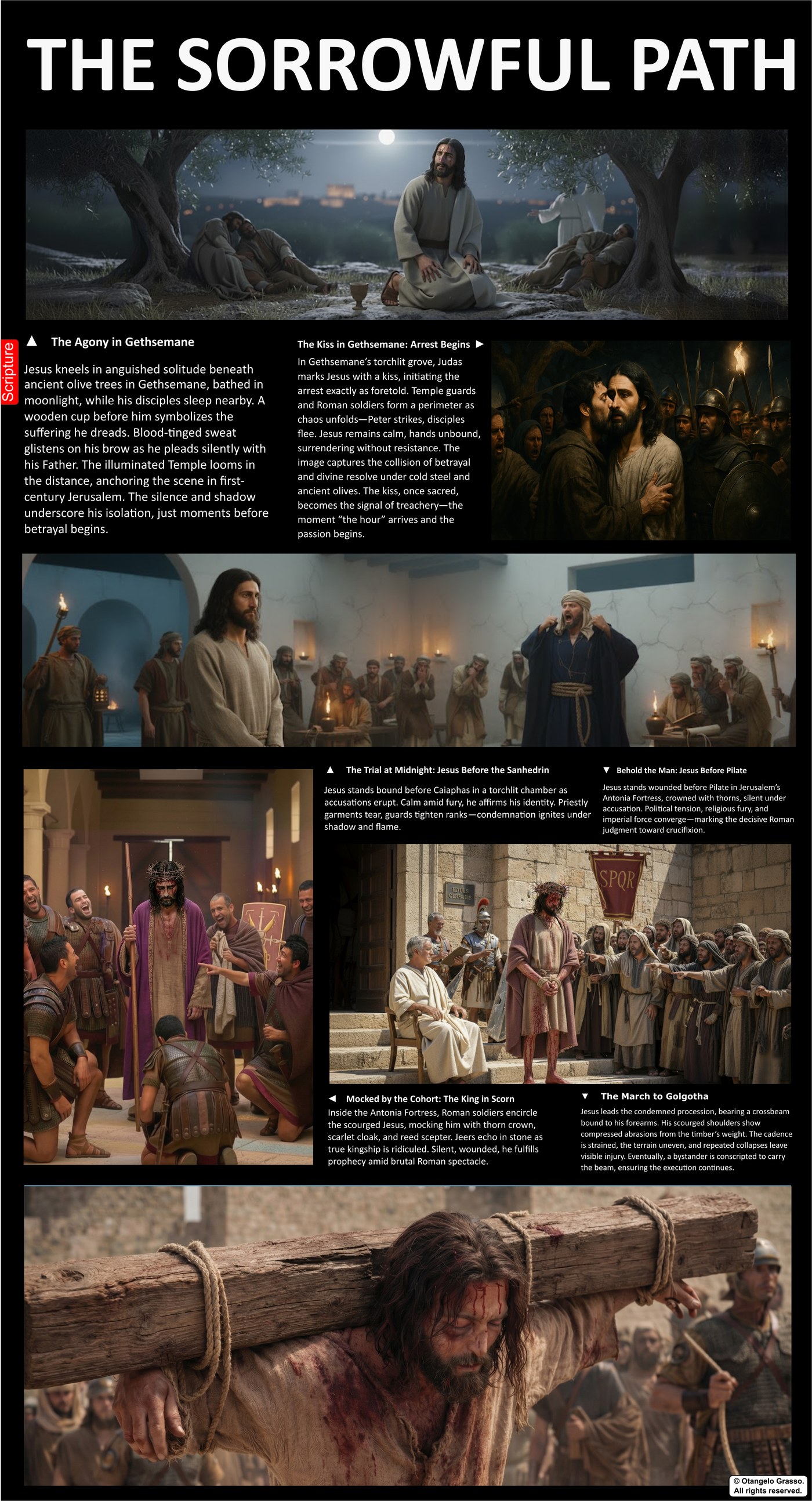
The Gospels tell the story of the last night and the morning of Jesus’s life in a sequence of scenes. He prays in a garden on the Mount of Olives, is arrested, is taken before the Jewish authorities, is handed to the Roman governor, is flogged, is mocked and crowned, and is led out through the city to a place of execution. The scenes follow one another in the text, but the text was not written as a timetable, and the sequence has to be reconstructed from several accounts that differ in detail. The Shroud records some of the injuries that belong to this sequence, and it is often read as a witness to its order. This chapter sets out the Gospel sequence, the places along the route, the physical states at each stage, what the cloth and the blood patterns can and cannot contribute, and where the reconstruction is firm and where it is inference.
The Gospel sequence
Each of the four Gospels tells the story in its own way, and the sequences differ in their details. Mark, the earliest, gives a compact account. Jesus goes with his disciples to Gethsemane, prays, and is betrayed by Judas with a kiss. He is arrested and taken to the high priest, where a council examines him and condemns him. The next morning he is handed to Pilate, who examines him, offers the crowd a choice of prisoner, and hands him over to be crucified after flogging him. The soldiers mock him, put a purple robe on him, crown him with thorns, and lead him out to Golgotha (Mark 14:32–15:22).1
Matthew follows Mark closely and adds details, including the dream of Pilate’s wife and the washing of hands. Luke gives a different order in places. He places a trial before Herod between the two Roman hearings, and he gives the words of the penitent thief and the sayings from the cross that are absent from Mark. John has the most distinct account, with a longer conversation before the high priest, a different timing of the trial, and an explicit statement that the crucifixion took place on the day of preparation for the Passover (John 18–19).2
The sequence therefore has a core that all four agree on, and it has differences in order and detail. The core is the prayer in the garden, the arrest, the examination, the handing over to Pilate, the flogging, the mockery, and the procession to the cross. The differences matter for the historian, and they matter for the reading of the cloth, because the cloth shows some injuries and not others, and the order of the injuries is part of what the reader is trying to establish.
Gethsemane: the place of prayer
Gethsemane lies on the lower slopes of the Mount of Olives, east of the city walls, beyond the Kidron valley. The name means olive press, and the garden is traditionally identified with a grove of ancient olive trees within the Franciscan enclosure. The trees are old, but their age is uncertain, and the identification of the exact spot is a tradition rather than a demonstrated fact. The site is at an elevation of roughly 740 metres above sea level, and the path from the garden to the city runs downhill, across the valley and up the western slope to Mount Zion.
In Mark and Matthew, Jesus goes to the garden with his disciples and prays three times, asking that the cup might pass from him. In Luke he prays and sweats, and the text says that his sweat became like drops of blood falling to the ground (Luke 22:44). The verse is absent from some of the earliest manuscripts, and its authenticity has been debated since the nineteenth century. Its inclusion in the modern translations is a matter of textual judgement, and a reader should note that the textual question is open.3
The medical literature has discussed a condition called hematidrosis, in which blood appears in the sweat under extreme stress. It is rare, and it has been described in cases of severe fear, distress and physical strain. The Lukan verse has been read as a description of hematidrosis, and the reading is plausible. It is not certain, because the Lukan language is figurative and may describe heavy sweating, and because the case for hematidrosis rests on a verse whose text is uncertain. The point matters for the cloth because some forensic readings have argued that the skin of a man who had sweated blood would have been fragile and easily broken by the flogging that followed.4
The arrest and the night
The arrest takes place in the garden, after Judas has come with a crowd sent by the chief priests and the elders. The Gospels describe a struggle in some accounts, in which one of the disciples cuts off the ear of a servant of the high priest, and Jesus restores it. The night is then spent in the custody of the high priest’s household, where the examination takes place. The Gospels describe mockery and violence in the household, including blows and spitting, and they describe Peter’s denials in the courtyard while the examination goes on.
The night in custody was a period of physical and mental strain. A man who had prayed through a night in the garden, who had been arrested and bound, and who had been struck in the household, would have had little sleep or rest by the morning. The forensic readings of the sequence assume that this strain was real, and they take it into account when they reconstruct the state of the body by the time of the flogging. The text does not describe the physical condition in detail, and the reconstruction is an inference from the general situation.
The morning before Pilate
In the morning the council hands Jesus over to Pilate. The governor examines him, asks whether he is king of the Jews, and hears the accusation. In Luke, Pilate sends him to Herod, who mocks him and sends him back. Pilate then offers the crowd the release of a prisoner, and the crowd chooses Barabbas. Pilate says that he finds no crime in Jesus and orders him flogged, and then hands him over to be crucified (Luke 23:1–25; John 18:28–19:16).2
The Roman governor’s court, the praetorium, is located by Christian tradition at the Fortress of Antonia, near the Temple. Many historians and archaeologists have argued instead for Herod’s Palace, on the western side of the city, which was the residence the governor would have used during the festivals. The question is discussed in Chapter 8, and the difference between the two sites matters for the route. A flogging at the Antonia would place the scourging near the Temple, and a march from there to Golgotha would follow a different line from one that began at the western palace.5
The route from the praetorium
The route from the praetorium to Golgotha is traditionally called the Via Dolorosa, the Way of Sorrows. The name is medieval, and the stations along it, which are now marked in the city, were fixed over many centuries. The traditional route passes through the streets of the Old City, and it ends at the Church of the Holy Sepulchre, which is the site of Golgotha in the Christian tradition. The stations are not a reconstruction of the route the soldiers took, and the historical question is whether any part of the traditional route follows the actual path.
The Gospels mention that the procession went out through a gate, and John says that the place of execution was near the city. Hebrews 13:12 says that Jesus suffered outside the gate. Those statements are consistent with a site outside the walls of the period, and they bear on the choice of Golgotha. The quarry and the tombs near the traditional site are discussed in Chapter 11.
The physical state at each stage
The sequence can be read as a series of physical states. At Gethsemane, the body is under emotional and physical strain, and the reconstruction allows for the possibility of haemorrhagic sweating. In the high priest’s household, the body receives blows and is bound. Before Pilate, it is examined, mocked and perhaps struck. At the flogging, it receives the scourge, and the scourge marks are the largest single record of injury on the cloth. At the crowning, the scalp is punctured and bleeds. On the procession, the body is weakened, and it carries or is made to carry the cross.
Each state has a physical consequence. The loss of blood from the back and the scalp reduces the blood pressure and the body’s reserves. The pain and the fatigue reduce the ability to walk. The sleeplessness and the stress reduce the ability to resist shock. A reader who wants to understand the Passion should see the sequence not as a list of separate cruelties but as a cumulative process, in which each stage shapes the next.
The cloth and the sequence
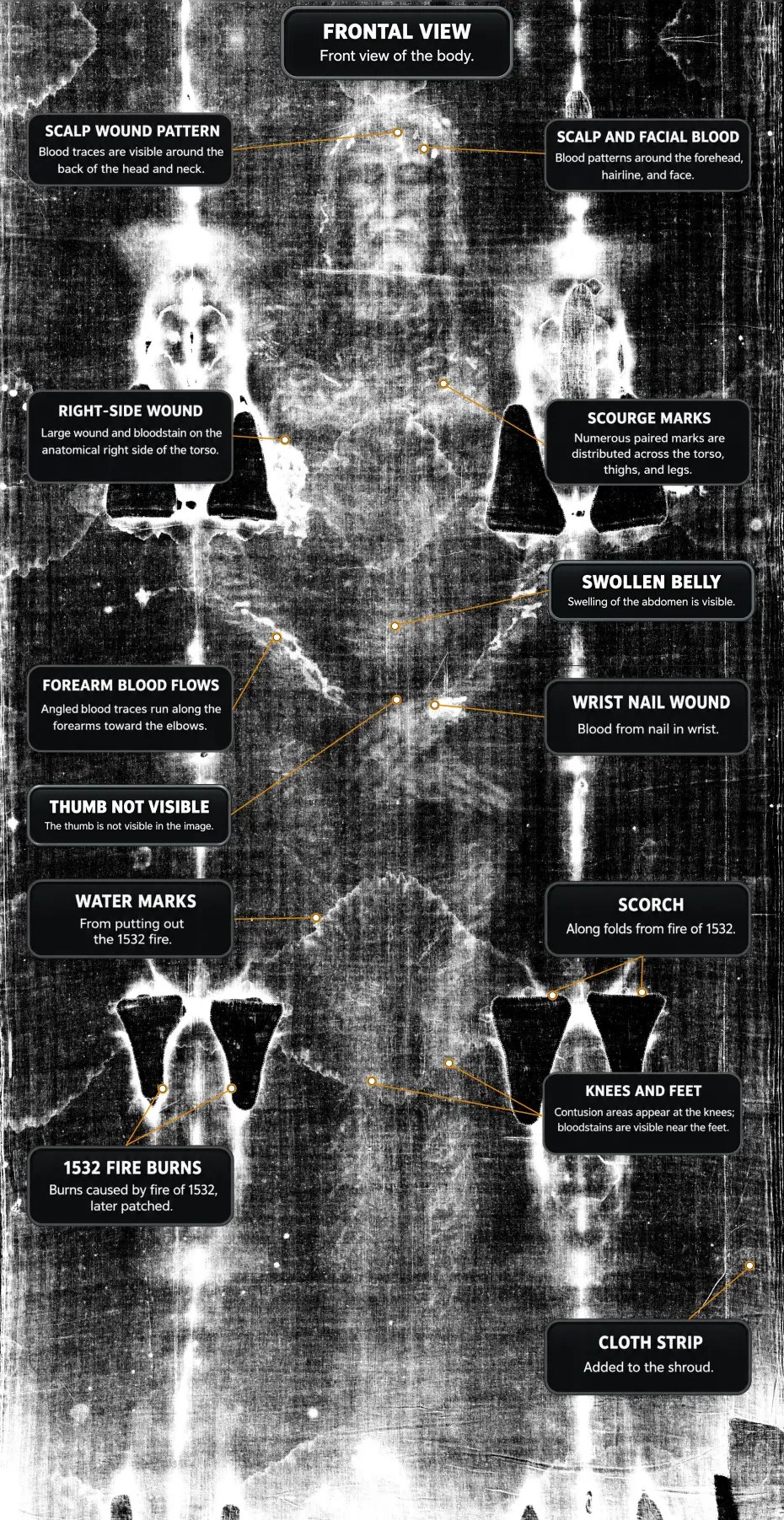
The Shroud records the flogging and the crowning, and these two injuries are the most easily sequenced on the cloth. The forensic readings argue that the crown was placed after the scourge, because the blood from the scalp runs over the back in some places, and because the scourge marks are not covered by the flow from the crown. The argument depends on the reading of the flow patterns, and on assumptions about the position of the body when the blood dried. It is a reasonable reading, and it is not a proof.
The sequence of the other injuries is harder to read. The marks of the carrying of the cross, if they are present, are on the shoulders and the back, and they overlap the scourge marks. The marks of the nails, which belong to the crucifixion and are discussed in Chapter 12, are on the wrists and the feet in the forensic readings. The cloth shows the wrists differently from the hands, and the readings argue about the position of the nails. The sequence of the cross and the nails is part of the chapter 12 discussion.
What the blood can show about the order
The blood on the Shroud is in some places clotted and in others liquid. The flow patterns have been read as evidence of the order of the injuries and the position of the body. Blood that runs from the scalp down the forehead and the face will follow the contours of the head, and it will show the position of the head at the time it was flowing. Blood that runs from the back will show the position of the body at the time of the flogging. If the two sets of patterns meet, the readers can argue about which came first.
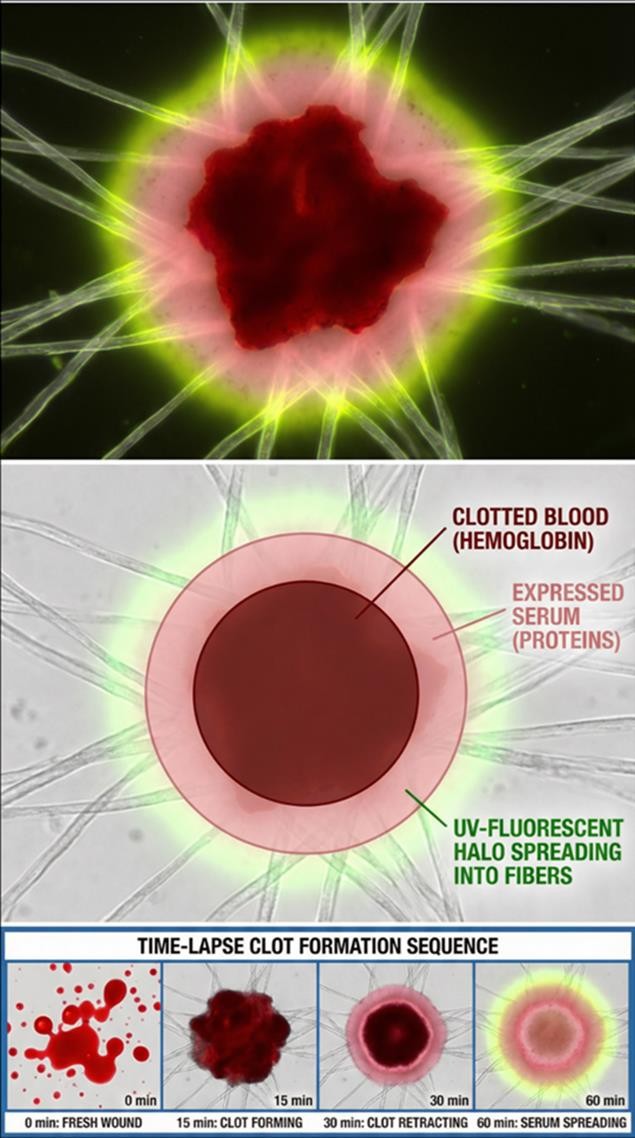
The argument is subtle, and it depends on how quickly the blood clotted. A wound that bled for a long time, and then clotted, would show a different pattern from a wound that clotted quickly. The reading of the order therefore depends on assumptions about the rate of clotting, and those assumptions are not easily tested.6
Where the reconstruction is firm
Several points in the sequence are firm. The Gospels agree that the flogging preceded the crucifixion, that the crowning took place in the context of the mockery, and that the procession went out to the place of execution. The medical literature agrees that a flogging of this kind would weaken the body, and that a scalp wound would bleed freely. The cloth records wounds that are consistent with the flogging and with the crowning. These are the points on which most readers agree.
Where the reconstruction is inference
Several points are inference. The exact order of the flogging and the crowning in the physical event, as opposed to the Gospel text, is an inference from the flow patterns. The exact position of the body at each stage is an inference from the marks and the model. The exact route from the praetorium to Golgotha is an inference from the topography and the tradition. The physical state of the man at Gethsemane is an inference from the Lukan verse, whose text is uncertain. Each of these inferences should be labelled as such, and the series labels them throughout.
The sequence as a test of the cloth
The sequence is useful as a test, because it generates predictions. If the cloth shows the flogging before the crowning, the blood patterns should follow a certain order. If it shows the crowning first, the order should be reversed. If the route passed through a particular gate, the wounds on the body should be consistent with a particular kind of walking. Each prediction can be checked, and each check can fail. A reader who wants to test the claims of the forensic literature should look at the predictions and ask whether they hold.
The sequence is also a test of the Gospels, in the sense that the cloth can be used to check whether the Gospel order is physically plausible. A physical order that is impossible under the Gospel account would be a serious problem for the account, and a physical order that is consistent with it would support the account, though not prove it. The series takes this second kind of test seriously, and it notes that the test is hard to carry out with confidence.
The high priest’s household
The Gospels describe two examinations on the night of the arrest, one before the high priest and one before the council. John places an initial questioning before Annas, the former high priest and father-in-law of Caiaphas, and then a sending to Caiaphas (John 18:13–24). Mark and Matthew place the examination before Caiaphas and the council, with witnesses who disagree about what Jesus had said about the Temple (Mark 14:55–59). The accounts differ in the number of stages and in the people present, and the historian has to decide how far the differences reflect different memories and how far they reflect different purposes.2
The household is also the setting of Peter’s denials. In Mark, Peter follows at a distance into the courtyard, warms himself at a fire, and denies knowing Jesus three times before the cock crows (Mark 14:66–72). The scene places the disciple in the cold and the crowd, and it contrasts his fear with the examination inside. The physical details are modest, but they are part of the picture of the night. A man in custody, under questioning and struck in the household, would have been under severe strain.
The Gospels describe mockery in the household. Mark says that some spat on him, struck him and told him to prophesy, and that the guards received him with blows (Mark 14:65). Luke adds that the men holding him mocked and beat him, and then blindfolded him (Luke 22:63–65). These are not the scourging, but they add to the injuries of the night, and some of the forensic readings have considered whether the blows of the household could have contributed to the bruising and the swelling of the face that the cloth shows.2
Pilate and the crowd
The Roman hearing is the second stage of the examination. Pilate asks whether Jesus is the king of the Jews, and the answers in the Gospels are short and difficult. Mark gives the crowd a choice between Jesus and Barabbas, a prisoner held for insurrection and murder, and the crowd asks for Barabbas (Mark 15:6–15). Matthew adds Pilate’s washing of his hands and the crowd’s acceptance of responsibility. John gives a longer dialogue, in which Pilate asks about truth and says that he has the authority to release or crucify (John 18:33–38; 19:10).2
The governor’s decision to flog before the crucifixion is the point at which the sequence of the Passion meets the sequence of the Roman punishment. Pilate’s intention, as Luke records it, was to chastise and release, and the flogging is the punishment that was meant to be enough. The soldiers went beyond that intention, and the mockery and the crowning followed. The Roman sources give no clear rule for this, and the Gospels leave the decision to the soldiers and the governor.
The chronology of the day
The Gospels disagree about the day and the hour of the crucifixion. Mark says that it was the third hour when they crucified him (Mark 15:25), which would place the crucifixion in the morning. John says that the sentence was passed about the sixth hour, on the day of preparation for the Passover, and that the crucifixion followed (John 19:14). The two dates have been compared since the early centuries, and the differences have been explained in several ways, including different reckonings of the hours and different understandings of the Passover meal.7
The chronology matters for the sequence of the cloth, because the timing of the flogging and the crucifixion affects the interval between the injuries. A flogging in the early morning, followed by a procession and a crucifixion in the middle of the morning, would give a short interval between the injuries. A flogging later in the morning would give a longer one, and the body would have had time to show the effects of the scourge before the cross. The forensic readings have generally assumed a short interval, but the Gospels do not fix the interval exactly.
The procession
The Gospels describe a procession out of the city. Mark says that the soldiers forced a passer-by, Simon of Cyrene, to carry the cross (Mark 15:21). Luke adds that the women of the city followed and mourned, and that Jesus spoke to them (Luke 23:27–31). John says that Jesus carried the cross himself until he went out to the place called the Skull (John 19:17). The accounts are not fully consistent, and the historian has to decide whether the carrying was done by Jesus, by Simon, or by both in turn.
The question matters for the physical reading of the cloth. A man who had been flogged, crowned and bound would have been very weak, and the ability to carry a heavy beam over a long distance would have been much reduced. The forensic readings of the shoulder and the back have considered whether the marks of a carried beam are visible, and the readings are disputed. The Gospel accounts give a practical reason for the substitution, which is that the victim could no longer carry the load, and that reason fits the physical picture of the flogging.8
The sources compared
The following table sets out the main points in the four Gospel accounts of the sequence. It is a summary, and the reader should consult the Gospels for the full texts.
| Stage | Mark | Matthew | Luke | John |
|---|---|---|---|---|
| Garden and prayer | Gethsemane, three prayers | Gethsemane, three prayers | Gethsemane, prayer and sweat | Garden across the Kidron |
| Arrest | Betrayal with a kiss | Betrayal with a kiss | Betrayal, a servant’s ear healed | Arrest by a band and officers |
| Jewish examination | High priest and council | High priest and council | Council, then Herod | Annas, then Caiaphas |
| Roman hearing | Pilate and the crowd | Pilate, the dream, the washing of hands | Pilate, Herod, Pilate again | Pilate, a long dialogue |
| Flogging | Stated briefly | Stated briefly | Implied as chastisement | Stated briefly |
| Mockery and crown | Robe, reed, crown of thorns | Robe, reed, crown of thorns | Mockery by Herod’s men | Robe, crown, mockery |
| Procession | Simon of Cyrene carries | Simon of Cyrene carries | Women follow, Simon carries | Jesus carries the cross |
| Hour of crucifixion | Third hour | Not stated | Not stated | About the sixth hour (sentence) |
The night in the body
The physical state of the man through the night can be described in general terms, and the description draws on the medical literature on sleep deprivation, physical stress and injury. A man who has been awake through the night, who has prayed under distress, who has been arrested and bound, and who has been struck in the household would have been exhausted, dehydrated and in pain by the morning. His capacity to resist further injury would have been reduced, and his blood pressure and cardiac reserves would have been under strain.
The medical literature also describes the effect of fear and distress on the body. Adrenaline release increases the heart rate and the blood pressure, and it can lead to a sense of unreality and a loss of appetite and sleep. The forensic readings of the night have used this literature to argue that the body was already under severe stress before the flogging began, and that the stress would have magnified the effect of the scourge. The argument is plausible, and it is an inference from general physiology rather than from the cloth.
The ground and the walk
The walk from the praetorium to the place of execution would have been on paved or rough streets, and then on the approach to the city gate, where the road ran uphill. A man who had been flogged and crowned, and who was carrying a load, would have had to climb and to balance, and each step would have been painful. The forensic readings of the feet and the knees, which are discussed in Chapter 12, have considered whether the walk left marks on the cloth. The marks, where they can be identified, are consistent with a fall or a stumble, but the attribution of a particular mark to a particular event is uncertain.
The Gospels mention a fall only indirectly. Some later traditions describe three falls on the way, and the stations of the Via Dolorosa include them. The Gospels themselves do not describe falls, and the traditions are later additions. The series treats the falls as tradition, and does not use them as evidence for any particular mark.
The Passover and the day of preparation
John describes the crucifixion as taking place on the day of preparation for the Passover, when the Passover lambs were being prepared in the temple. The Synoptic Gospels describe the Last Supper as a Passover meal, and the crucifixion as taking place after it. The apparent conflict has been discussed for centuries, and its resolution depends on how the Passover was reckoned and how the meal is understood. The conflict does not change the physical reading of the injuries, but it affects the chronology, and therefore the interval between the flogging and the cross.7
What the sequence can and cannot show
The sequence can show that the injuries on the cloth are consistent with the order the Gospels describe, and that the flogging and the crowning are the most visible of them. It can show that the physical state of the man at each stage is consistent with the medical literature on flogging and stress. It cannot show the exact hour of each event, the identity of each soldier, or the precise route taken. The reader who wants a timetable should recognise that the Gospels do not supply one.
The argument for a fixed order
The argument for a fixed order rests on the cloth, on the Gospels and on the medical literature. The cloth shows the marks of the flogging and the crowning, and the flow patterns can be read as showing the sequence. The Gospels give an order that the cloth can be made to fit. The medical literature explains the state of the body at each stage. Taken together, these supports make the fixed order a reasonable reading. Taken alone, each support is weaker, and the reader should weigh them together.
The argument against a fixed order
The argument against a fixed order is that the flow patterns can be read in more than one way, that the Gospels disagree on details, and that the medical literature cannot fix the hour of each event. The argument is that the sequence is a plausible reconstruction, and that a different reconstruction would fit the same evidence. The series does not decide between the two arguments, and it presents the evidence for each.
The political setting of the trial
The trial took place in a city under Roman control, during a festival that brought large crowds to Jerusalem. The governor was in the city to keep order, and the festival was a time of tension. The Gospels show the Jewish authorities and the governor in an uneasy relation, in which each needed the other to deal with a man who had attracted a following. The governor’s decision was therefore shaped by the pressures of public order, and not only by the merits of the charge. The flogging and the crucifixion were the instruments of that order.
The Roman punishments of the period were designed to deter, and their public character was part of their purpose. A flogging before the crowd, followed by a procession to a visible place of execution, sent a message to those who watched. The sequence in the Gospels reflects that purpose. The mockery of the soldiers, which the Gospels record in detail, belongs to the same culture of public humiliation, and it was carried out in the same spirit.
What a visitor sees today
A visitor to Jerusalem who follows the traditional route will pass through several sites. The Gethsemane enclosure with its old olive trees is on the Mount of Olives, and it is visited by pilgrims who come to pray. The Church of Saint Anne and the Pools of Bethesda are in the north-east of the Old City. The Franciscan Monastery of the Flagellation stands on the site traditionally associated with the scourging, and the Ecce Homo arch marks another station of the route. The Church of the Holy Sepulchre contains the site of Golgotha within its walls.
The visitor should recognise that most of these sites are later identifications, and that the standing buildings are medieval or later. The archaeological evidence for the first-century city is in the excavations beneath and around these buildings, and it is partial. A visitor who wants to understand the ancient route should consult the archaeological literature as well as the traditions, and should accept that the traditional sites may or may not correspond to the events.
Open questions
Several questions remain open. The first is the exact site of the praetorium, and the choice between the Antonia and Herod’s Palace. The second is the exact order of the flogging and the crowning, which depends on the reading of the flow patterns. The third is the chronology of the day, and the relation between the Synoptic and Johannine accounts. The fourth is the route, which depends on the topography of the first century and on the course of the city walls at the time. The fifth is the physical state of the man at each stage, which depends on inference from the medical literature. None of these questions can be settled from the cloth alone.
The series does not claim to settle them. It identifies them, and it presents the evidence on each side. A reader who wants to take the questions further should begin with the Gospel texts, the archaeological reports on the city, and the medical literature on flogging and stress, and should compare the forensic readings with each.
What the sequence contributes to the series
The sequence from Gethsemane to Golgotha is the frame in which the injuries on the cloth are placed. It is also the point at which the Gospel account and the forensic reading can be compared most directly. The next chapter turns to the place of execution, and to the question of what Golgotha looked like and what can be known about it.
The sequence from Gethsemane to Golgotha is best understood as a chain of linked events, each of which bears on the next. The prayer and the arrest shape the state of the body through the night. The examinations shape the decision to flog. The flogging shapes the strength the man has for the procession, and the procession shapes the place and the manner of the execution. The cloth preserves a record of some of these links, and the Gospels preserve a record of others. Neither record is complete, and neither was written as a physical account. A reader who keeps the two records apart, and who asks what each can and cannot show, will be in a better position to judge the reconstructions than one who takes either record as a complete timetable.
References
- Mark 14:32–15:22. Mark 14:32–15:22.
- Luke 23:1–25; John 18:28–19:16. John 18:28–19:16.
- Luke 22:44 and the textual question of its inclusion. The verse is absent from several early manuscripts, and the debate is discussed in the critical commentaries on Luke. Publication details to be confirmed before publication.
- Hematidrosis in the medical literature. Descriptions of blood in the sweat under extreme stress are discussed in the clinical and historical literature. Specific references to be confirmed before publication.
- The praetorium and its possible sites in Jerusalem. The debate between the Antonia and Herod’s Palace is discussed in the archaeological and biblical scholarship. Publication details to be confirmed before publication.
- Clotting rates and the order of blood flow on the Shroud. The forensic argument is discussed in the literature on the cloth, and its assumptions are to be confirmed against the original reports before publication.
- Mark 15:25; John 19:14, 31; Mark 14:12. The chronological difference between the Synoptic Gospels and John is discussed in the critical commentaries and in the historical literature on the Passion. Publication details to be confirmed before publication.
- Mark 15:21; Luke 23:26–31; John 19:17. The carrying of the cross and the role of Simon of Cyrene are discussed in the commentaries on the Passion narratives. Publication details to be confirmed before publication.