The Shroud of Turin · Chapter 9 of 21
The crown of thorns: the wounds of the scalp
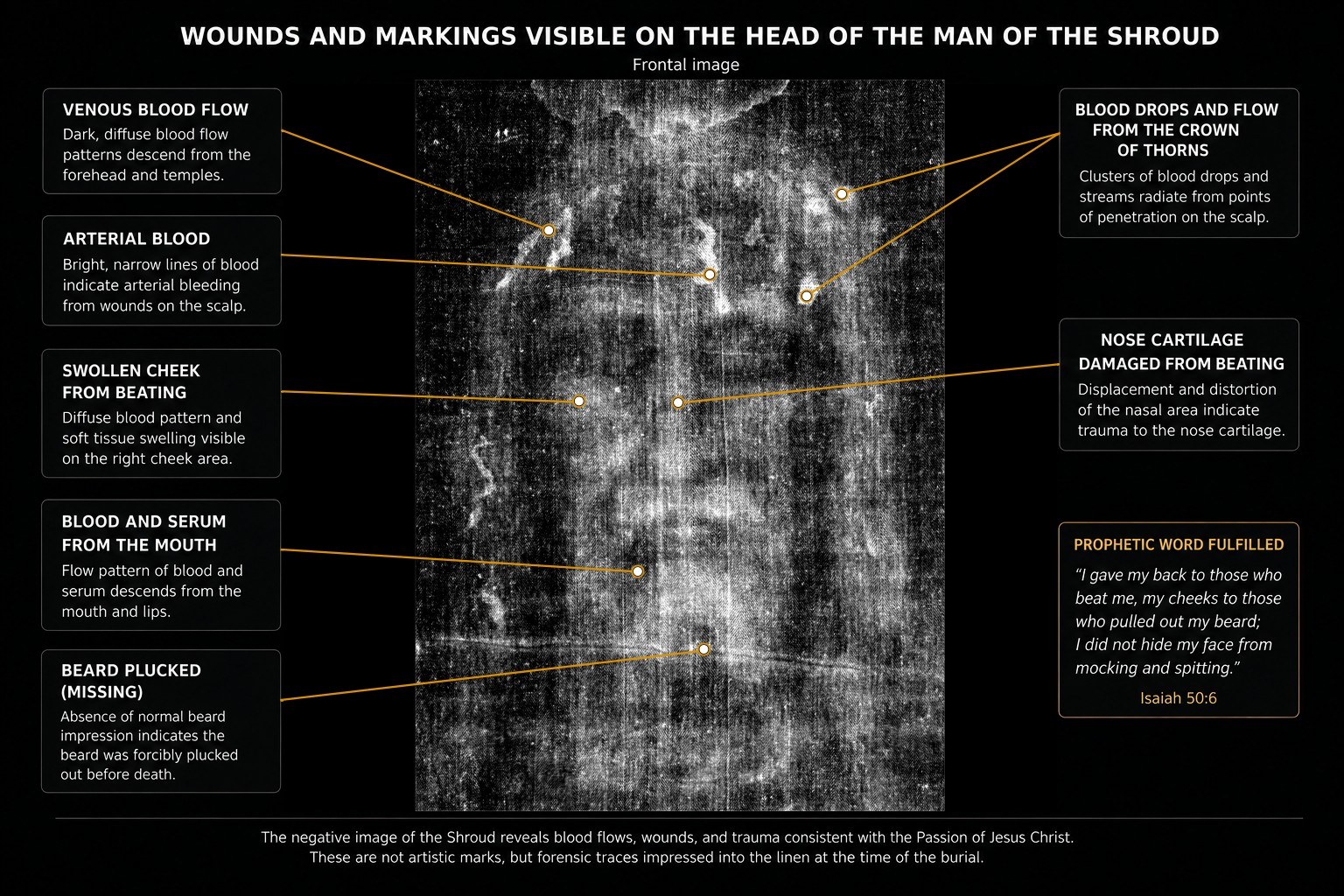
Between the flogging and the procession, the Gospels describe a mockery. Soldiers dress the prisoner in a purple or scarlet cloak, twist a crown from thorny branches, and press it on his head. They strike him, kneel before him, and call him king. The episode takes a few verses, and it has been one of the most visually persistent scenes of the Passion. The crown in the paintings is a neat ring of thorns, set on the brow like a circlet. The Shroud, read carefully, does not show a circlet. It shows many small punctures across the scalp, a pattern that has been used to argue for a different kind of crown, and a different kind of injury. This chapter sets out the Gospel accounts, the artistic tradition, the scalp wounds on the cloth, the reconstructions of the crown, the botany of the thorn, the physiology of scalp bleeding, and the places where the argument is firm and the places where it is not.
What the Gospels say
All four Gospels mention the crown, and they agree on its essentials. Matthew writes that the soldiers plaited a crown of thorns and put it on his head, with a reed in his right hand, and mocked him as king of the Jews (Matthew 27:29).1 Mark gives a similar account, and adds that they struck his head with the reed (Mark 15:17–19). John has the crown made of thorns, put on his head, and a purple robe placed on him, after which the soldiers came and struck him (John 19:2–3). Luke, who gives the fullest account of the trial before Herod, does not describe the crown, though he records the mockery and the robe.
The Gospel vocabulary is simple. The word translated as thorns is akanthos, the general Greek word for a thorny plant, and it does not name a species. The crown is described as woven or plaited, which implies that it was made from branches or stems, and not from a single rod. The Gospels also say that the robe was purple or scarlet, a colour associated with royalty and with the mock imperial costume of the soldiers. The Gospel writers were concerned with the meaning of the scene: a mock royal investiture, and a mock acclamation. They were not concerned with the anatomy of the wound.
The sequence matters for the cloth. In Matthew and Mark the crown follows the flogging and precedes the procession to the cross. John places the crowning after the flogging as well, and before the presentation of the mocked prisoner to the crowd. On all three accounts the crown was put on a body that had already been scourged, and that is the sequence the forensic readings of the cloth have used.2
The crown in art
The artistic tradition shaped the way the crown is imagined. From the early medieval period the crown is often shown as a ring of thorns, set on the head like a diadem, with the thorns pointing outward. The ring is small and neat, and it sits on the forehead or above the brow. Many paintings show the thorns as decorative spikes, and they show little blood, or a few drops at the brow. The tradition gives the crown a dignity that the Gospel scene, with its cruelty and its mockery, does not quite share. It also makes the crown a symbol of kingship that has been turned into a sign of suffering.
The tradition has had consequences for the way the Shroud has been read. Viewers who expect a circlet look for wounds on the brow, and when the pattern on the cloth extends across the scalp and the back of the head, they can be surprised. The mismatch has led to two responses. Some readers have concluded that the Shroud is inconsistent with the Gospel account. Others have concluded that the artistic tradition is itself a simplification, and that the Gospel crown may have been different from the crown of the paintings. The series takes the second view as a question to be tested rather than a conclusion to be assumed.
The scalp wounds on the cloth
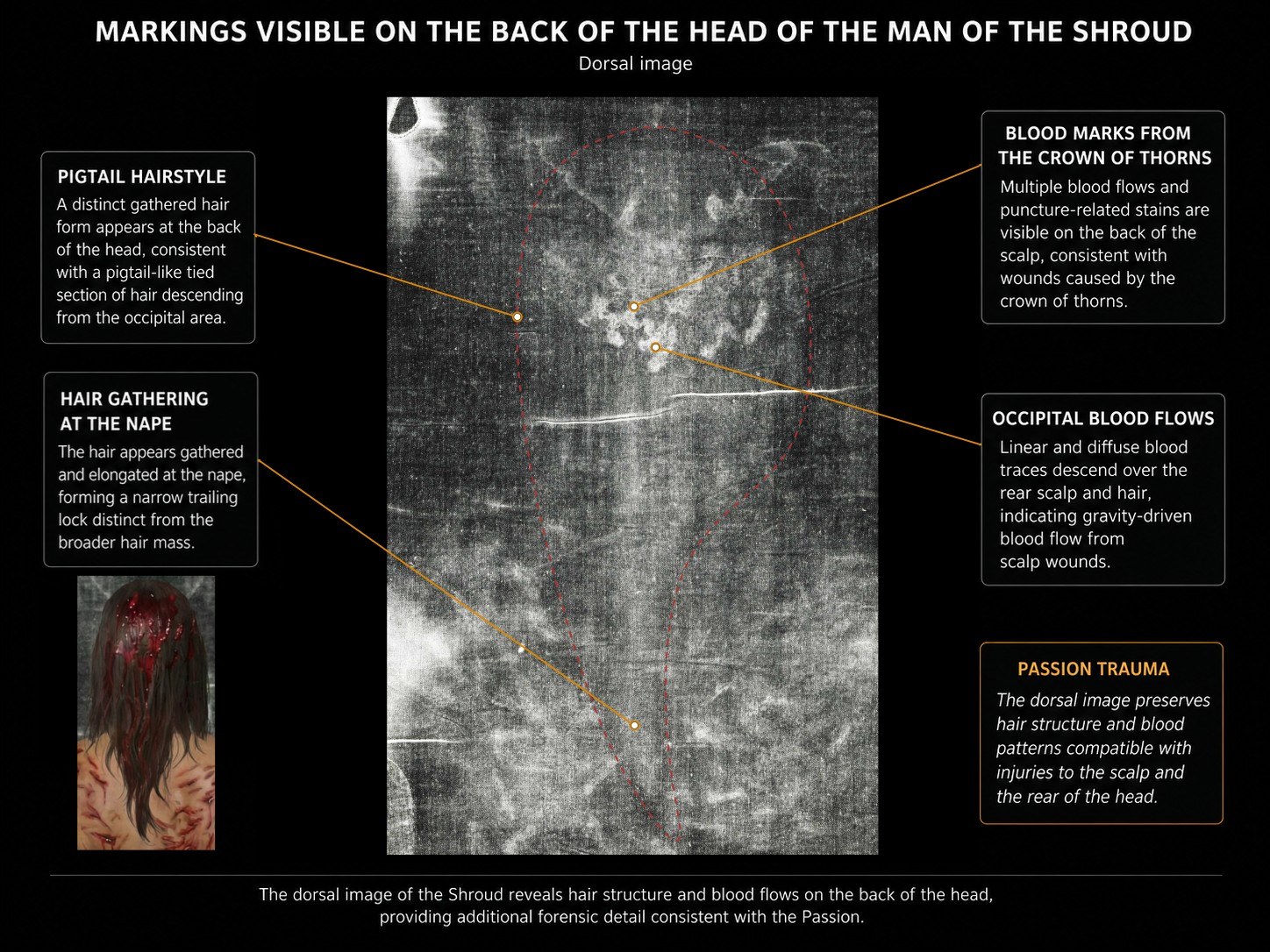
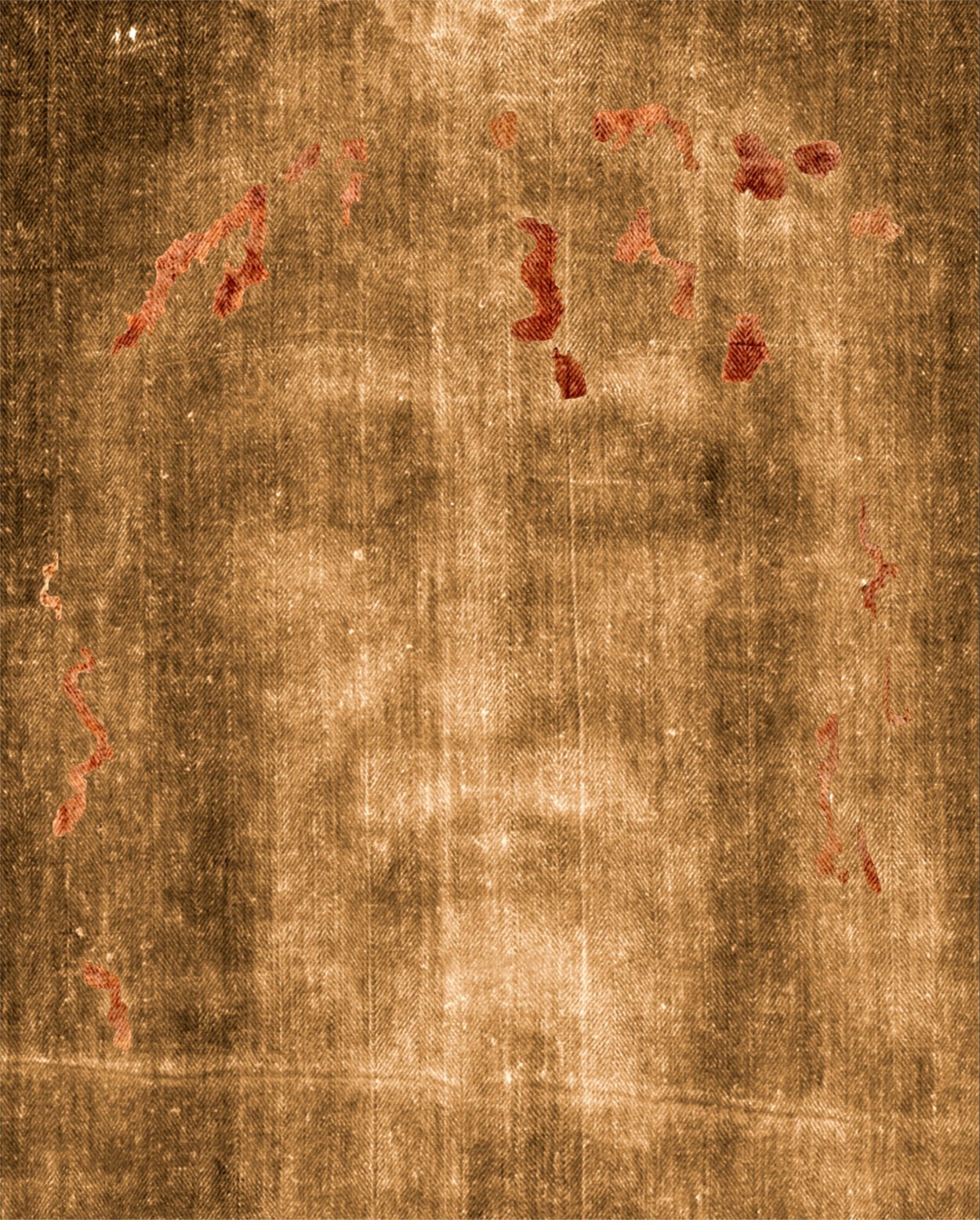
The head on the Shroud shows a set of punctures and marks across the forehead, the crown of the head, and the back of the skull. The most discussed marks are on the forehead, above the eyes, and along the hairline. There are also marks on the scalp at the top of the head and on the back of the skull, in the dorsal image. The marks are not identical. Some are small and round, some are paired, and some are elongated and run down toward the hairline. Their brightness varies, and in some places the marks are obscured by the hair.
The forehead marks are the ones that connect most directly with the crown. They lie in a band across the brow and along the hairline, and their upper edges are the most sharply defined. The forensic readings have treated them as the point of entry of thorns, and they have counted them as separate punctures. Some researchers have counted more than thirty separate marks on the head, and have argued that the marks are too numerous for a simple circlet. Their counts differ, and the counts depend on how the hair-obscured and faint marks are treated.3
The marks on the back of the head are a second line of evidence. In the dorsal image they appear across the occiput and the upper neck, and they continue the pattern of the forehead around the skull. If the crown was a circlet, set on the brow, the back of the head would be expected to show few marks. The presence of marks there has been read as evidence for a crown that covered more of the head, and that pressed down on the skull from above.
The helmet hypothesis
The most influential alternative to the circlet was proposed by the physician Pierre Barbet. In his book A Doctor at Calvary, first published in French in 1950 and translated into English in 1953, Barbet argued that the crown was not a ring but a cap. He described a hemispherical latticework of thorny branches, designed to cover the whole of the head, and he argued that such a cap would produce punctures across the scalp, including on the back of the head.4
Barbet’s argument was medical as well as visual. He pointed out that the scalp is richly supplied with blood vessels, and that even small wounds there bleed freely. A cap of thorns, pressed down on the head, would produce many small wounds, each bleeding onto the hair and the face. The flow would follow the contours of the skull and the forehead, and it would run down over the face. The pattern of bleeding, in his reading, would match the marks on the cloth.
The helmet hypothesis has been developed and criticised. Its supporters argue that it best explains the spread of the marks and the presence of marks on the back of the head. Its critics argue that the cap is an inference from the marks, and that the Gospel text does not specify its form. They also point out that the artistic and textual tradition, which described a crown on the brow, is not a reliable guide to what the soldiers did. The debate is about interpretation, and both sides accept the same photographic evidence.
The circlet hypothesis
The circlet, a ring of thorns set on the brow, has its own defenders. They argue that the Gospel word for crown implies a wreath or circlet, and that a simple ring is the natural meaning of the Greek. They also argue that the forehead marks, which are the sharpest, lie along a band that a circlet would reach. On this view the marks on the back of the head are the result of the cloth folding over the body, or of the head being pressed against a surface, and they do not require a cap.
The circlet reading has difficulties of its own. A ring of thorns would have to be pressed onto the head with considerable force to make the punctures, and the reconstructions examined below suggest that a simple ring would tend to slide or to hover above the scalp. The circlet explains the forehead marks well and the back-of-head marks less well. Neither hypothesis explains every mark, and that is one reason the question remains open.
The reconstructions
The question of the crown has been tested in physical models as well as in argument. The companion book describes a mannequin test attributed to the engineer Mark Fisher (dated 2024), in which a silicone scalp layer of about three millimetres was fitted over a head form, and a circlet was built from rods with artificial thorns of varying lengths. The thorns were set to match the length of the thorns of a plant used in the botanical literature, and the circlet was pressed onto the mannequin head. The test was reported to show that a simple circlet tended to hover, supported only by the tips of the longest inward-pointing thorns.5
The same test suggested that a circlet, if it was to be seated firmly, required considerable downward pressure, and that the act of seating it would drive some thorns deeper. The reported punctures were numerous, and some thorns penetrated the silicone and travelled beneath the surface before emerging, which produced several wounds from one thorn. A circlet with about twenty thorns was reported to produce between fifty and sixty visible puncture points. The reported outcome was that a heavier, seated circlet could produce a wound pattern similar to the cloth, but that it would still favour the forehead and would produce fewer marks on the back of the head than the cloth shows.
No published source for the Fisher test was located in the checks made for this series, so its results are unverified. The test is an engineering test, not a forensic one, and its results depend on the materials, the depth of the silicone and the lengths of the thorns. The companion book reports it as one reconstruction among several. The publication details are to be confirmed before the test is cited in a formal setting, and the test should not be read as settling the question on its own.
The botany of the thorn
The Gospels say thorns, but do not name a species. The botanical question is which plant the soldiers would have used. Several plants grow near Jerusalem and have been proposed. The most discussed is Ziziphus spina-christi, the Christ’s thorn jujube, a shrub or small tree whose branches carry paired thorns at each node. One thorn is usually straight and the other curved. The plant is native to the region, is common in the Jordan valley and the hills around Jerusalem, and is flexible enough to be woven.6
The companion book argues that Ziziphus spina-christi fits the constraints best. Its thorns can be two to four centimetres long, enough to reach through the scalp. Its branches can be bent and interlaced, and a wreath can be made from them without cutting. Each node carries two thorns, so a branch with several nodes gives many thorn tips, and a cap or circlet made from such branches could carry a large number of thorns pointing inward. The book also notes that the plant is abundant in early spring, which fits the season of the Passion in the Gospel accounts.
Other candidates have been suggested, including Gundelia tournefortii, a thistle-like plant with spiny leaves and dense spines, which grows in the region and has also been considered. The companion book argues that Gundelia creates more problems than it solves, because its spines are less likely to penetrate deeply, and because it is harder to weave into a stable form. The botanical argument is a reasonable inference, and it is not a proof. The literature on Biblical plants does not settle which species the soldiers used, and it is wise to present the identification as the most probable among several, not as a certainty.6
Thorn density and the puncture count
The number of punctures depends on the number of thorns and the number of times the crown was pressed onto the head. The companion book works through a simple estimate. A branch with several nodes, each carrying two thorns, may give a large number of thorn tips. If a crown was assembled from many such branches and pressed down several times, the number of puncture events could run into the dozens. The book reports ranges of around forty-five to sixty-three puncture events for a plausible set of assumptions. The estimate is a model, and its result depends on the assumed number of thorns and the number of blows.
The count of visible wounds on the cloth is a different matter. A thorn may puncture the scalp and leave several marks, as the mannequin test suggests, and a single puncture may be hidden by the hair or by the blood. The number of visible marks is therefore not the same as the number of thorns, and the relation between the two is one of the more difficult points in the argument. A reader should be wary of any single number, whether it is offered as a count of marks or as a count of blows.
Scalp bleeding
The scalp is one of the most vascular parts of the body. The vessels that supply it are numerous and close to the surface, and even small wounds there can bleed freely. Blood from a scalp puncture runs down the hair and across the face, and it spreads across the skin in patterns that depend on the position of the head. A body lying on its back will show a different flow from a body that is upright. The forensic readings have used the flow patterns on the cloth to argue about the position of the body and the sequence of the injuries.
The flow patterns on the Shroud have been studied in some detail. Several researchers have argued that the rivulets on the forehead and the face run in directions consistent with flow from the scalp while the body was upright, and then with flow while the body was lying down. The argument is that the blood was left on the head during different phases of the body’s position, and that the sequence can be read. The interpretation depends on assumptions about the shape of the head, the drape of the cloth, and the speed at which blood dried. Each of those assumptions is contestable.
Blood and the scalp
The chemistry of the scalp marks has been studied since the 1970s. In 1981 the investigators Heller and Adler reported that the stains they examined contained substances consistent with blood, and they described tests for bilirubin and other markers.7 The 1978 STURP examination also sampled the scalp marks, and the sticky-tape samples from these areas were reported to contain material consistent with blood.8 The chemistry is contested. Other investigators have argued that the tests do not uniquely identify blood, and that similar results could come from other materials. The question is not closed, and the chapter on the chemistry of the image treats it in more detail.
The relevance of the chemistry to the crown is that the scalp marks are the only wounds on the head, and their chemistry is the basis of the claim that they are blood. If the marks are blood, they are consistent with a scalp injury. If they are not, the forensic readings of the crown lose their basis. The series therefore treats the blood claim as a necessary step in the argument about the crown, and tests it separately.
Nerve and pain
The scalp contains many nerve endings, and the greater occipital nerve runs across the back of the head. A thorn that compresses or irritates this nerve would produce severe pain, and the pain would persist after the wound had closed. The companion book suggests that the thorns could have compressed the nerve at the back of the head, and that the crown could have caused a sustained headache-like pain. The suggestion is plausible, but it is an inference from anatomy, and it is not recorded in any source.
The pain of a crown of thorns is a reasonable part of the account, because the Gospels describe a mockery that was meant to humiliate and wound. The question for the forensic reader is whether the wounds can be linked to a particular form of the crown, and that link is an inference that the cloth alone cannot prove.
The mockery in its setting
The crowning belongs to a Roman pattern of mockery of condemned men. Soldiers of the governor’s guard are described in the Gospels as dressing the prisoner in royal costume and acclaiming him, and the scene has been compared with other accounts of the mocking of prisoners in the ancient world. The Roman practice was public and cruel, and its purpose was to humiliate the condemned and to amuse the soldiers. A crown of thorns, placed on a prisoner who had already been flogged, would be a natural element of such mockery.
The setting matters for the reading of the scalp wounds. A mock crown made quickly from available branches would be different from a carefully made circlet. The soldiers would not need a precise form. They needed a crown that looked like a royal emblem and that hurt. The Shroud’s pattern, if it reflects a cap or a rough circlet, is consistent with a quickly made crown, and not with an elaborate one.
What the scalp can show
The scalp marks can show that the head was struck or pierced by many small points, that the wounds bled freely, and that the blood ran down the face in patterns that depend on the position of the body. They can show that the wounds are consistent with the thorn of a plant of the kind described in the botanical literature. They cannot identify the plant, count the thorns, or determine the exact form of the crown with certainty.
The marks cannot, on their own, date the cloth. A thorn wound made in the first century and a painted or imitated wound made in the Middle Ages would look similar at the level of the photograph. The date must be settled on other evidence, and the radiocarbon date is discussed in Chapter 19.
The argument for and against the cap
The argument for a cap is that the marks extend across the scalp and onto the back of the head, that a cap would produce such marks, and that the artistic tradition of a circlet is a simplification. The argument against a cap is that the Gospels do not describe one, that the marks on the back of the head may be explained by the drape of the cloth, and that the cap is an inference from the marks rather than an independent fact.
Each side has a point, and the points can be weighed. A reader who holds the Gospel account can accept that the crown was a rough and cruel object, and can accept that its form is unknown. A reader who holds the forensic account can accept that the marks are consistent with a cap, while noting that consistency is not proof. The series does not decide between them, and it presents the evidence so that the reader can judge.
A checklist for the scalp evidence
The following questions help when reading any claim about the crown. How many marks are counted, and by what criteria? Are the hair-obscured marks included or excluded? Is the claim about a circlet or a cap, and what marks would each predict? Are the flow patterns read from the photograph or from a model, and what assumptions about the head and the drape are made? Was the chemistry tested for blood specifically, or for other materials? And does the claim survive when the thorn species, the number of thorns and the pressure are varied?
The hair and the blood
The hair of the head shapes the scalp evidence in several ways. Blood from a puncture is absorbed by the hair, and it is carried along the strands in a way that can spread the stain away from the wound. The hair also hides some punctures, so that a count of visible marks underestimates the number of wounds. Where the hair is matted with blood, the stain may look continuous, and the separate wounds beneath it cannot be distinguished. Readers of the cloth have had to decide how to treat these areas, and different decisions give different counts.
The hair also changes the way the blood dries. Wet hair holds blood against the scalp for longer than dry skin does, and a body lying on its back will allow the blood to pool at the nape of the neck. The forensic readings of the back of the head have used this to explain the pooling in the dorsal image. The explanation is plausible, and it depends on the position of the head at the time of drying, which cannot be fixed from the cloth alone.
The wound edges
The edges of the scalp marks have been studied as a guide to the shape of the thorn. A sharp, clean puncture leaves a small, well-defined edge, while a thorn that has been pushed in at an angle, or that has been twisted, leaves an elongated or irregular edge. Several of the marks on the forehead have an elongated shape running in one direction, and the forensic readings have taken this as a sign that the thorns were pressed in at an angle, rather than straight down. The angle would follow from the shape of the crown, with thorns pointing inward toward the scalp.
The interpretation of wound edges is difficult in photographs, especially in old ones. The edges are affected by the blood, by the hair, by the cloth’s weave and by the photographic process. The reading of an edge as the trace of a particular kind of thorn is therefore an inference from a small region of the image, and it should be treated as one piece of evidence among many.
Ancient crowns and royal mockery
The ancient world knew several kinds of crown. Greek and Roman rulers wore diadems, wreaths and laurel crowns, and the Roman emperors were depicted with radiate crowns that suggested the sun. Crowns of thorns are less well attested, but the Gospel scene has parallels in the mocking of prisoners and of supposed kings, in which a condemned man is given a mock royal emblem before his execution. The Gospels present the crown as one such emblem, made from materials at hand and placed on the head of a man accused of claiming kingship.
The form of the mock crown would have been determined by what the soldiers had available and by the purpose of the mockery. A crown that looked like a royal diadem would be more effective as mockery than a shapeless tangle, and a cap of thorns, pressed onto the head, would be both more cruel and more visibly absurd. The Gospels do not say which form was used, and the reader who wants to decide must rely on the physical evidence and on the probabilities of the situation.
Scalp wounds in the medical literature
The medical literature on scalp injury describes several features that are relevant to the crown. Scalp wounds bleed heavily because of the rich blood supply, and small punctures can produce large blood losses. They are also prone to infection and to scarring, and they can cause persistent pain if nerves are involved. The bleeding from a scalp wound tends to be slow to stop, because the vessels are held open by the surrounding tissue. These features would have made a crown of thorns a source of considerable and sustained bleeding, even if the wounds were small.
The medical literature also describes the effects of head wounds on the level of consciousness. A man who has lost blood from the scalp, and who is in pain, may be dizzy or confused, and the Gospel scene of mockery would be carried out on a man in that state. The forensic readings do not usually extend this point, but it is a reasonable inference from the medical literature, and it bears on how the scene should be read.
The crown and the Passion sequence
The crown belongs to a sequence that begins with the flogging and ends with the cross. The Gospel order is flogging, then crowning, then procession. The forensic readings have used this order to explain the relation between the scalp wounds and the scourge marks, and the relation between the blood on the head and the blood on the back. A body that was crowned after the flogging would bleed from the head onto a back that was already wounded, and the two patterns would overlap in a particular way. The overlap is not easy to read in the cloth, and the readings disagree about its extent.
The sequence also matters for the procession. A man who had been flogged and crowned would be weakened, and his ability to carry a load would be reduced. The Gospels record that the cross was carried, and that a man from Cyrene was made to carry it. The physical state of the man who began the procession is part of the context of that event, and it is discussed in the chapters that follow.
How the scalp marks are mapped
A map of the scalp marks is built in stages. The first stage is the photograph itself, usually a high-resolution image of the head region, taken with raking light or with a standard exposure. The second is the identification of candidate marks, which are small areas of darker tone or distinct shape. The third is the decision about each candidate: whether it is a wound, a stain, a fold of the cloth or an artefact of the image. The fourth is the placement of each accepted mark on a model of the head, so that its position can be compared with the positions predicted by a given form of the crown.
Each stage involves judgement. Candidate marks depend on the threshold chosen, and a lower threshold will find more marks, including some that are not wounds. The decision about each mark depends on the shape, the colour and the context, and two observers can disagree. The placement on the model depends on the model’s shape and on the assumed position of the head in the cloth. A map is therefore a product of several decisions, and its reliability depends on how they were made and reported.
The best practice is to publish the threshold, the list of accepted and rejected marks, and the model used for placement. A reader can then check the map and test the claim that the marks fit a particular crown. Maps that do not publish their criteria can still be useful, but they are harder to test, and their claims should be treated as provisional.
What the crown contributes to the series
The crown is the second of the three scenes of mockery and suffering that the series treats before the cross. It is also a test case for the forensic method, because the scalp marks are dense, varied and difficult to count, and because the interpretation of them depends on assumptions about the instrument and the body. A reader who follows the crown through the series will see how the same kind of evidence supports different conclusions, depending on the assumptions.
The chapter that follows takes the story from the mockery to the procession, and from the procession to the place of execution. The movement is described in the Gospels and reconstructed in the series, and the next chapter takes up the route as a question of both text and terrain.
Three things should be kept from this chapter. The first is that the Gospels describe a crown without describing its form, and that the familiar circlet of the paintings is an artistic choice rather than a textual fact. The second is that the scalp marks on the cloth are dense and varied, and that their interpretation depends on the threshold, the model and the assumptions about the hair and the blood. The third is that the botanical and engineering tests can show what kinds of crown could produce a given pattern, but they cannot show which crown was actually used. A reader who keeps these three points in view will be able to judge the claims about the crown on their merits, whatever their starting position.
References
- Matthew 27:29; Mark 15:17–19; John 19:2–3. Matthew 27:29; John 19:2.
- The sequence of the Passion in the four Gospels, as discussed in the New Testament commentary literature. The forensic readings that depend on the sequence are discussed in Chapter 8 and Chapter 10.
- Scalp mark counts on the Shroud. The counts differ between studies according to the treatment of hair-obscured and faint marks. Specific publications to be confirmed before publication.
- Barbet, P. (1953). A Doctor at Calvary. Translated by the Earl of Wicklow. New York: P. J. Kenedy. First published in French in 1950 as La Passion de N.-S. Jésus Christ selon le Chirurgien. Catalogue dates for the English edition vary between 1953 and 1954; to be confirmed.
- Fisher, M. (2024). Mannequin test of a crown of thorns, as described in the companion book. No published source located. A related experimental study, König et al. (2023), on the formation of blood stains on the Shroud is cited for comparison; its journal and details are to be confirmed. Unverified before publication.
- Zohary, M. (1982). Plants of the Bible. Cambridge: Cambridge University Press. The botanical identification of Ziziphus spina-christi and Gundelia tournefortii is discussed in this work and in the companion book.
- Heller, J. H., & Adler, A. D. (1981). A chemical investigation of the Shroud of Turin. Canadian Society of Forensic Science Journal, 14(3), 81–103.
- Schwalbe, L. A., & Rogers, R. N. (1982). Physics and chemistry of the Shroud of Turin: a summary of the 1978 investigation. Analytica Chimica Acta, 135, 3–49. doi:10.1016/s0003-2670(01)85263-6