The Shroud of Turin · Chapter 8 of 21
The scourging: the wounds of the back and legs
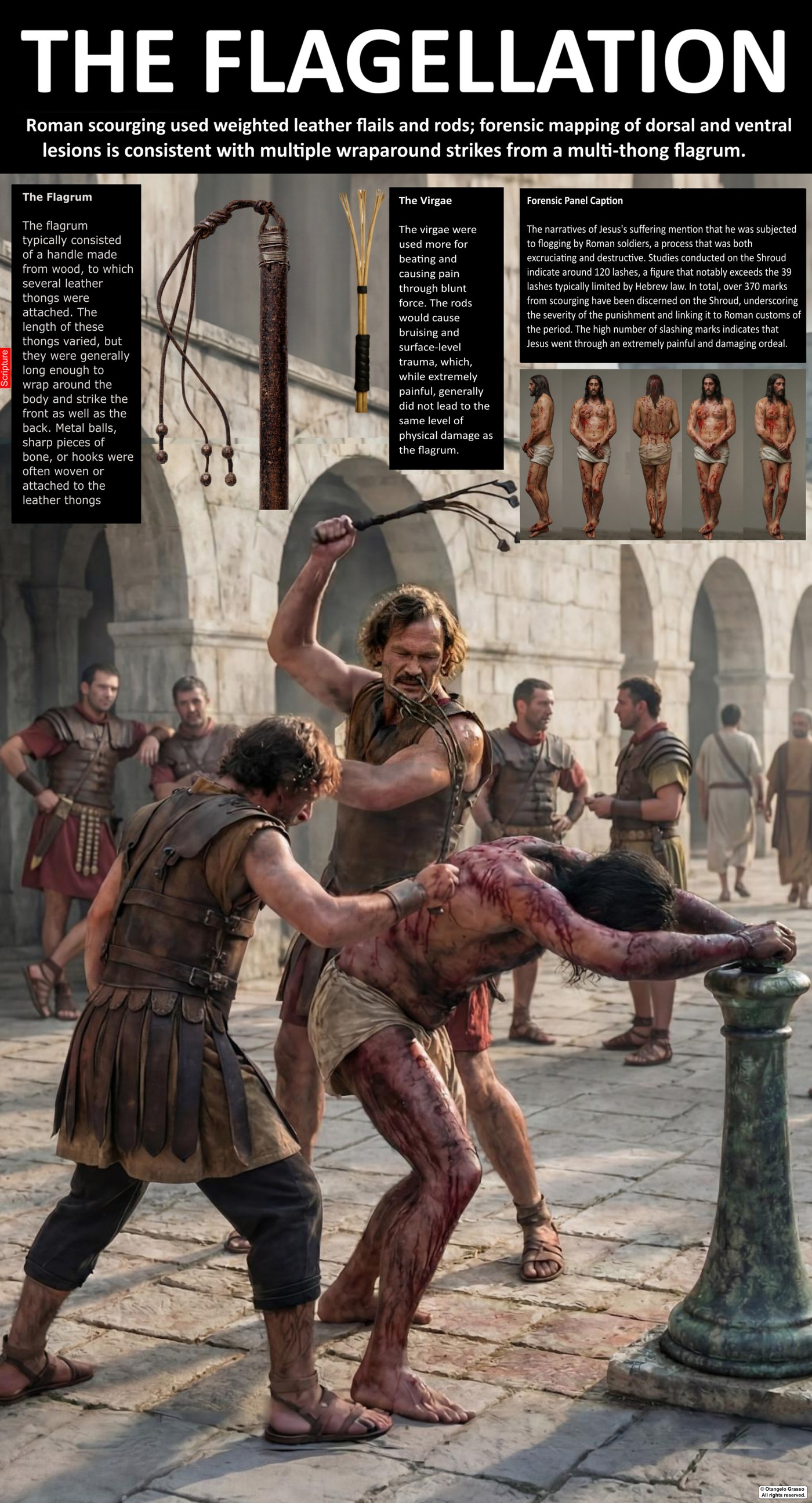
Before the cross, Jesus was flogged. The Gospels record the flogging in a single sentence, and the cloth records it on the back and legs of the figure in several hundred small, sharply defined marks. The marks are among the most discussed features of the Shroud, because they bear on the question of whether a medieval artist could have produced them, and because they are the record of a violence that the Gospels mention only briefly. This chapter sets out the Gospel accounts, the Roman practice of scourging and its instruments, the cloth’s record of the marks, the changing counts and their significance, the physiology of the injury, and the limits of what the marks can show.
What the Gospels say
The four Gospels mention the flogging, and they do so with economy. John writes that Pilate took Jesus and had him flogged (John 19:1). Matthew and Mark give the same outcome in similar words: Pilate had Jesus flogged and handed him over to be crucified (Matthew 27:26; Mark 15:15).1 Luke alone gives a hint of Pilate’s intention. Pilate says three times that he finds no capital charge against Jesus, and he proposes to “chastise him and release him” (Luke 23:16, 22). The Greek verb Luke uses, paideuo, means discipline or correction rather than execution. If the flogging was meant to be the whole punishment, the soldiers were not meant to kill him, and what followed exceeded the original intent.
The Gospels do not describe the flogging in any detail. Their first readers knew what a Roman flogging involved, and the writers did not need to say more. The later readers of the Gospels, separated from the event by two millennia, have had to turn to other sources to understand it. The most important of those sources are the Roman writers, the medical literature on flogging, and the physical record of the cloth.
The Gospel account also places the flogging in a particular sequence. In John it comes after the examination before Pilate and the offer of Barabbas, and before the mockery and the presentation of the crowned figure. In Matthew and Mark it comes immediately before the procession to the cross. The sequence matters for the cloth, because the marks of the flogging and of the crown should, on the Gospel account, be ordered in time. Whether the cloth shows that order is discussed in Chapter 10.
Roman scourging
The Roman flogging that preceded crucifixion was a formal punishment carried out by trained soldiers. The usual instrument was the flagrum, also called the flagellum. It had a short handle to which several leather thongs were attached, and each thong was often weighted near its end with metal or bone. The weights made each blow tear as well as strike, because the thong wrapped around the body and was drawn back across the skin. Edwards and his colleagues, in their 1986 medical review, described the mechanics of this kind of injury and the tissue damage that results.2
The Roman writer Philo, describing a flogging of Jews in Alexandria, reported that the victims were stripped and lacerated with scourges, and that some were carried away on stretchers and died at once.3 The Alexandrian episode is not Judean, and it is not a description of the flogging of Jesus. It does show the lethal potential of the punishment and its public character, and it is one of the few ancient descriptions of the effects of the scourge that survives.
Few complete specimens survive, so the form of the weapon is reconstructed from literary descriptions, from depictions in art, and from the small number of finds that have been published.4 The reconstructed form has a handle, several thongs, and weighted tips. The term used in some Shroud literature for the instrument, flagrum taxillatum, is not a Roman term. It was coined by the scholar Justus Lipsius in the sixteenth century, and the modern literature has adopted it. The instrument it names is archaeologically attested, even though the term is not.5
The Roman sources distinguished grades of punishment, including the simple beating and the more severe flogging. The terms were used loosely, and the modern sorting of them into grades should be treated with caution. A prisoner who was to be crucified would usually be scourged as a preliminary to the execution. The flogging was intended to weaken the victim and to serve as a warning, and the number of blows was left to the soldiers. Roman law set no fixed limit on the strokes.6
The Jewish limit and the Roman practice
Jewish law set a limit on judicial flogging. The Torah prescribes that the number of stripes should not exceed forty (Deuteronomy 25:3). The Mishnah, the later codification of the rabbinic tradition, reduced the maximum to thirty-nine, to avoid miscounting the strokes. Paul writes that he received forty lashes less one on five occasions from Jewish authorities (2 Corinthians 11:24).7
The Jewish limit does not apply to Roman punishment. Jesus was scourged under Roman jurisdiction, and the Roman soldiers were not bound by the Jewish rule. The number of marks on the cloth, several hundred by the most recent counts, exceeds the Jewish limit by a wide margin. That is consistent with Roman practice, and it is not consistent with a judicial flogging under Jewish law. The point is a simple one, and it is often made in the literature on the cloth.
The place of the flogging
Christian tradition places the flogging at the Franciscan Monastery of the Flagellation in Jerusalem, near the site of the Fortress of Antonia, and pilgrims begin their devotions there. Many historians and archaeologists now locate the praetorium, where the flogging took place, at Herod’s Palace on the western side of the city, near the Jaffa Gate. The palace was the residence the Roman prefect would have used when he came to Jerusalem for the festivals, and it is a more probable setting for the governor’s court.8 The identification is widely discussed and is not settled, and the flogging could have occurred at either site, or elsewhere in the city.
The setting also bears on the practice of stripping and binding. A flogging was carried out in a public or semi-public place, and the victim was stripped and bound to a post or a column. The Gospels do not describe the binding, but the marks on the cloth are consistent with a victim bound in a fixed position while the strokes were applied. The positions proposed in the literature, including an upright position against a post and a bent position over a low column, have been read from the distribution of the marks. Each reading is an inference, and the distribution alone does not decide between them.
What the cloth shows
The marks appear on the dorsal image across the back, from the shoulders down to the calves, including the buttocks. They also appear on the frontal image across the chest, the abdomen, the thighs, and the legs. The neck and the groin appear to be free of marks. That absence has been read as consistent with a practice of avoiding places where a stroke could prove immediately fatal, though it may also reflect the posture or the drape of the cloth.9
Each mark is a small, dumbbell-shaped impression, consisting of two or three small oval marks joined by a straight cut. The impressions are read as the impact of paired weights at the ends of the thongs, and the connecting cut as the trace of the thong itself. The marks are sharper under ultraviolet light, where they show a fluorescence associated with blood breakdown products, and the STURP team of 1978 reported that the sticky-tape samples from these areas contained clotted blood with serum separation.10 Some marks show fine parallel lines, which have been read as the trace of irregularities on the weights.
The marks also show a particular distribution. Their density is higher on the back and the buttocks than on the front, and there is a gradient along the legs. The distribution has been read as the result of two scourgers working from opposite sides, or of one scourger moving from side to side. This reading comes from the angles of the impacts relative to the midline, and it has been argued by several analysts. It is an interpretation of the image geometry, and it has not been independently confirmed.
The counts and how they have changed
The marks have been counted several times, and the counts have changed. Early visible-light counts gave figures in the region of three hundred and fifty to three hundred and seventy marks. Earlier descriptions gave a smaller number, of roughly ninety to one hundred and twenty marks on the back. The difference reflects the photographs used, the criteria for accepting a mark, and the care taken in counting.11
A 2025 study by Giulio Fanti and colleagues set out to reconstruct the kinds of whip that could have produced the marks. Its authors argued that the number of blows was probably larger than the number of visible marks, because parts of the body that did not touch the cloth left no imprint.12 The exact mark totals in that study should be checked against the paper before they are quoted. Their classification separates the marks into morphological categories, and they reconstruct the several whip types that would have produced them. The reconstruction is a hypothesis about instruments, and it has not been independently replicated.
The counts should be read as ranges, and the choice of range depends on the criteria. A mark counted as certain by one researcher may be counted as doubtful by another. The number that matters for the argument is not the total, but the pattern. A distribution with a clear logic, such as the bilateral pattern described above, is more informative than a single number.
The physiology of the flogging
A severe flogging can initiate a cascade of physiological effects. Each stroke breaks the skin, lacerates muscle, and ruptures small blood vessels. Multiplied across several hundred strokes, the cumulative blood loss can be large, and distributed bleeding from many small wounds is harder to control than bleeding from a single laceration. The loss of blood can lead to shock, in which the blood pressure falls, the heart rate rises, and oxygen delivery to the organs diminishes. Pain, which activates the sympathetic nervous system, adds to the strain.2
Blunt trauma to the chest can cause further injury. Ribs can be fractured, lungs bruised, and blood can collect in the pleural space, the cavity around the lung. The muscles of the back and the chest can be crushed and torn, and the release of muscle contents into the circulation can disturb the heart rhythm. These effects are not all visible on the cloth, and the marks represent the external record only. Pierre Barbet argued that deep bruising without external bleeding would leave no trace on the burial cloth, which means that the visible marks are a lower limit on the injury.13
The chest is a special case. The physician Anthony Sava argued in 1957 that blood and fluid collecting in the pleural cavity could account for the flow from the side wound described in John 19:34.14 That is a different question from the scourge marks, and the link between the flogging and any chest bleeding is a hypothesis, not a finding. The proposal has not been confirmed independently, and it remains contested. It is nevertheless a plausible way of linking the flogging to the later course of the crucifixion, and it is discussed further in Chapter 13.
The flogging and the cross
The flogging is part of a sequence that leads to the cross, and the victim who had been scourged so severely would have been weakened when he reached the place of execution. The physiological state of the man on the cross depended on what had come before. A man who had lost a large volume of blood, who was in pain, and who had been without sleep and food for many hours, would have had little reserve for the hours of crucifixion. The flogging was therefore not an isolated cruelty. It was part of the procedure, and it shaped the course of the execution.
The Roman sources do not describe this relation in detail. The modern medical literature does, and the forensic analysis of the cloth draws on it. A reader who wants to understand the crucifixion should understand the flogging first, because the crucifixion was carried out on a body that had already been severely injured.
The argument from the marks
The marks have been used in the argument for the cloth’s authenticity, and they have been used in the argument against it. The argument for is that the marks are consistent with a Roman flagrum, that their number exceeds the Jewish limit, that their distribution suggests trained executioners, and that their chemistry is consistent with blood. The argument against is that the marks could have been painted or otherwise produced by a medieval artist who had seen a flogging, or who had studied the Roman descriptions, and that the chemistry of the stains has been disputed.
Each side has a point, and the points can be weighed. A medieval artist who knew the form of a flagrum could reproduce its impression. A medieval artist who knew the Jewish limit could produce a count above it. The more specific points are the distribution, the chemistry, and the relation between the marks and the flow patterns of the blood. Those points are harder to produce by imitation, and they are the points on which the forensic argument rests.
What the marks can and cannot show
The marks can show that the body was struck by a multi-thonged, weighted instrument, that the blows were numerous and widely distributed, and that the blood on the marks has the properties of blood that clotted on the body. They can show that these features match the Roman flogging described in the historical sources and in the medical literature. They cannot give the number of blows with certainty, identify the scourgers, or say whether the flogging was carried out in one place or several.
The marks cannot, on their own, date the cloth. The flagrum was in use over a long period, and its marks would be similar in any period in which such an instrument was known. A medieval forger who had access to a flagrum, or to a description of one, could produce marks of this kind, though the distribution and the chemistry would be harder to reproduce. The date must be settled on other evidence, and Chapter 19 discusses the radiocarbon result.
The instrument in detail
The flagrum is easier to understand when its parts are separated. A handle gave the scourger grip and allowed the arm to swing through a controlled arc. Attached to the handle were several thongs, which in the reconstructions range from three to several in number. Each thong was made of leather, sometimes cut in strips, and each could be knotted or weighted near its free end. The weights were often of metal or bone, and their size and shape determined the kind of mark the thong left. A plain thong produced a long stripe. A weighted thong produced a bruise with a sharp centre, and a pair of weights on one thong produced the paired impression that the cloth shows.
The mechanics explain why the wounds of a flogging differ from the wounds of a blunt blow. A blow that strikes flat leaves a broad bruise. A thong that wraps around the body and is drawn back across the skin leaves a tear, because the weights bite and then slide. The skin is split along the line of the drag, and the tissue beneath is crushed and torn. The result is a wound with a clear edge at one end and a ragged or bruised margin at the other. The Shroud marks show this asymmetry, and it is one of the reasons the forensic literature has treated them as the product of a whip with weighted tips and not of a rod, a stick or a blunt club.2
Several variants of the instrument are described in the literature, and it is important not to treat any one reconstruction as the only option. A short-handled flagrum with two or three thongs is one possibility, a longer instrument with more thongs is another, and the arrangement of the weights varies between descriptions. Forensic reconstructions of the instrument have examined several variants, and the reconstructions suggest that different whips can produce marks of similar overall shape.12 The shape of a single mark is therefore a weak guide to the instrument. The distribution of many marks, across the body, is a stronger guide, because the arm of the scourger, the position of the victim, and the number of thongs together shape the pattern.
The scourge marks on the back
On the back, the marks are most numerous across the shoulders, the upper back, and the buttocks. They become less dense on the lower back and the thighs, and they are sparse on the calves. The distribution is not uniform, and it is not symmetrical in a simple way. The density is greater on one side in places, and the marks on the two sides do not match exactly. Those differences are read by some analysts as the result of the scourger moving during the flogging, and by others as the result of the cloth folding and of differences in the image contrast.
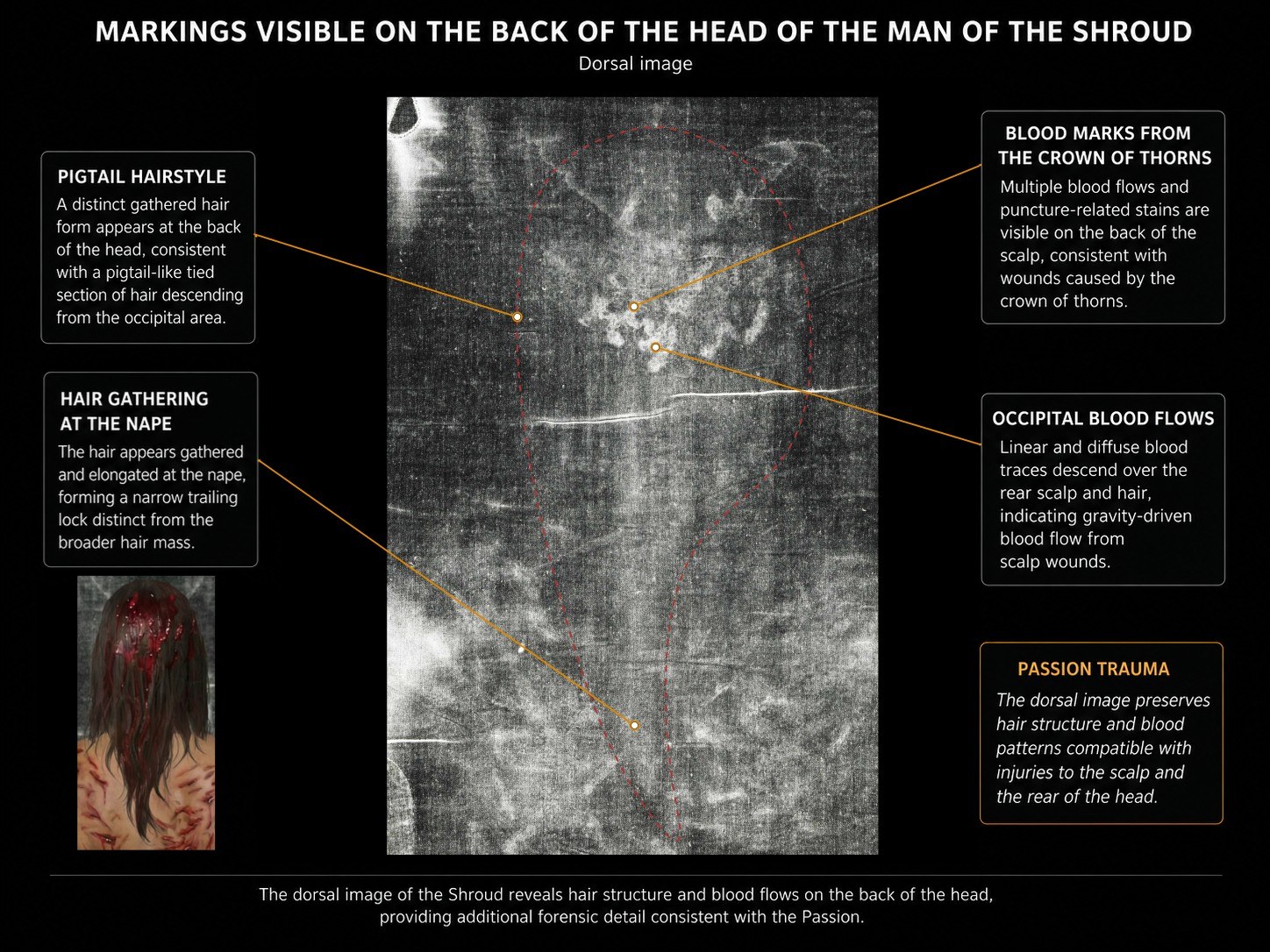
The dorsal image also shows the upper back and the shoulders in some detail, and the marks there are the most frequently studied. Their characteristic shape, with a pair of small oval impressions and a connecting line, is most clearly seen in high-contrast images. Some marks overlap, and in those places the separate impressions merge into a single larger shape. The overlap makes counting difficult, and it is one reason the counts differ between studies.
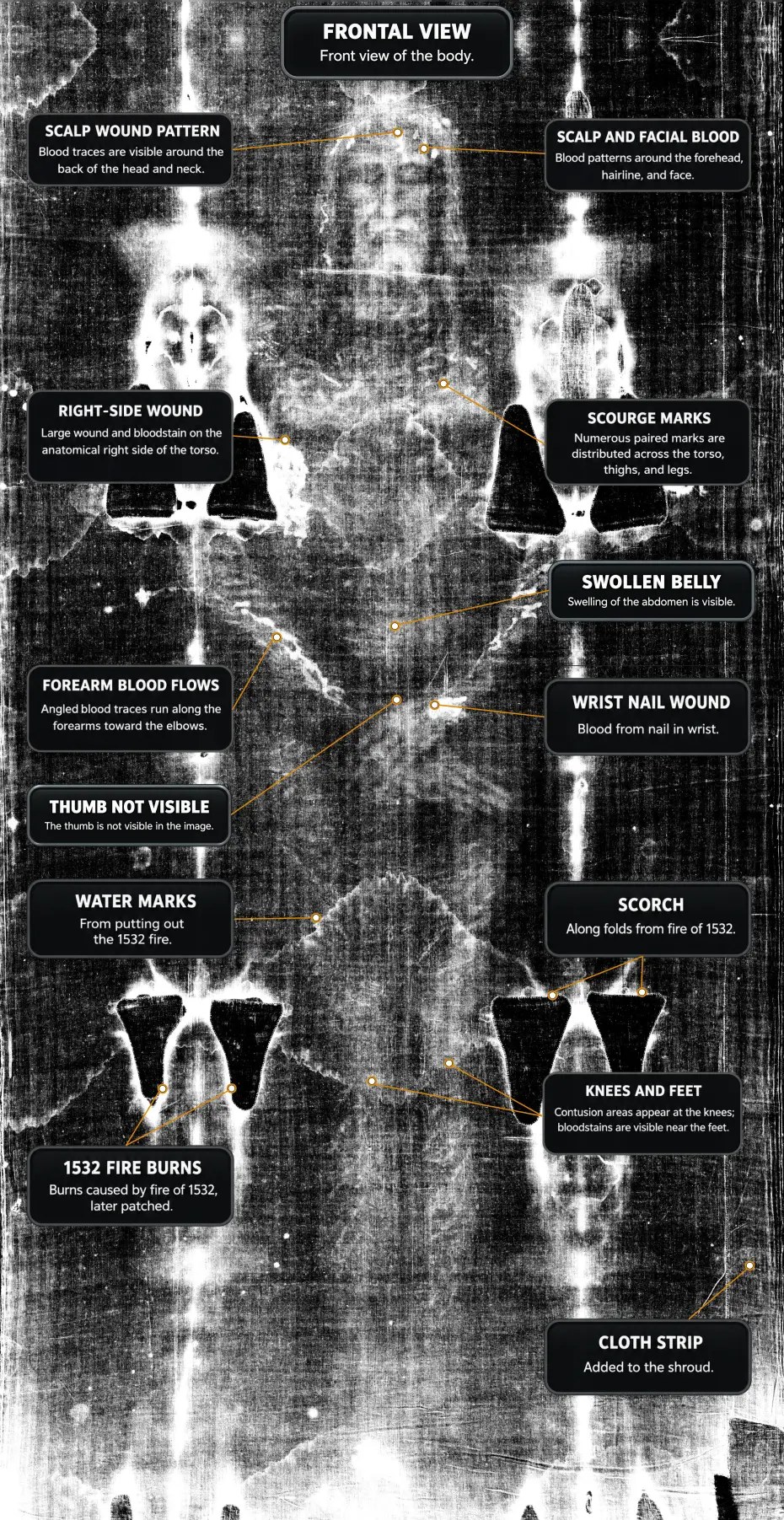
The scourge marks on the front
The frontal image shows marks on the chest, the abdomen, the thighs, and the shins. The frontal marks are generally fainter than the dorsal marks, and they are harder to separate from the surrounding stains. The explanation most often given is that the front of the body was less directly struck, because the scourger stood behind the victim and struck the back. Some marks on the front, especially on the thighs and the lower legs, are read as the result of the whip wrapping around the body, which would have reached the front from the sides and the back.
Two scourgers, or one?
A recurring question is whether the flogging was carried out by one soldier or by two. The argument for two rests on the bilateral distribution of the marks on the back and on the legs. If the scourger had stood at one side only, the marks would be expected to fall mainly on one side of the body, with the other side less affected. The Shroud marks are spread on both sides, which has been read as the result of two scourgers working from opposite positions, or of one scourger moving between two positions during the flogging.
The argument for one is that a single scourger, moving around the victim, could produce a similar distribution. The Roman practice did not, so far as the sources show, fix the number of executioners, and a flogging by a single soldier, who changed position as needed, is a plausible scenario. The distribution alone cannot decide between the two scenarios. The question is genuinely open, and the series does not claim to settle it.
The legs and the feet
The marks on the legs are fewer and lighter than the marks on the back. Some are on the thighs and the calves, and a few are on the shins. The feet show no clear scourge marks in the published images. The marks of the nails in the feet belong to the crucifixion, and they are discussed in Chapter 12. The pattern on the legs has been read as evidence that the lower body was struck less severely, or that the victim’s position limited the reach of the thongs. Both readings are consistent with the Roman practice of concentrating the blows on the back and the buttocks, and both are inferences from the image.
Common errors in popular accounts
Popular accounts of the flogging often make three errors, and it is worth naming them. The first is to treat the count as exact. The marks are not a set of discrete, countable objects in every case, and the total depends on criteria that differ between researchers. The second is to attribute every mark to a separate blow. A single blow may leave several marks, and several blows may overlap to form one. The third is to treat the instrument as known. The flagrum is documented in the literature, but no single reconstruction of it is certain, and the choice of weights and thongs in any model is an assumption.
A fourth error is common in devotional writing. It treats the flogging as the most important part of the Passion, or as the source of all subsequent suffering. The Gospels do not make that claim, and the forensic literature, which emphasises the flogging, is itself a particular reading. The reader who wants to understand the Passion should keep the flogging in proportion to the account as a whole.
The record in art
The flogging has been a subject of Christian art since the medieval period, and the depictions show a range of forms. Some show a bound figure at a column, with a scourger on each side. Others show a single scourger and a crowd. The depictions differ in their treatment of the body and of the marks, and most do not show the detailed distribution of the Shroud. They are useful for understanding the devotional imagination of the period, and they are not evidence about the actual flogging.
The comparison with the Shroud is instructive. The medieval depictions tend to show a clean, idealised body with a few wounds, while the Shroud shows a body covered in many small marks. The difference suggests that the Shroud’s wound pattern is not the product of the iconographic conventions of the period, and it has been used in that argument. The point is contested, and the reader should judge it on the evidence of the depictions themselves.
What the flogging contributes to the series
The flogging matters to the series for three reasons. It is the first point at which the cloth records a violent event, and it sets the physical condition of the body for the crucifixion. It is also the point at which the forensic readings are most detailed, and at which the forensic claims are most open to testing. And it is the place where the question of the instrument, the count, and the distribution can be examined without relying on the more contested readings of the face or the chemistry of the image.
A reader who wants to test the claims should start with the distribution, the counts, and the instrument, and should compare the forensic readings with the medical literature on flogging. The relation between the marks and the Gospel account is a second test, and it is a test that the marks alone cannot pass or fail.
The methods used to read the marks
The marks have been studied with several methods, and each method shows something different. Visible-light photography gives the overall shape and the position of the marks, and it is the basis of most counts. Ultraviolet fluorescence, used by the STURP team in 1978, separates the blood-related areas from the linen and the image pigment, and it shows marks that are faint in ordinary light.10 Image enhancement, applied to the high-resolution photographs, increases the contrast of the faint marks and makes the overlapping ones easier to separate. Each method has limits. Enhancement can create edges that are not in the cloth, and fluorescence can be affected by the age and condition of the linen.
The sticky-tape sampling of 1978 provides a different kind of evidence. The tape was pressed onto areas of the cloth, and the fibres and the material on it were then examined under the microscope and by chemical tests. The samples from the scourge areas were reported to contain material with the properties of blood, and the team reported serum separation and fibrin-like material in some of them.10 The chemistry is central to the claim that the marks are blood, and it has been disputed. A reader who wants to weigh the claim should read the original reports, and should ask whether the reported tests distinguish blood from other materials with the same colour.
The marks and the Gospel sequence
The Gospel sequence puts the flogging before the mockery, the crown, and the procession. On the cloth, the marks of the flogging and the marks of the crown are both visible, and the question is whether their relation can be read in time. The forensic literature generally holds that the flogging preceded the crown, and that the crown wounds were inflicted on a body that was already bleeding from the scourge. The argument is that blood from the crown would have run into the scourge marks in some places and not in others. Those patterns have been read as evidence of the order of events, and they are discussed in Chapter 10.
The sequence also matters for the blood. A body that has been flogged and then crowned would show different flow patterns from a body crowned first. The forensic readings draw on the flow patterns of the blood on the face and the hair, and on the relation between those patterns and the marks of the back. The reader should note that the flow patterns are read from a photograph and a model, and that a different body position would give a different reading.
The flogging in the Roman setting
The flogging of a condemned man was part of the routine of Roman provincial government. The governor had authority over the penalties applied in his province, and his soldiers carried out the punishment. The victim was usually stripped, tied to a post or a column, and struck until the officer in charge judged that the punishment had been completed. The Roman sources record the custom and its severity, but they seldom describe a particular flogging in detail. The scene in the Gospels has to be read against this general background, and the background is what makes the cloth’s record intelligible.6
The soldiers who carried out the flogging were not specialists in the modern sense, but they were trained in the use of the instrument and in the discipline of the punishment. Their task was to inflict pain and to weaken the victim without necessarily killing him, so that he could be taken to the cross. Their behaviour in the Gospel account, which includes the mockery that follows, is consistent with the atmosphere of the military guard in a provincial garrison, and it is not a sign of unusual cruelty in the context of the period.
What a careful reader can check
A careful reader can check several things about the flogging without relying on any single claim. The first is the count. The published counts can be compared, and the differences between them can be traced to the photographs and criteria used. The second is the distribution. The marks can be mapped, and the mapping can be compared with the distribution predicted by different scourging positions. The third is the instrument. The reconstructions of the flagrum can be compared, and their predictions can be tested against the marks. The fourth is the chemistry. The original reports can be read, and the tests they describe can be assessed for their specificity.
None of these checks is decisive by itself. Together, they show which parts of the forensic reading are supported by the image and which are supported only by the interpretation. A reader who finishes the checks will be better placed to judge the claim, whatever their starting view of the cloth.
What comes next
The flogging is followed in the Gospel account by the mockery and the crown of thorns, which are the subject of the next chapter. The crown is a separate injury, with its own marks and its own interpretation, and it has been read as the record of a particular act of mockery. The series takes it up in that context.
References
- John 19:1; Matthew 27:26; Mark 15:15; Luke 23:16, 22. John 19:1; Matthew 27:26; Mark 15:15.
- Edwards, W. D., Gabel, W. J., & Hosmer, F. E. (1986). On the physical death of Jesus Christ. JAMA, 255(11), 1455–1463. PubMed 3512867.
- Philo of Alexandria, In Flaccum. Translations are widely available. Publication details to be confirmed before publication.
- Archaeological and iconographic evidence for the flagrum, as summarised in the forensic and historical literature on Roman scourging. Specific specimens and publication details to be confirmed before publication.
- Lipsius, J. (sixteenth century). Scholarly usage of the term flagrum taxillatum. See the forensic literature on the Shroud, which notes that the term is not Roman.
- Roman practice of scourging and the absence of a fixed limit, as discussed in the medical and historical literature on crucifixion. See Edwards et al. (1986), above.
- Deuteronomy 25:3; Mishnah, Makkot 3:10; 2 Corinthians 11:24. Deuteronomy 25:3.
- Herod’s Palace and the praetorium, as discussed in archaeological and biblical scholarship. Publication details to be confirmed before publication.
- Distribution of the marks and the areas free of marks. Discussed in the forensic literature on the cloth. Publication details to be confirmed before publication.
- Sticky-tape samples and the 1978 STURP examination of the scourge marks. See Schwalbe, L. A., & Rogers, R. N. (1982). Analytica Chimica Acta, 135, 3–49.
- Earlier counts of the scourge marks. See the forensic literature on the cloth, and the discussion in the image book, Part V.
- Fanti, G., et al. (2024–2025). Scourge marks study. The exact title, year and DOI could not be verified; the DOI previously recorded for this entry (10.51219/MCCRJ/Giulio-Fanti/417) did not match any listing found. To be confirmed against the original before publication.
- Barbet, P. (1953). A Doctor at Calvary. Translated by the Earl of Wicklow. New York: P. J. Kenedy. First published in French in 1950 as La Passion de N.-S. Jésus Christ selon le Chirurgien. Catalogue dates for the English edition vary between 1953 and 1954; to be confirmed.
- Sava, A. F. (1957). The wound in the side of Christ. Catholic Biblical Quarterly, 19(3), 343–346. Not located in the checks made for this series; verify before publication.