The Shroud of Turin · Chapter 6 of 21
When distance became data: the three-dimensional encoding
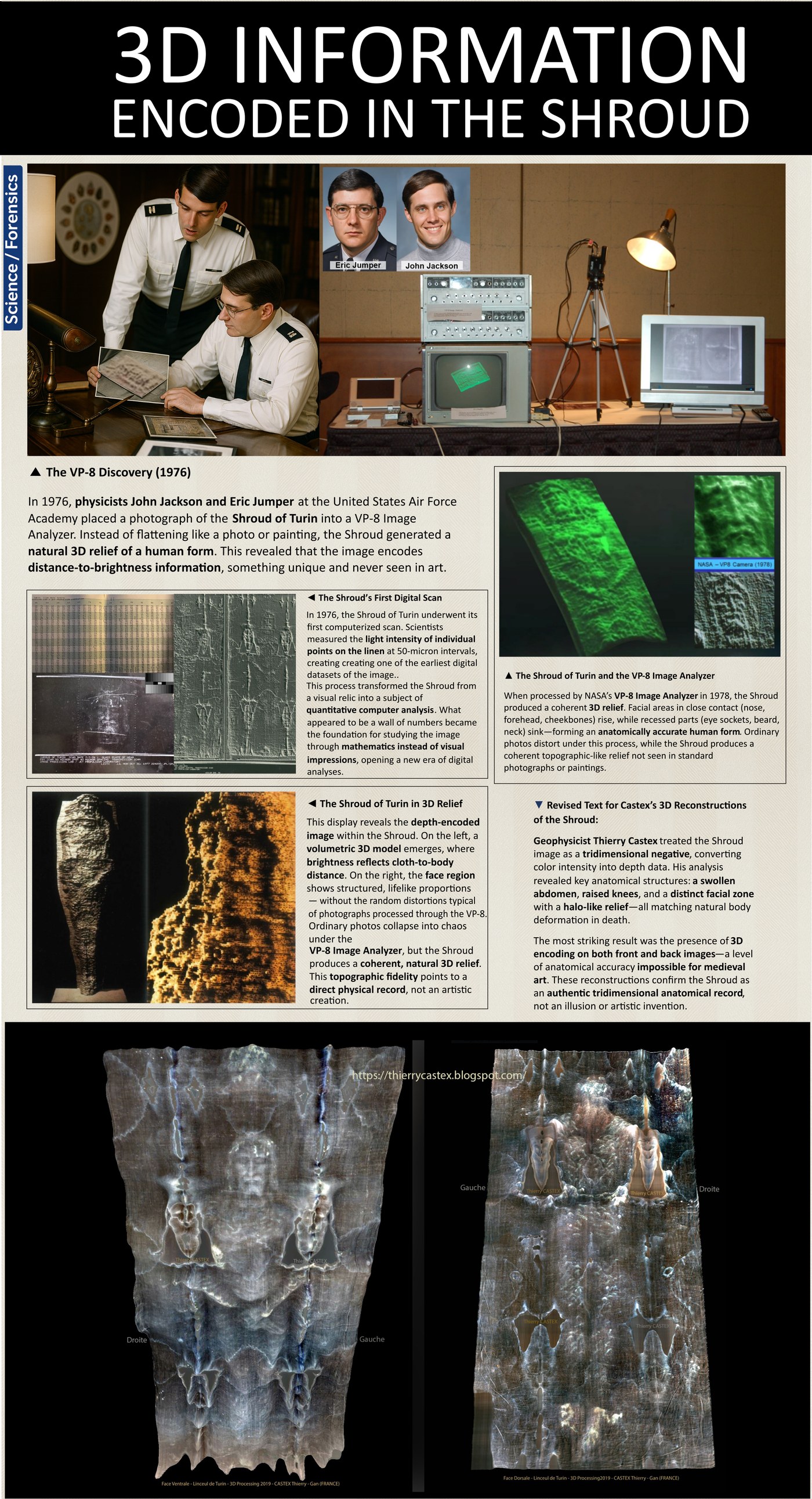
A photograph records how much light reaches the film from each part of a scene. Its brightness reflects the lighting, the angle of the camera, and the colour of the surfaces, as well as the shape of the subject. On the Shroud the brightness of the image appears to track something different: how far each point of the cloth lay from the body beneath it. When that relationship is read as data, a three-dimensional relief of the figure emerges. That is the claim of the three-dimensional encoding, and it has been among the most discussed claims about the cloth since the 1970s.
This chapter explains how the relationship was found, what the analysis showed, how it has been checked and challenged since, and where the claims stand. The subject is technical, and it has been argued in the scientific literature with considerable care. The key numbers come from a small number of publications, and they should be read in full rather than repeated from summaries.1
Why a photograph is not a height map
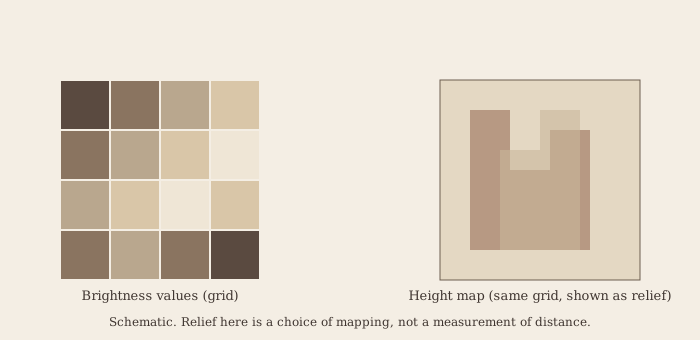
An ordinary photograph stores brightness, and brightness depends on lighting. The nose of a portrait is bright because light strikes it directly, the eye sockets are dark because they are recessed and shadowed, and the cheekbones catch the light at the angle of the lamp. The pattern of bright and dark therefore reflects lighting conditions as much as the shape of the face. A machine that reads brightness as height will faithfully reproduce the lighting as a landscape, and the result is a distorted and meaningless relief.
A painting is further removed from geometry. The shadows and highlights of a painted portrait are placed by an artist to suggest volume to the human eye, and the artist’s choices follow aesthetic and conventional aims rather than a rule of distance. The same is true of a drawing or a print. None of these media are designed to encode the distance between a surface and a body. That is why the appearance of depth in a photograph or painting does not, by itself, show that the image encodes geometry.2
The first machine analysis, 1976
In February 1976, the physicist John Jackson and the Air Force officer Eric Jumper took photographs of the Shroud to a VP-8 Image Analyzer, a machine developed for processing aerial and satellite imagery. The VP-8 converts brightness into a height map. Given an ordinary photograph of a face, it produces chaos. Given the Shroud, it produced a coherent human face, with the nose in relief and the eye sockets receding. The operator, Pete Schumacher, later wrote that the results were unlike anything he had processed before or since.3
The VP-8 result was qualitative. It showed that the image behaves as though it encodes distance. It did not measure the relationship, and the next step was to ask whether the relationship could be quantified. That step was taken by Jackson, who selected anatomical locations on the face, measured the optical density of the photographic image at each, and compared the densities with the distance from each point to the body, calculated from a model of draped linen.1
The correlation of 1976 and 1977
Jackson’s early analysis used thirteen anatomical points on the facial region of a high-quality transparency. The points were chosen because they could be identified in two domains: the photograph and a theoretical model of a face draped with linen. A high-precision microdensitometer measured the transmittance of the transparency at each point. The distance from the cloth to the body at each point was calculated from the model. The question was whether the two sets of numbers were related.
If the image were a painting, the two sets of numbers would be unrelated, because an artist’s brushwork follows aesthetic choice rather than geometry. If the image were a contact stain, a relationship would be expected, but it would follow the mathematics of contact pressure rather than of standoff distance. The result was a correlation, expressed as a coefficient of determination of about 0.60. That means that roughly sixty per cent of the variation in image density across those points could be accounted for by the distance from the body. The relationship held in the direction expected if darker regions were closer to the body and lighter regions farther away. The nose tip, the closest feature to the cloth, was the darkest measured point, and the eye sockets were among the lightest.1
The early result was presented at a conference in 1977. Jackson, Jumper, Mottern, and Stevenson described the three-dimensional image and the VP-8 demonstration, and they published the first version of the analysis.4 The 1977 paper is available online, and it is worth reading in full, since it sets out both the claim and the reasoning behind it.
The definitive study of 1984
The fuller analysis was published in 1984 by Jackson, Jumper, and William Ercoline, in Applied Optics.1 The study advanced on the preliminary work in three ways. First, the team built three-dimensional reliefs of a human body in the posture implied by the image, and photographed linen draped over them under controlled conditions. This gave empirical distances, rather than the idealised geometric approximations of the earlier work. Second, the analysis was extended to a larger set of anatomical regions across the frontal image. Third, the team tested whether a single mathematical function, applied uniformly, could describe the relationship between density and distance, or whether different regions needed different functions. The analysis supported a global relationship, in which one functional form gave a reasonable account of the density across the body.
The paper is explicit about its limits. The strongest numerical result came from the small facial sample, which the authors described as preliminary. The distances were computed from a reference model rather than measured from the cloth, and the approximation of the global mapping was acknowledged. The dorsal image was not subjected to the same analysis. The authors also stated that no single mechanism, including radiation, vapour, direct contact, or artistic technique, accounted for the full set of observations. Their conclusion was that the three-dimensional encoding is a necessary condition for any formation hypothesis, not a sufficient one.1
An independent check: Tamburelli, 1981
The three-dimensional character of the image was independently examined by Giovanni Tamburelli, an Italian computer scientist working at the Centro Studi e Laboratori Telecomunicazioni in Turin. He had no institutional connection to the STURP team. Tamburelli applied digital image-processing algorithms to the 1931 photographs of Enrie, rather than to the 1978 material. His method was numerical rather than analog. He suppressed noise, smoothed the image, and extracted a relief representation of the facial region. The result was a coherent three-dimensional relief with recognisable anatomical features.5
Tamburelli’s work matters for a specific reason. It used different source photographs, a different computational approach, and a different researcher. It therefore showed that the three-dimensional property was not an artefact of the VP-8’s transfer function, or of the STURP team’s own instruments. Its limitation is that it remained qualitative. It showed that a relief-like processing produces coherent results, but it did not attempt the correlation analysis that Jackson, Jumper, and Ercoline published three years later. Tamburelli also produced versions of the face with the small wound marks suppressed, which showed the underlying features more clearly. That processing choice is itself an interpretation, and it should be recorded as one.
What the density measures
The density of the image is the amount of light that passes through or is reflected from the cloth at a point, after the cloth has been photographed. It is a property of the photographic record. The density is then related to the physical properties of the linen, including the number of coloured fibrils and the depth of their colour. The relationship between density and distance is therefore an inference about the physical process that coloured the cloth, and it passes through several steps of measurement and calculation.
The chain of inference has several links. The photograph must represent the cloth faithfully. The density must be measured in a linear way. The relationship between density and the physical colouring must be known. The distance must be calculated from a model of the body and the cloth. And the model must be a fair representation of the body whose distance is being estimated. Each link can introduce error, and each has been discussed in the literature. The result is strongest when all the links are well established, and weakest where one of them rests on an assumption.
Checking the claim: the challenges
Several objections have been raised, and each deserves a direct statement.
The lighting objection. A photograph of a relief can also produce a distance-like pattern, because lighting and shape are linked. A light falling across a face produces shadows that depend on the shape of the face. Tests of this kind help to separate the two effects, and the question is whether the Shroud’s pattern is more consistent with distance than with lighting. The published analysis claims that it is, but the tests need to be repeated with modern equipment.2
The bas-relief objection. The skeptical investigator Joe Nickell showed in 1983 that cloth rubbed or pressed against a sculpted bas-relief can take on tonal gradients that the VP-8 renders as a face in relief.6 Critics of the authenticity claim have used this result to argue that the three-dimensional encoding is a property of contact, not of distance. The defenders reply that a rubbing or pressing against a relief records pressure and contact, and not standoff distance. The image continues to carry information in areas where the cloth did not touch the body, such as the hollows of the eyes and the space beneath the nose, and a relief cannot produce a gradient from a region it never touched.
The draping objection. The image shows distortions at the hands and the calves that correspond to a cloth draped over a three-dimensional body. Those distortions have been read as evidence of draping. In 2025 Cicero Moraes used open-source body models and fabric simulation to compare a full body with a low-relief model, and he reported that the low-relief model gave a contact pattern closer to the image.7 Casabianca, Marinelli, and Piana responded that the study modelled only the frontal image, treated contact as the only possible mechanism, and did not address the chemistry of the image. Moraes replied that his scope was deliberately limited to contact geometry.8
The collapse model. Jackson and Jumper proposed that the body departed in a way that left the linen unsupported, so that the cloth collapsed into the space the body had occupied. A collapsing cloth should show lateral distortion at the sides of the figure, because the flanks of the cloth would move inward toward the body’s axis. The image shows little lateral distortion. Jackson and Jumper explained this by a projection model, in which the image forming radiation travelled vertically and suppressed lateral effects. Critics have noted that the two models support each other, and that the lateral prediction has not been tested independently. The circularity is a genuine concern, and it is a gap in the geometric argument.1
The fibre-level objection. The three-dimensional encoding depends on the density of the image at the scale of the photograph. At the scale of the fibres, the colouring is extremely shallow, and the density reflects how many fibrils are coloured in an area, rather than how intensely each is coloured. That point has been used to argue that the encoding is a halftone-like phenomenon, and that the process forming the image switched individual fibrils on or off at a threshold. The model is attractive, but it is a model. It is not a measurement of each fibril, and it has not been independently confirmed at full scale.9
Later analyses: the principal component result
In 2025 Thomas McAvoy published a principal component analysis of the 2002 Durante photograph, the highest-resolution full-image photograph in common use. He found that about 98 per cent of the information in the visible-light image is captured by the first principal component, and that this component is almost perfectly anticorrelated with the pixel intensity of the negative. The three colour channels of the photograph reduce, for practical purposes, to a single variable. McAvoy applied the same analysis to ultraviolet fluorescence photographs from 1978, with a similar result.10
The analysis is not a direct replication of the Jackson and Jumper correlation. It is a different statistical operation, carried out on a different photograph. It is nevertheless consistent with the earlier result. An image whose information can be reduced to one intensity variable is consistent with an image that encodes one scalar quantity, such as distance. The result constrains what the image is encoding, without identifying the mechanism.
Digital height conversion and the Castex montage
Thierry Castex, a French researcher whose professional background is in seismic processing, has produced three-dimensional renderings of the image using filtering, equalisation, and height conversion. His workflow, as described by the research centre CIELT, separates the colour channels, suppresses the periodic pattern of the weave, and converts the processed amplitudes into calculated heights. His renderings show a relief that resembles the figure, with particular features highlighted.11
Renderings of this kind are useful for showing structure. They are also model outputs. Each filter and each height conversion changes the signal, and a feature that appears only with one choice of settings is not a robust anatomical feature. A quantitative claim should start from raw or minimally processed data, and it should test whether the feature survives a range of reasonable processing choices.
What the encoding does and does not establish
The encoding establishes several things with reasonable confidence. The image has a tonal structure that is statistically related to a model of cloth-to-body distance, and the relationship has been reproduced by several analysts using different methods. The image contains geometric distortions consistent with a cloth laid over a body, though the interpretation of those distortions is contested. And the image’s information is concentrated in a single intensity variable, which is consistent with a scalar encoding.
The encoding does not establish the mechanism. It does not show that the distance was the physical cause of the image, or that the image was formed by radiation, vapour, contact, or any other process. It does not establish the absolute size of the relief, because the distance values depend on the model. It does not decide between a body and a relief, and the contest between those readings is ongoing. And it does not date the cloth or identify the man.
The instrument and its transfer function
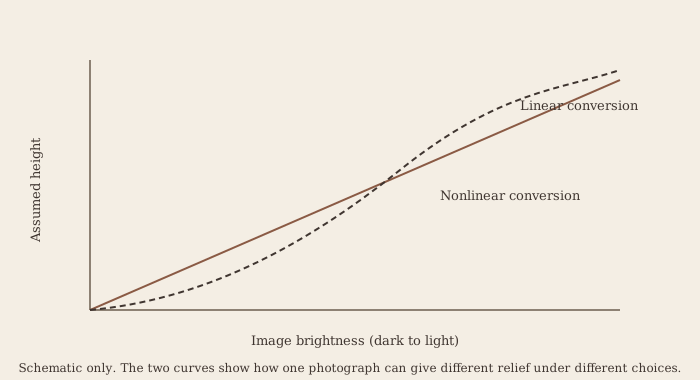
The VP-8 Image Analyzer was developed by Interpretation Systems, Inc., a company that worked with the aerospace and imaging communities, and it was designed to convert the grey levels of an image into a height map that could be displayed on a screen and rotated for viewing. Its output is a function of its own internal transfer curve, which maps brightness to elevation according to a fixed rule. That rule is part of the instrument, and it shapes every result the machine produces.3
The transfer function is important for two reasons. First, it means that the VP-8 does not measure distance directly. It applies a rule that treats brightness as height, and the result is a visualisation of the brightness, not of the body. Second, it means that a different rule would produce a different surface. The fact that the VP-8 produced a coherent face from the Shroud, and chaos from an ordinary photograph, is therefore a fact about the image relative to that rule. It is a strong fact, because the rule is the same in both cases. But the rule is not a physical law, and it cannot by itself demonstrate that the brightness corresponds to distance.
Tamburelli’s independent digital processing, discussed above, is one way of checking the VP-8 result. Another is the comparison with later analyses that use different transfer functions. The consistency across those analyses is the strongest argument that the relief is a property of the image, and not of the particular machine. That consistency is one of the reasons the three-dimensional encoding is taken seriously by researchers who disagree about its meaning.
The VP-8 was also used at the Jet Propulsion Laboratory on photographs of the cloth, and the results were reported in the same period. The JPL work and the Interpretation Systems work were carried out in different settings, and both produced coherent reliefs of the face. The independence of the two settings adds some weight, although both used analogue or semi-analogue methods of the 1970s, and neither used the full-resolution digital photographs of later decades.
The dorsal image
Most of the early analysis concerned the frontal image, because the face is the most legible part of the cloth. The dorsal image, which shows the back of the figure, was less fully analysed in the early work, and the 1984 paper states that it was not subjected to the same procedure. That is a significant gap, because the dorsal image carries much of the forensic information, including the scourge marks, the blood flows on the back of the head, and the marks on the shoulders and legs.
The dorsal image also raises a question about the physical relation between the cloth and the body. The frontal and dorsal images are not simply mirror copies of each other. They differ in intensity, in the distribution of the stains, and in the visibility of some features. Some researchers have argued that the difference reflects the different contact of the cloth with the body on the front and the back, while others have argued that it reflects differences in the processing of the two halves of the cloth, or in the way the cloth was folded after the event. The question is open, and it bears on the body model used in any reconstruction.
The 1977 analysis compared the two images in a preliminary way, and it found that the dorsal image shows an intensity pattern broadly similar to the frontal one. A full quantitative comparison, with the same body model and the same statistical treatment, has not been published in the form that would settle the question. The chapter on the frontal and dorsal compatibility, which follows, discusses the length of the two images and what it implies.
Frontal and dorsal lengths and the stature
A simple geometric check on the encoding is the length of the figure. The frontal image measures about 1.95 metres, and the dorsal image about 2.02 metres, according to the measurements reported in the literature. The two lengths cannot be read directly as the height of a person, because the cloth is not a rigid shell, and because the head, the knees, and the feet are positioned differently in the two images. A model is needed to relate the lengths to a body.
Fanti, Basso, and Bianchini modelled the two images using a computerised articulated manikin. They fitted selected landmarks from both images to the manikin, allowed for forward flexion of the head, partial bending of the knees, extension of the feet, and the effects of cloth wrapping. Under those assumptions the two images were mutually compatible with a body about 175 centimetres tall, with a margin of about two centimetres.12 The Jackson and Jumper model gives a figure of about 178 to 180 centimetres. The two results are close, but they rest on different assumptions, and the difference is methodologically important. The image supports a broadly consistent adult stature. It does not support a measurement precise to one or two centimetres independently of the assumptions about posture, landmarks, and cloth geometry.
The stature question has a bearing on the archaeology of the period. A man of about 175 centimetres would be tall for a first-century Jewish man, if the average height of the period is taken from the skeletal record, but not impossibly so. The archaeological height estimates from the period carry their own uncertainties, and the figure of the Shroud falls within the range that the anthropometric literature reports for the period. The stature therefore does not exclude the period, and it does not confirm it.
The gap-image problem
A problem raised by Jackson in 1990 concerns the regions of the image that a relief could not have touched.13 The bas-relief objection is strongest in areas where the cloth lay on the raised parts of the relief. The Shroud carries image in areas where the cloth would not have touched a sculpted surface at all: the hollows of the eye sockets, the space beneath the arch of the nose, and some regions between the brow and the cheek. A relief produces contact and pressure. It does not produce image in regions where no contact occurred.
The argument has been answered in several ways. Some critics argue that the image in the hollows is faint, and that it may be an artefact of the processing, or of the way the cloth collapsed in the hollows. Others argue that a relief with a carefully shaped surface could produce some image in the hollows through diffusion or through shadowing of the transfer. The answers are not decisive, and the gap-image problem remains one of the more serious challenges to the bas-relief explanation.
The gap-image problem has been stated since 1990, and it has not been fully resolved by subsequent analysis. Any test of the distance hypothesis that aims to be decisive has to include the hollows, and has to show how the image behaves there under controlled conditions. That requirement is one of the clearest specifications for a future experiment.
Fibre-level encoding and the halftone model
The three-dimensional encoding depends on the density of the image at the scale of the photograph, but the colouring of the linen is extremely shallow, and it lies on the outer surface of the fibres. At that scale the density of the image reflects how many fibrils are coloured in an area, rather than the intensity of colouring on each fibril. That point has been used to argue for a halftone model, in which the continuous tones of the image are built from a pattern of coloured and uncoloured fibrils, much as a printed photograph builds grey from black dots.16
The halftone model is attractive, because it accounts for the continuous tones without requiring each fibril to be coloured to a different degree. It also raises a question about the threshold. If each fibril is either coloured or not, something must determine the threshold, and the threshold must vary with the distance from the body. That is a demanding requirement, and it is one reason the model has been discussed as a constraint rather than as a settled mechanism. The model is a hypothesis about the surface, and its implications for the process of formation are part of the debate discussed in Chapter 20.
Holographic and later reconstructions
In the 2000s, the Dutch physician Petrus Soons used enhanced digital versions of Enrie’s 1931 photographs to produce depth data, and he reported holographic reconstructions of the face. The reconstructions show more detail than the VP-8 output, and they illustrate the potential of modern enhancement. They are also interpretations of processed images, and their results depend on the enhancement methods and the choices made in the processing. They should be read as visual records of a processing method, not as independent measurements of the cloth.
Later reconstructions, including the AI-assisted work discussed in Chapter 7, go further, adding detail that the photographs do not show. Such work has to be separated clearly from the measured relief. The measured relief is the result of a relationship between the image and a model. The added detail is the product of an artist or an algorithm, and it cannot be treated as evidence about the cloth.
What the encoding means for the forgery question
The three-dimensional encoding is one of the most important constraints in the forgery debate. A medieval maker who wished to produce a convincing figure would not need to encode distance in the way the image appears to do. A painter could produce a figure that looks three-dimensional to the eye without any relation to distance. The encoding is therefore a constraint that a forger would have to meet only if the forger aimed at that particular property, and the question is whether any medieval technique could have produced the encoding by accident.
The question is not whether a medieval person could have understood the encoding. A maker could reproduce a property without knowing its cause, by copying a model or a relief, or by using a process whose effects were not understood. The relevant question is whether any known process produces the full combination of properties, including the relation to distance, the superficiality, and the absence of pigment. No such process is known, and the encoding is one of the reasons the forgery question remains open rather than settled. Chapter 21 takes up the forgery question in full.
Testing the encoding: an agenda
Several tests would clarify the three-dimensional question, and the requirements are now well defined. A complete replication across the frontal and dorsal images, using modern body models and the high-resolution photographs, would show whether the relation to distance holds across the whole cloth. A blinded test of the lighting objection, using controlled photographs of reliefs, bodies, and flat surfaces with known shading, would show how well the distance pattern can be separated from the effects of illumination. A test of the lateral prediction would address the collapse model, and the hollows would need to be included in any decisive experiment.
A further test would examine the processing choices. Several height conversions applied to the same raw data would show which features are robust, and which depend on the choice of transfer function. A feature that persists across many reasonable conversions is more likely to be a property of the image. A feature that appears only with one conversion should be treated with caution. These tests are not difficult in principle, and they are a clear agenda for the next stage of the work.
Summary
The three-dimensional encoding is a well-measured property of the Shroud image. Its relation to the distance between the cloth and the body has been reported by several researchers, using different instruments and different methods, and the reports are broadly consistent. The relationship is not, however, a settled explanation of the image. Its interpretation depends on models, processing choices, and assumptions about the body, and some of its features, such as the hollows and the dorsal image, are not yet fully explained. The encoding is therefore one of the constraints that any account of the image has to satisfy, and it remains one of the most interesting open problems in the study of the cloth.
How the claim was received
The reception of the three-dimensional encoding has changed over the decades. In the late 1970s the VP-8 result was widely reported as a striking confirmation of the image’s anomalous character, and it was used to argue that the cloth could not have been a painting. The more careful scientific literature was more cautious, and it emphasised that the result was a visualisation, not a measurement. The 1984 paper was written in that cautious register, and its authors acknowledged the limits of their data.
In the following decades the claim was tested by critics, by replicators, and by researchers who used it in different arguments. The critics pressed the lighting and bas-relief objections. The replicators examined the processing choices and the digital data. The researchers who used the claim in arguments about authenticity sometimes drew stronger conclusions than the data supported, and those conclusions were in turn criticised. The debate is not a simple progression toward a settled answer. It has produced a more precise statement of what is measured and what is inferred, and that precision is the most useful result of the forty years of work.
The reader who meets the claim today will find it presented in many forms, from technical papers to popular articles and online renderings. The form matters. A technical paper states its method and its limits. A popular article may state the conclusion without the method. A rendering may show the relief without the processing that produced it. The reader should look for the method, and should ask whether the claim survives when the processing is changed.
A methodological checklist
The following questions are a useful guide when assessing any claim about the three-dimensional encoding. What is the source image, and what is its provenance? Was the image processed, and if so, how? Was the brightness converted to height by a fixed transfer function, and what was the function? Were the distances measured from the cloth or calculated from a model? Which body model was used, and how were its proportions chosen? Were the regions analysed chosen before or after the result was known? Were the results replicated with a different transfer function, a different body model, or a different photograph? And does the claim hold for the dorsal image as well as the frontal?
A claim that answers these questions clearly, and that survives the answers, is a strong claim. A claim that cannot answer them, or that depends on one choice of processing, is a weak claim, however striking its illustrations. The checklist applies equally to the claims made in favour of the cloth and to those made against it, and the series applies it throughout.
The relation to the radiocarbon date
The three-dimensional encoding and the radiocarbon date are separate kinds of evidence. The encoding is a property of the image on the linen, and it tells us about the process that formed the image. The radiocarbon date is a measurement of the carbon in a sample of the linen, and it tells us about the age of the sampled material. A medieval date for the linen would not, by itself, explain the encoding, and an ancient date would not explain it either. The two questions have to be answered separately, and the answers combined only in a second stage of argument.
Some writers have argued that the encoding makes a medieval origin implausible, because a medieval maker would not have understood the physics of distance. Others have argued that the encoding is consistent with a medieval origin, because a painter could produce the appearance of relief without any knowledge of its cause. Both arguments depend on what the maker knew, and the question of knowledge is one that the physical evidence cannot settle directly. The series returns to that question in Chapter 21.
What remains to be done
Several studies would clarify the three-dimensional question. A full replication of the Jackson and Jumper analysis across the frontal and dorsal images, using modern body models and the high-resolution photographs, has not been published. A blinded test of the lighting objection, using controlled photographs of reliefs and bodies, would show how well the distance pattern can be separated from lighting. A test of the lateral prediction, using a cloth draped over a body and then collapsed, would address the circularity in the collapse model. And an independent processing study, applying several height conversions to the same raw data, would show which features are robust.
Each study has been technically achievable for some years. Until they are carried out, the three-dimensional encoding remains one of the best-measured properties of the image, and one of the least settled in its interpretation. The chapters on digital reconstruction and on image formation take up the consequences of that position.
References
- Jackson, J. P., Jumper, E. J., & Ercoline, W. R. (1984). Correlation of image intensity on the Turin Shroud with the 3-D structure of a human body shape. Applied Optics, 23(14), 2244–2270. doi:10.1364/AO.23.002244
- The lighting and photographic objections to the distance analysis, as discussed in the image book, Part V, and in the critical literature on the VP-8 work. Publication details to be confirmed before publication.
- Schumacher, P. (n.d.). Photogrammetric responses from the Shroud of Turin. VP-8 technical report. Publication details to be confirmed before publication.
- Jackson, J. P., Jumper, E. J., Mottern, R. W., & Stevenson, K. E. (1977). The three-dimensional image on Jesus’ burial cloth. In K. E. Stevenson (Ed.), Proceedings of the 1977 United States Conference of Research on the Shroud of Turin (pp. 74–94). Holy Shroud Guild. shroud.com/pdfs/jackson.pdf
- Tamburelli, G. (1981). Some results in the processing of the Holy Shroud of Turin. IEEE Transactions on Pattern Analysis and Machine Intelligence, PAMI-3(6), 670–676. doi:10.1109/TPAMI.1981.4767157
- Nickell, J. (1983). Inquest on the Shroud of Turin. Buffalo: Prometheus Books.
- Moraes, C. (2025/2026). Image formation on the Holy Shroud: a digital 3D approach. Archaeometry, 68(1), 84–93. doi:10.1111/arcm.70030
- Casabianca, T., Marinelli, E., & Piana, A. (2026). Commentary on the article ‘Image Formation on the Holy Shroud—A Digital 3D Approach’ by Cicero Moraes. Archaeometry. doi:10.1111/arcm.70109 Moraes’s reply: doi:10.1111/arcm.70112
- Fanti, G., & Basso, R. (2008). Body image formation hypotheses based on corona discharge. Presented at the 3rd Dallas International Conference. Publication details to be confirmed.
- McAvoy, T. (2025). Artificial intelligence analysis of images of the Shroud of Turin. International Journal of Archaeology, 13(1). doi:10.11648/j.ija.20251301.17
- Castex, T. (2025). Traitement d’image de la photographie du Linceul de Turin. Revue internationale du Linceul de Turin, 46. Workflow as described in CIELT (Centre International d’Études sur le Linceul de Turin).
- Fanti, G., Basso, R., & Bianchini, G. (2010). Turin Shroud: Compatibility between a digitized body image and a computerized anthropomorphous manikin. Journal of Imaging Science and Technology, 54(5), 050503. doi:10.2352/J.ImagingSci.Technol.2010.54.5.050503
- Jackson, J. P. (1990). Is the image on the Shroud due to a process heretofore unknown to modern science? Shroud Spectrum International, 34, 3–29. shroud.com/pdfs/jackson90.pdf
- The halftone model of fibril colouring, as discussed in the image formation literature. See Chapter 20 for the fuller discussion and its sources.