The Shroud of Turin · Chapter 5 of 21
The night the Shroud spoke: Secondo Pia’s photograph and what followed
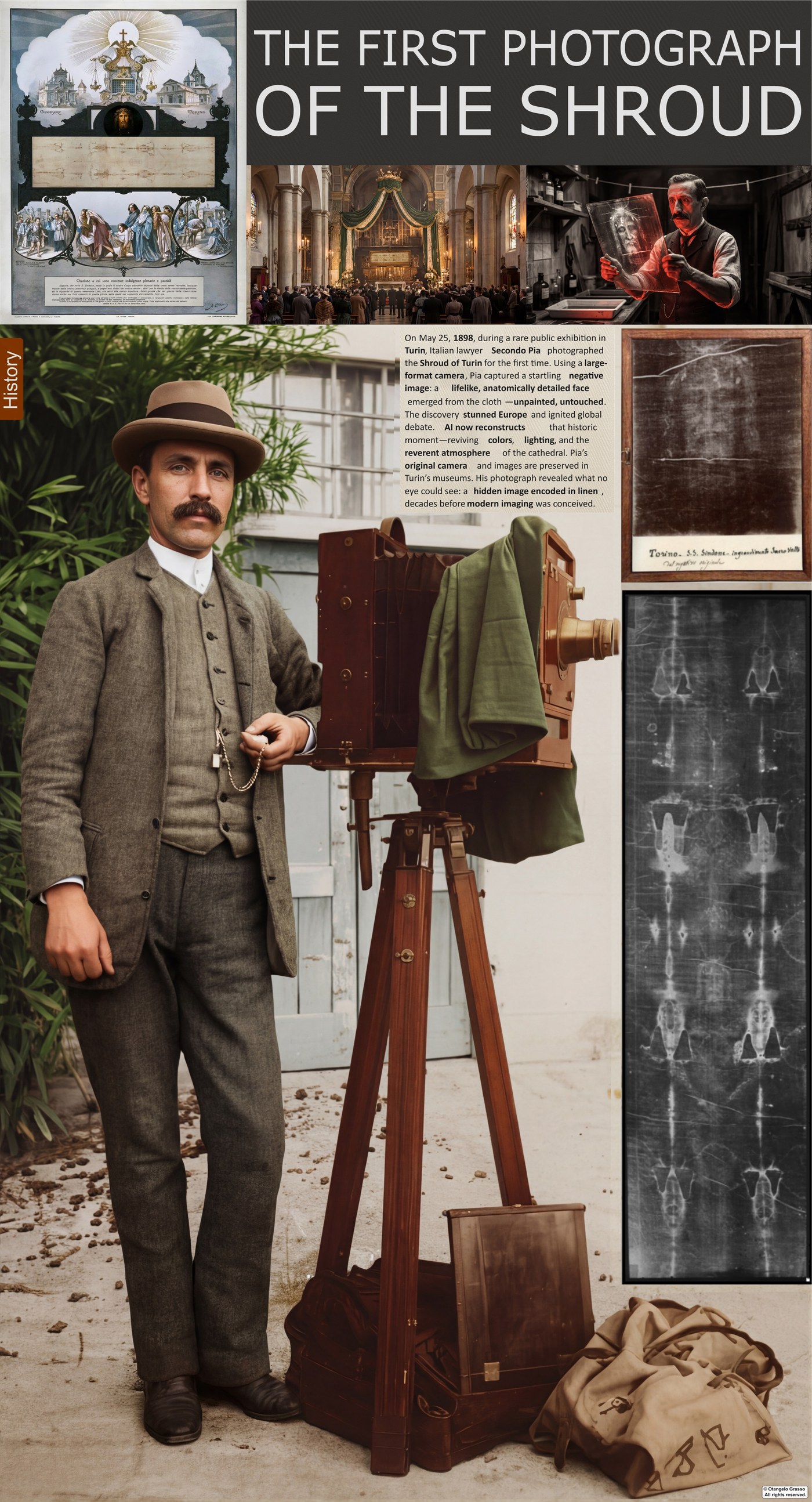
On the evening of 28 May 1898, in a darkroom in Turin, a lawyer from Asti named Secondo Pia watched a photographic plate develop. He had photographed the Shroud of Turin that evening, and he had expected the familiar reversed tones of a negative. What he saw instead was a face. The image that had been almost invisible on the linen became, on the glass, a clear and coherent likeness of a man. The discovery is usually dated to that night, and it began the modern scientific study of the cloth.
This chapter tells that story with its sources, separating what the photographs and the documents establish from what later accounts have added. It also follows the scientific and public reaction, the controversies that arose, and the confirmation that came thirty-three years later. The discovery is not only a matter of photography. It changed the status of the cloth from a relic to an object of study, and it set many of the questions that the rest of this series examines.
A relic kept from public view
By 1898 the Shroud had become a recluse object. The House of Savoy, which owned it, had shown it publicly only a few times in the nineteenth century, and each showing had been brief and tied to a political occasion, such as a royal wedding or a diplomatic visit. The cloth was kept in a silver casket behind grilles in the Chapel of the Holy Shroud. Its image was known to devotees through engravings and paintings, and the photographic record that would later define it did not yet exist.1
The occasion for the 1898 exhibition was the fiftieth anniversary of the Albertine Statute, the constitutional charter of the Kingdom of Sardinia that became the basis of the Italian state. Turin hosted celebrations that included a Sacred Art Exhibition and a General Italian Exhibition, and the exhibition of the Shroud was arranged to coincide with them. The decision to display the cloth was welcomed by Catholics in the city and was viewed more cautiously by the monarchy, which had an uneasy relationship with the Church at the time.2
The idea of photographing the cloth was not new. An earlier attempt had been discussed in 1842, when the Shroud was displayed from the balcony of the Royal Palace in Turin during a royal wedding. A local instrument maker, Enrico Jest, had equipment capable of the daguerreotype process, then the new photographic method. The display was brief and the light was poor, and the photograph was not made. Half a century later, the idea was raised again, and this time it was accepted.3
Choosing the photographer
The priest Don Nogier de Malijai, a Salesian and an enthusiastic amateur photographer, was among those who saw the opportunity, and the king allowed an official photograph to be taken.3 The photographer chosen was Secondo Pia, a lawyer and member of the Turin city council, who was also a serious amateur photographer. Pia was born in 1855 in Asti, and he had made a considerable body of photographs of the architecture and landscape of Piedmont, documenting the region’s heritage. He was not a professional, and he was not paid, and he was known for careful, methodical work.4
His selection was in some ways accidental. He was not the obvious choice, and he was chosen because of his competence and his standing. He was not expected to find anything extraordinary, and he was not expected to publish. The plates were to be deposited in the royal collections. Neither the king, nor the church authorities, nor Pia himself could have foreseen the result.

The technical problem
Photographing the Shroud in 1898 was not like photographing a building or a landscape. The cloth could not be taken down, moved outdoors, or placed in a studio. It hung behind a sheet of protective glass above the high altar of the cathedral, and the photographer had to work where it was displayed. The glass produced reflections and glare, and the light available in the cathedral was poor.4
The camera had to be placed on a raised platform, about three and a half metres above the floor, to achieve the correct angle. The platform had to be stable enough that the slightest vibration did not blur the image. The plates were large, about fifty by sixty centimetres, and they were made of glass coated with a light-sensitive emulsion. The light came from electric arc lamps, which were a novelty in 1898 and which were unreliable. The exposures had to be long, running to several minutes, and any movement in the cathedral during an exposure would ruin the plate.4
The first attempt
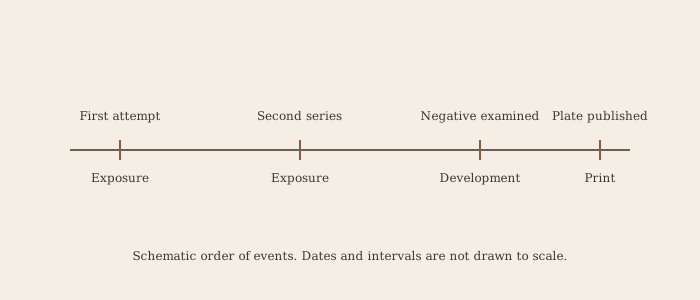
The first attempt took place on the evening of 25 May 1898. Pia set up his equipment with the help of others, and the platform, the camera, the lamps, and the cables were tested. The lamps then failed, and Pia made two exposures before the equipment stopped working. Both exposures were flawed. There was movement blur and uneven lighting, and the results did not justify a full series.4
When he developed the flawed plates later that night, Pia noticed something. In the negatives the faint markings of the cloth were rendered in a way that suggested a face, and the effect was more coherent than he had expected. He did not announce it. The exposures were imperfect, and he was cautious. He wanted to know whether the effect was real or an artefact of his equipment, the glass, or the light, and he needed to repeat the photographs under better conditions.
The second series, 28 May
Three days later, on the night of 28 May, Pia returned to the cathedral with his equipment. This time the lamps held, and Pia exposed four plates. Several others present were also in the cathedral, and some of them made their own unofficial photographs, to guard against accusations of trickery.4 The exposures were long, and the lamps had to be kept steady throughout. Pia had calculated the exposures carefully, and he used a yellow filter to enhance the tonal contrast, a standard technique of the period.
After the last exposure he took the plates to his darkroom, which was in his studio, and he developed them that night. The developer was applied to the glass, and the image began to appear. The usual inversion of a photographic negative was present, and the dark burn marks of the 1532 fire showed as white, while the white repair patches showed as black. The body image, however, did not behave like the other features. It resolved into the form of a man, with a face, shoulders, and arms, and its shading gave a sense of three-dimensional modelling.5
Accounts of that night differ in their details, and they were written later. Pia is said to have reacted with astonishment, and he is reported to have called to a relative waiting outside the darkroom. A later account attributes to him the words that it was a miracle. Those words are not in a record made at the time, and they should be treated as a retelling. The reaction is credible. The photographs themselves are the documented record, and they are the reason the night is remembered.
What the negative showed
The face on Pia’s negative was a positive portrait. The features that were faint on the linen appeared with clear modelling. The nose had a bridge and a tip, the cheekbones cast shading, the closed eyelids showed depth, and the beard had texture and direction. The image was not a flat icon, and it did not look like a conventional painted portrait of the period. Its shading suggested a body lit from the front, and its anatomy was consistent with a real head.5
The negative also showed that the bloodstains behave differently from the body image. On the cloth the stains appear dark red to brown. In the negative they appear light, which suggests that they are a separate record, deposited by a different process. This observation has been repeated in every later study of the photographs, and it is one of the reasons the blood and the image are treated separately in Chapter 3.5
The wounds, too, were visible in the negative with a clarity the cloth did not show to the naked eye. The marks on the wrists, the side, the back, and the scalp appeared in detail, and the observers were struck by how specific the wounds were. These observations were the beginning of the forensic study of the cloth, which is developed in the chapters on the Passion.
The reaction in the press
King Umberto I and his advisers were not prepared for the result. The original plan had been to take archival photographs, store them in the royal collections, and move on. Instead, they had what seemed to be scientific evidence of something unexplained. The political implications were immediate, and the first response was to keep the matter quiet while they considered it.6
The secret did not last. Within days the news reached the press. An Italian newspaper published the first report on 1 June 1898, and a photograph taken by one of the unofficial photographers during the session appeared in print soon afterwards. The story spread through European newspapers quickly, and it was reported in Paris, Florence, Berlin, Genoa, and Rome. Some of the coverage was surprisingly warm, and even secular papers described the face in terms of wonder.6
Two early reports survive. A notice in a Paris publication was carried in Berlin, and it described the image as showing a human face with all the details that science had confirmed. An Italian Catholic newspaper in Florence described the plates as showing the naked body of a man, with the marks of the Passion. Both reports were published before the first serious scientific study, and both reflect the excitement of the moment rather than any considered view.6
Scepticism and accusations
Scepticism followed quickly. Some critics proposed technical explanations for the effect, including the yellow filter Pia used, overexposure, optical distortion from the glass, and refraction. Each explanation attempted to make the discovery a mistake of equipment rather than a fact about the cloth. Those explanations were reasonable to propose, and they were tested by the later photographs.
More damaging were the accusations of fraud. Rumours suggested that Pia had retouched the plates or staged the discovery. The accusations were hard to refute at the time, because few people understood the photographic process well enough to judge the plates, and because the plates were in the hands of the royal collection rather than in public view. Pia’s reputation was affected, and his competence was questioned in print. He did not respond at length, and he did not publish a full account of his methods until much later.7
The d’Arcis memorandum and Chevalier
The most serious challenge to the cloth, though not directly to Pia, came in 1900 from the French historian Ulysse Chevalier. He published an edition of a memorandum written around 1389 by Pierre d’Arcis, the Bishop of Troyes, presenting it as proof that the cloth had been painted. The memorandum claims that an earlier bishop, Henri de Poitiers, had investigated the cloth around 1355, had found it to be a painting, and had obtained a confession from the artist.8
The memorandum has a complicated history, and the historical literature disagrees about its editing and dating. The surviving text is unsigned and undated in the form Chevalier presented, and some historians argue that it is a draft of a letter sent to the papal court, with a date consistent with its internal references. Critics, including the historian Markwardt, have argued that Chevalier combined separate documents and added a date and an address that were not in the original. That charge is disputed, and the reader should treat the memorandum as an allegation with a difficult documentary history, not as an established finding.9
The claim of a confession is also difficult on its own terms. An investigation that found a forgery would ordinarily leave records, such as a trial, a confiscation order, or an ecclesiastical proceeding. None of those records survives from the mid-fourteenth century. The historian Herbert Thurston, who was not a supporter of the cloth’s authenticity, noted the absence of such records in his English translation and commentary.10 The Lirey exhibitions continued after the alleged finding, which is not what would be expected if the cloth had been shown to be a painting.
Chevalier was awarded a prize by the Académie des Inscriptions for his work. His view became influential, and the English-language literature took it up. For some decades the consensus of the historical literature was that the cloth was a medieval painting, and that Pia’s negative was an accident or a hoax. Pia had been right about what he saw, but he could not prove it to a sceptical public with his plates and his testimony alone.
Vignon and Delage
The scientific study of the photographs was taken up by others. Paul Vignon, a French biologist at the Institut Catholique de Paris, studied Pia’s plates in detail, and in 1902 he published a book, Le Linceul du Christ, that set out a systematic physical account of the image.11 His hypothesis was a vaporographic theory. He proposed that vapours released by the body, mixed with the burial spices on the linen, produced a chemical browning that was strongest where the cloth lay closest to the body. The gradient of distance would then encode the body’s relief, and the negative character would follow from the same process.
Vignon’s specific chemistry is not accepted by later research. Diffusion through a gas does not easily reproduce the sharpness of the Shroud’s anatomical detail, and the spectroscopic work of the 1978 team, including the study by Gilbert and Gilbert, found that the image chromophore is not consistent with the chemistry Vignon proposed.12 Vignon’s contribution was not the mechanism. It was the statement of the problem. He argued that any viable mechanism had to produce tonal inversion and had to be governed by distance from the body. Those two conditions have dominated the study of the image since, and his hypothesis was the first falsifiable model in the field.
The zoologist Yves Delage, professor at the Sorbonne and director of the Roscoff marine station, was agnostic in his beliefs. He was shown Pia’s photographs by Vignon and took them seriously. Over the next few years Vignon and Delage examined the photographs with other specialists, and in 1902 Delage presented their argument to the French Académie des Sciences. They argued that the anatomical detail was consistent with a crucified man, and that a medieval artist was unlikely to have produced it. Delage said that the identity of the man was a matter of history and faith, and outside the scope of the scientific argument.13
The verification of 1931
Thirty-three years after Pia, the House of Savoy displayed the Shroud again in Turin. The exhibition marked the wedding of Crown Prince Umberto of Piedmont to Princess Marie-José of Belgium, and it drew very large crowds. The royal family commissioned the photographer Giuseppe Enrie to settle the question that Pia had raised. Enrie was a professional photographer with a major studio and laboratory in Turin, and he was the director of a leading photographic journal in Italy.14
Enrie photographed the cloth on the night of 3 May 1931. This time there was no glass barrier between the lens and the linen, and the cloth hung unobstructed. He used large glass plates made by a Milan manufacturer, rated for exposure and spectral sensitivity, together with filters chosen to enhance detail. He made a series of photographs, including the full cloth, sections of it, the dorsal image, the face at progressively larger scales, and a close view of the nail wound in the left wrist. The total was twelve official photographs.14
To guard against the accusations that had followed Pia, Enrie developed his plates immediately, in a darkroom set up in the sacristy of the cathedral, in front of witnesses. Church officials, photographic experts, and invited observers were present. Pia himself was among them, at the age of seventy-five. Paul Vignon was also present, having studied the 1898 plates in detail and built his theory around them. The plates came out of the developer, and they showed the same negative image that Pia had recorded.14
Enrie’s photographs were technically superior to Pia’s, with better optics, better emulsions, and better control of the lighting, and without the glass. They showed the same thing. The negative effect was confirmed, and it was not an accident of the 1898 equipment, the filter, or the light. Witnesses reportedly signed statements that the plates had not been retouched, and that the negative effect was genuine. Thousands of visitors to the 1931 exhibition also photographed the cloth with their own cameras, and some of their images showed the same effect.14
What the photographs established
The photographs established several points that later work has built on. The image is a negative in the photographic sense, and the reversal is consistent across independent photographs made under different conditions. The bloodstains are a separate record, and they reverse differently from the body image. The body image has a tonal structure that reads as three-dimensional when it is inverted, and that structure became the basis of the distance analysis discussed in Chapter 6. The wounds are visible in the negative with a clarity that the cloth does not show to the eye.
The photographs did not establish the date of the cloth, the process that formed the image, or the identity of the man. They did establish that the cloth carries a systematic record that is not a painted figure, and they made the cloth an object of repeated, documented scientific attention. That is the sense in which Pia’s night was the beginning of the modern study of the Shroud.
The photograph and the cultural memory
The 1898 photograph has become one of the most reproduced images of the Shroud. Its negative face is familiar to many people who have never seen the cloth, and it is often used as the representation of the Shroud in books, websites, and devotional material. The photograph is therefore not only a record of the cloth. It has shaped how the cloth is understood and remembered.
The image has also been used in arguments on both sides of the authenticity question. Those who hold the cloth to be genuine point to the negative as a sign of something that no medieval artist could have foreseen. Those who hold it to be a painting point to the negative as a sign of a photographic trick, or as evidence that the image is an artefact of the photographic process. The photograph cannot settle those arguments, but it can be read carefully, and the series tries to do so.
Pia’s later life
Pia continued his work as a lawyer and photographer. He was in his seventies when he attended the 1931 darkroom session, and he lived long enough to see Enrie’s photographs confirm his own. He died in 1941. The record of his life is modest, and his later reputation rests largely on the single night in the darkroom and on the confirmation that followed. He did not claim to have proved anything, and he left the interpretation to others.4
The photographic method in detail
The 1898 photograph was a technical achievement, and understanding the method helps to judge the result. Pia used a large plate camera, fitted with a high-quality lens of the period. The plates were glass, coated with a silver halide emulsion that darkened on exposure to light. The exposure was made by opening the shutter for a set time, and the latent image was made visible by chemical development in the darkroom, then fixed so that it could not change further.4
The sensitivity of the emulsions of the period was low by modern standards, and the cathedral was dimly lit. The exposures therefore had to be long, and the arc lamps provided the additional light. Arc lamps are bright but unsteady, and their flicker and heat both affected the work. The lamps had to be positioned so that they illuminated the cloth without producing hot spots on the glass, and the glass itself produced reflections that could only partly be controlled. Each of these difficulties affects the quality of the final image, and each has to be considered when the plates are used as evidence.
The development of a glass plate is a delicate process. The developer brings out the latent image gradually, and the photographer judges the moment to stop it by eye. The plate is then fixed, washed, and dried. Each step can introduce defects, such as stains, scratches, or uneven development, and the surviving plates have been examined for these defects. The 1898 plates have been treated with care in the later literature, because the question of whether they had been retouched was central to the accusations of 1898 and to the answer that Enrie provided in 1931.4
What the 1898 plates are and where they are
The original glass plates made in 1898 are held in the royal collections in Turin, and they have been studied from the originals and from high-quality copies. Their physical condition, the presence of marks and emulsion defects, and the consistency of the negative effect across several plates are all part of the record. The reader should be aware that the copies circulated in print and online are not all of the same quality. A reproduction of a negative can differ considerably from the original in contrast and tone, and that difference alone can change the apparent clarity of the face.4
The number of plates is also relevant. Pia made four exposures on 28 May, and his earlier flawed exposures from 25 May are a separate record. The consistency of the negative effect across the four exposures is one of the arguments against an accident of a single plate. The unofficial exposures made by others present in the cathedral add a further check, although their quality varies.
Enrie’s equipment and the 1931 campaign
Enrie’s campaign was more carefully controlled than Pia’s, and its technical details have been described in the literature. He tested film types before beginning. A German-manufactured plate was rejected because its required exposure was too long to photograph the full length of the cloth in the available time. He chose plates made by a Milan manufacturer whose emulsions were produced on both film and glass. The plates were rated for sensitivity in the units of the Hurter and Driffield system, equivalent to a low speed by modern standards, and they had a spectral sensitivity suited to the reddish tones of the cloth and its stains.14
The 1931 campaign used the glass barrier removed, better lighting, and a dedicated darkroom in the sacristy. The developing session was witnessed, and Enrie’s results were compared with those of other photographers who had been given the opportunity to work at the same time. The result was a set of images that could be checked against Pia’s and against one another, and that is why 1931 is treated as the confirmation of 1898.14
The 1931 images are not a perfect record either. The lighting of an exhibition is not the lighting of a laboratory, and the cloth had been moved, folded, and handled in the years since 1898. The photographs of 1931 are a record of the cloth as it was then, and they must be read with that date in mind.
The modern digital record
The Shroud has since been photographed many times. The STURP team of 1978 made a large photographic record in colour, in ultraviolet and infrared light, and in X-radiography. The photographs taken by Vernon Miller during that investigation are among the most widely used images of the cloth, and they are held in digital form by several archives.15 Later high-resolution photographs, including the Durante photographs of 2002, were made with digital equipment, and they have been used in the more recent analyses of the image.
The digital record has made the cloth easier to study. A reader can now examine the photographs at many scales, adjust the contrast, and compare images from different dates. The digital record has also introduced new kinds of processing. Each adjustment changes the picture, and each processing method, from simple contrast stretching to height conversion, introduces its own assumptions. The chapter on digital reconstruction discusses those assumptions, and the reader should keep them in mind when looking at any processed image.
A comparison of the 1898 negative with a modern digital negative of the same cloth is a useful exercise. The two will differ in resolution, in contrast, and in the tonal curve, and the differences will show how much of the appearance depends on the processing. The essential features, such as the position of the face and the relation between the dark and light regions, should remain consistent across the two. Where they do not, the difference points to a feature of the processing rather than of the cloth.
Contemporary reactions in more detail
The reactions of 1898 were not only the press reports and the accusations. The church authorities in Turin had to decide how the photographs should be treated, and the royal family had to decide what to do with a result that might embarrass or reassure them. Their response was cautious. The plates were kept in the royal collection, and the publication of images was restricted. The restrictions reflected a concern with propriety, and also a concern about the consequences of a public claim that could not be verified.
Scientists approached the photographs differently. Some were interested in the photographic method and wanted to know how the result had been produced. Others were interested in the anatomy, and they asked whether the wounds described in the Gospels were visible in the image. A third group was sceptical of the whole enterprise, and they asked whether the result could be explained by ordinary optical or chemical processes. Each group asked questions that the photographs could partly answer, and each group left some questions open.
The Catholic press, and some devotional writers, took the photographs as confirmation of the cloth’s authenticity. The secular press, and some scientists, took them as an unexplained curiosity. Both responses went beyond the evidence at the time. The photographs showed a negative face, and they did not show who the face belonged to, when the cloth was made, or what process had formed the image.
Common misconceptions about Pia and his photograph
Several claims about Pia are repeated in popular accounts, and some of them are not supported by the record.
“Pia was a professional photographer who sold his plates.” Pia was a lawyer and a city councillor, and his photography was an amateur passion. He was not paid for the 1898 work, and the plates were deposited in the royal collection. The record does not show that he sold them.4
“Pia saw a miracle and announced it.” The words attributed to Pia about a miracle are reported in later accounts, not in a contemporary record. Pia was cautious in public, and he did not make a claim of miracle in his own published statements.4
“Enrie proved the photographs were genuine.” Enrie confirmed the negative effect under better conditions, and the witnesses at the 1931 darkroom session supported his results. He did not prove the identity of the man, the date of the cloth, or the process that formed the image. His photographs are a confirmation of a physical observation, not a verdict on the question of authenticity.14
“The negative is a modern photograph of the cloth.” The negative effect is a property of the cloth itself. The photographic process reveals it, and it does not create it. The photographs show the cloth in reverse, but the reversal is a property of the image on the linen.
“The 1898 image was retouched.” The accusation was made at the time, and it has not been supported by the evidence of the plates. The consistency of the effect across several independent exposures, and across the 1931 campaign, is one of the strongest arguments against the claim.14
Why the negative matters for image formation
The photographic negative is not an incidental feature of the image. It is one of its defining properties, and any explanation of the image has to account for it. A painted image would be expected to be positive, with its light and dark matching the subject. A contact image would be expected to show the reverse of the cloth’s relation to the body, in some cases, but not in the simple, consistent way the image shows. The negative character is therefore a constraint on the mechanism.
The negative also raises the question of how a tonal reversal could arise naturally. Vignon argued that a distance-dependent process would produce the reversal as a consequence of its physics. Others have argued that a process involving radiation or a chemical change in the outer fibres would produce the same result. Each proposal is discussed in Chapter 20, and each has to explain both the reversal and the distance relation at once. The negative is the first clue, and it is one of the reasons the image has been studied so closely since 1898.
What Pia’s night still asks of us
Pia’s night in the darkroom asks the reader to consider what it means to see something unexpected in a familiar object. He went to the cathedral to make a record, and he came away with a result that changed the study of the cloth. The discovery depended on his skill, on the equipment of his day, and on the willingness of the authorities to allow the photograph. It also depended on the chance that the cloth carried the image it carries.
The series returns to that night repeatedly, because every later analysis of the image begins with the negative face. Whether one reads the discovery as a sign of something beyond the ordinary, or as a puzzle that ordinary physics has not yet solved, the photograph is the record. It is the point at which the cloth first spoke in a language that could be measured.
Questions the photograph raises
The photograph raises several questions that the rest of the series takes up. How was the negative character formed? Why does the image encode distance? Why are the bloodstains a separate record? And what does the negative say about the process that made the cloth? The answers are not settled, and some of them are contested. The discovery of 1898 defined the questions, and it did not answer them.
References
- Shroud display and custody in the nineteenth century. Discussed in the historical literature on the cloth. Publication details to be confirmed before publication.
- The 1898 exhibition and the Albertine Statute celebrations. Discussed in the historical literature. Publication details to be confirmed before publication.
- Don Nogier de Malijai, the 1842 daguerreotype proposal, and the decision to photograph the cloth in 1898. Reported in the historical literature, including the image book’s account of Pia and the 1898 exhibition, and the 1898 account in Fanti’s retelling in the other book. Publication details to be confirmed.
- Pia, S. (1898). The first photograph of the Holy Shroud. Accounts of the 1898 sessions, including the reports of the technical problems, the two sessions of 25 and 28 May, and Pia’s later life. Publication details to be confirmed before publication.
- The negative image and the photographic evidence of 1898, as discussed in the scientific and historical literature. See Schwalbe, L. A., & Rogers, R. N. (1982). Physics and chemistry of the Shroud of Turin. Analytica Chimica Acta, 135, 3–49.
- Early press reports on the 1898 photographs, in Italian, French, German, and other newspapers. Publication details to be confirmed before publication.
- Accusations of manipulation and the reaction to Pia’s photographs. Discussed in the historical literature on the cloth.
- Chevalier, U. (1900). Étude critique sur l’origine du Saint-Suaire de Lirey–Chambéry–Turin. Paris.
- Markwardt, M. Critical review of the d’Arcis memorandum and Chevalier’s edition. Publication details to be confirmed before publication.
- Thurston, H. (English translation and commentary on the d’Arcis memorandum). Publication details to be confirmed before publication.
- Vignon, P. (1902). Le Linceul du Christ. Paris: Masson. Publication details to be confirmed before publication.
- Gilbert, R., Jr., & Gilbert, M. M. (1980). Ultraviolet-visible reflectance and fluorescence spectra of the Shroud of Turin. Publication details to be confirmed before publication.
- Delage, Y. (1902). Presentation to the Académie des Sciences, Paris, on the photographs of the cloth. Publication details to be confirmed before publication.
- Enrie, G. (1931). Photographic survey of the Holy Shroud, Turin. The 1931 campaign, the darkroom session, and the witnesses are discussed in the historical literature.
- Miller, V. D. (1978). STURP photographs of the Shroud of Turin, held in the Vernon Miller archive (shroudphotos.com). The later high-resolution Durante photographs (2002) are discussed in the image book, Part V, and the digital analyses of the image.