The Shroud of Turin · Chapter 4 of 21
Silent witnesses: pollen and limestone
A cloth that has been in European custody since the fourteenth century should carry the traces of European life: dust from the churches where it was kept, pollen from the gardens of the towns through which it passed, and the grit of the roads. Yet the fibres of its surface have been reported to carry pollen from plants that grow in the eastern Mediterranean, and particles of stone that some analysts have matched with rock from Jerusalem. The two sets of findings were made decades apart by different scientists, with different methods. Both have been challenged. The challenges matter as much as the findings, and this chapter gives them equal weight.
Pollen and mineral dust are not evidence of identity, and they are not evidence of a crucifixion. They are evidence of exposure: of what the cloth touched, or breathed, or was surrounded by, at some point in its history. A trace on a cloth is a record of contact with an environment, and the environment is what the analyst tries to read. The difficulty is that the same trace can be deposited in many ways and at many times, and that handling, display, storage, and the laboratories themselves can all add traces of their own.1
How the traces were collected
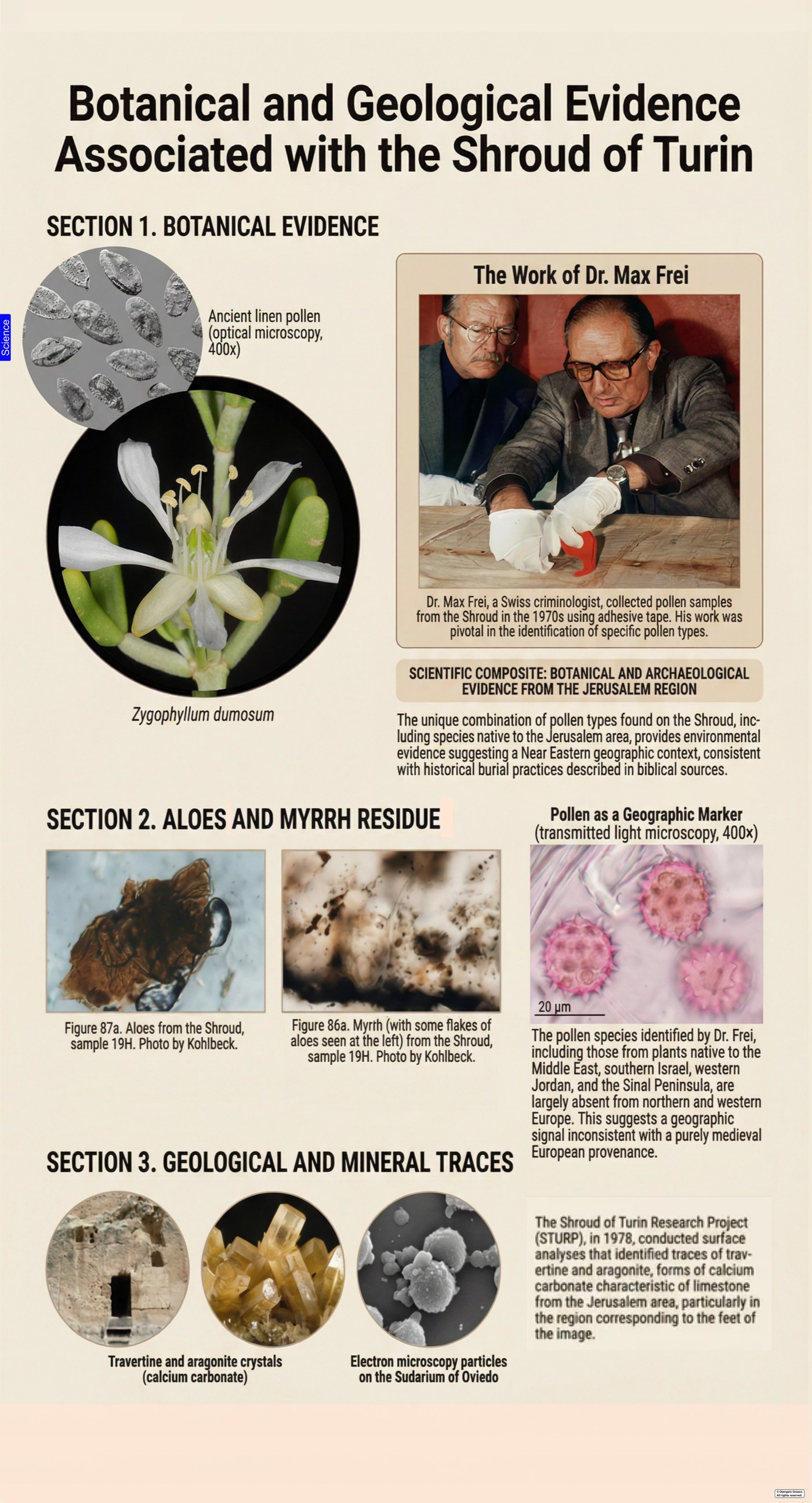
The principal organic evidence comes from adhesive tape. Tape was pressed onto the surface of the cloth, lifting fibres and particles from the surface, and the tape was then examined under a microscope. Max Frei-Sulzer, a Swiss criminologist and botanist who founded the Zurich police scientific laboratory, first applied the method to the Shroud in 1973, during a commission examination authorised by the Archbishop of Turin. He returned in 1978, during the examination by the Shroud of Turin Research Project.2
The method is elegant in its simplicity, and it has a serious weakness. A tape lifts whatever is on the surface, including material that arrived after the cloth left its original context. The adhesive can also distort the grains it captures, so that the surface detail needed for identification is obscured. The chain of custody of each tape, from the moment it was pressed on the cloth to the moment it was examined, determines how far a microscopic result can be trusted. That chain was not documented to modern standards, and that point is central to the debate.
A second method was used by Giovanni Riggi di Numana, an engineer attached to Fiat’s research division who was listed among the STURP team. Riggi di Numana collected loose material by vacuum suction, drawing it into a filter, and so avoided some of the adhesive problems. His samples included linen fibres, mineral grains, and biological material, and among the biological fraction were pollen grains. The results were described in his 1982 monograph, and they are referred to in the chemical summary by Schwalbe and Rogers.3 The vacuum samples and the tape lifts were taken from the cloth at different times, and their relation to each other is one of the points the later analysts had to reconcile.
The limestone was found on the same tapes, and it was examined separately. Joseph Kohlbeck, an optical crystallographer, examined some of the tape samples under polarised light and identified crystals of limestone. The method for the mineral work was different. It relied on the optical properties of the crystals and on elemental analysis at the level of single particles, and it was later applied to comparison samples from known locations.4
Pollen: the basics
Pollen grains have an outer wall, the exine, built from sporopollenin, one of the most chemically resistant biological materials known. Grains survive for thousands of years in sediment, peat, and desert soils, and they can be recovered from archaeological contexts. The shape, the surface sculpture, and the pattern of the openings in the wall can identify a grain to plant family, genus, or sometimes species, depending on the group. The identification is only as good as the reference collection to which the grain is compared, and the reference collection has to be assembled from the region and period in question.
Pollen is dispersed in two main ways. Wind-pollinated plants release large quantities of grains into the air, and those grains can travel long distances and settle on many surfaces. Insect-pollinated plants release fewer grains, which are carried by animals and rarely travel far from the parent plant. A pollen grain from an insect-pollinated species on a cloth is therefore evidence of direct contact with that plant, or with material that carried the grain, rather than of airborne drift. That distinction is central to the Shroud argument, and it has been made in several of the analyses discussed below.
Palynology, the study of pollen, is also used in forensic work, where it links a sample to a place and to a season. The discipline has standards for contamination control. Pollen profiles of the people, the rooms, and the equipment that handled a sample are documented before the sample is interpreted as a geographic signal, because pollen is easy to pick up in a laboratory. The standards matter for the Shroud, and the critics of the pollen work have invoked them repeatedly.5
Frei’s identifications
Frei reported pollen from a considerable number of plant species on his tape samples. He grouped them by region. Some pollen came from plants of the Mediterranean basin of France and Italy. Some came from the Anatolian steppe, and some from the Judean desert and the Dead Sea basin. The three groups together suggested a path that matched the documented history of the cloth in outline, from Jerusalem through Edessa and Constantinople to medieval Europe.2
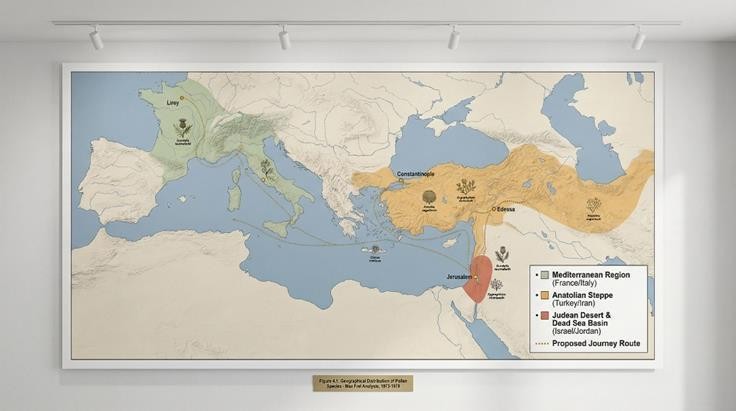
Two species carried most of the argument. The first is Gundelia tournefortii, a thorny composite thistle native to the eastern Mediterranean and the Near East. It is restricted in its natural range to Palestine and Anatolia, and it flowers in the spring, in the period of the Passover season. The second is Zygophyllum dumosum, a desert shrub whose range is restricted to Israel, Jordan, and the Sinai. Neither species is known from medieval France or Italy. Frei also reported other taxa, including species of Onosma and Ziziphus, which he took to indicate Levantine exposure.2
The argument from these species depends on identification, and identification depends on the quality of the grains and of the comparison. Here the problems begin. Frei died in 1983 before publishing a complete, peer-reviewed account, and his results survived in conference papers, popular summaries, and partial analyses. The full dataset was therefore not available for independent review in the form that scientific convention requires.6
Re-examination: Danin, Whanger, Baruch, and the 1999 atlas
The botanist Avinoam Danin of the Hebrew University of Jerusalem, working with Alan Whanger, Uri Baruch, and Mary Whanger, re-examined Frei’s preserved tapes in the 1990s. The results were published in 1999 as Flora of the Shroud of Turin by the Missouri Botanical Garden Press.7 The team reported 313 grains from Frei’s 1973 tapes and grains from a portion of the 1978 tapes. They reported that the diagnostic species, principally Gundelia tournefortii and Cistus, made up a substantial proportion of the identified grains, and that the Gundelia alone accounted for a notable share of the total.
The re-examination is more rigorous than the original work in some respects. Its reference material is better, and the identifications were made with modern botanical methods. It is not an independent sample, however. Danin’s team did not collect new tapes from the cloth. They worked from the same preserved material, and the handling history of that material is the same. Any problem with the original collection, including contamination during handling and the incomplete documentation of the chain of custody, applies equally to the re-examination. The 1999 study increases confidence that the grains on those tapes are of Judean character. It cannot show that the grains came from the cloth in the period of its documented history.
The atlas also made a claim of a different kind, that the faint image itself contains plant impressions. Danin argued that certain features of the body image are the silhouettes of plants, including Gundelia and Zygophyllum. If that identification were correct, it would suggest physical contact with the plants rather than airborne accumulation. The identification, however, requires judgements of pattern in a faint and complex image, and such judgements are vulnerable to pareidolia, the tendency to see meaningful shapes in ambiguous fields. Critics have argued that the identifications need blinded procedures before they can carry weight. The claim is interesting, and it is not yet established.7
Objections to Frei’s pollen
The reception of Frei’s work has been critical, and the critics have raised several substantive points. Each deserves a fair statement.
Credibility and documentation. Frei was a respected forensic scientist, and his reputation was damaged in 1983 when he was among the experts consulted on the Hitler Diaries, which were later shown to be forgeries. The damage to his reputation is a separate matter from the quality of his Shroud work, and the critics have been careful to say so. The point that matters for the Shroud is that his results were not fully published, and that scanning electron micrographs published in 1982 were questioned because some resembled reference specimens from his own comparative collection.8
Identification at species level. The palynologist Thomas Litt, examining slides from Frei’s tapes, reported that the adhesive had obscured the surface detail of many grains, and that precise identification to species was not possible in many cases. Litt concluded that Frei’s species-level assignments were unreliable.9 A more nuanced assessment came from the cytologist Silvano Scannerini and the palynologist Rosanna Caramiello, who worked through the collection in the early 1990s. They found identification errors, including some at genus level. After setting the most problematic assignments aside, they found that a residual set still supported the conclusion that the cloth had been in environments characteristic of Palestine and Anatolia.10
Distribution across the tapes. The tape-by-tape distribution of the diagnostic grains has never been published in full. The aggregate figures are cited in the literature, but the breakdown by tape is not, and it is the breakdown that would distinguish broad deposition from a concentration in one or two samples. If the diagnostic grains were concentrated on a few tapes, the pattern would suggest a single recent contact rather than a long history. Without the breakdown the two readings cannot be distinguished.
Pollinators. Many of the species Frei reported are insect-pollinated, so their grains do not travel far through the air. Their presence on the cloth points to direct contact with plants or their products, and that is a stronger claim than airborne drift. The point cuts both ways. Direct contact could have happened in the Near East, but it could also have happened in a European workshop or church that handled plant material from the Levant, or during later handling by researchers who had worked with Near Eastern plant collections.5
Season. Some analysts have noted that the species represented are broadly consistent with spring flowering in the Levant. A seasonal reading is attractive, but it is highly sensitive to contamination with pollen from other seasons, introduced through handling, display, or the air of the room. The seasonal argument should be weighed with more caution than the geographic argument.11
Boi and Lucotte: a second look at the pollen
The palynologist Marzia Boi re-examined the pollen record in 2017. Her paper, published in Archaeometry, both cautions against over-interpretation and affirms that Near Eastern pollen assemblages are present on the cloth, consistent with Jerusalem-area flora.12 Her reading of the most abundant grains differs from Frei’s. She argued that a plant of the genus Helichrysum, whose fragrant oil was used in ancient burial practice, is among the most abundant sources. On that reading the pollen is less a geographic passport than a residue of burial oils, and the Gundelia grains are more likely to be contamination, because the plant is common in the Mediterranean and its pollen is widespread in the air.
The botanist Gérard Lucotte conducted a further examination in 2015, using scanning electron microscopy to study particle morphology.13 He did not confirm Gundelia at species level. He did not find a European assemblage either, and the overall character of the pollen was consistent with an eastern Mediterranean context. The post-Frei work therefore reaches a partial agreement. It neither confirms the species-level identifications nor rules out a Near Eastern source.
Both analyses point to the same practical conclusion. Pollen on a cloth can be identified with some confidence at the level of broad regional flora. Species-level claims require methods, reference material, and controls that have not yet been applied to the Shroud in a fully documented way. The chapter treats the pollen as a suggestive line of evidence rather than a settled one.
The Sudarium and the second cloth
The Sudarium of Oviedo, a face cloth preserved in northern Spain, has been reported to carry pollen from the same plant families, including Gundelia, in grains recovered from its surface. The reports are subject to the same methodological problems as the Shroud work, and the Sudarium’s own custodial history has uncertainties. If the report is confirmed, it provides a second cloth, with a separate custodial history, that shares a botanical signature with the Shroud. That would be a more independent line of evidence than the Shroud alone. It is not yet confirmed to the standard that would allow the claim to be relied on, and the Sudarium is discussed in Chapter 14.14
Limestone: the mineral witness
The mineral evidence is of a different kind. Limestone and related calcium carbonate minerals occur in many places, and the question is whether the particles on the Shroud can be matched to a particular geological source. Kohlbeck, working with Ricardo Levi-Setti of the University of Chicago, who operated a scanning ion microprobe capable of resolving elemental composition at the level of single particles, compared particles from the Shroud with samples taken from rock-cut tombs in Jerusalem.4
The particles were identified as a form of travertine aragonite. Aragonite is one of the two crystalline forms of calcium carbonate, the other being calcite. Calcite is the common form, and it occurs almost everywhere. Aragonite forms under narrower conditions, and travertine aragonite, deposited from calcium-rich spring water, can carry trace elements, such as strontium and iron, in ratios that vary by location. On the reported comparison, the Shroud particles and the Jerusalem tomb samples were both travertine aragonite, and their emission spectra were close.4
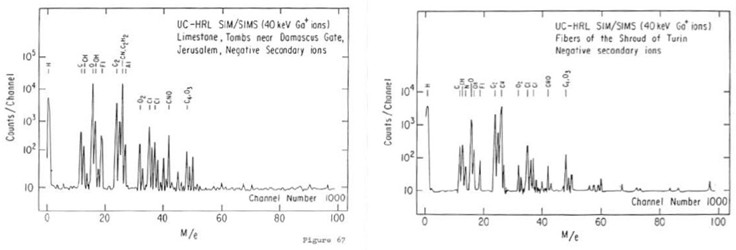
The 1978 X-ray fluorescence work of Morris, Schwalbe, and London, which measured the calcium and strontium content of the cloth, offered a caution. Calcium and strontium are common, and airborne calcium carbonate from marble and limestone regions of northern Italy was identified as a plausible source of the calcium-rich deposits on the cloth.15 Travertine aragonite is not confined to Jerusalem. Similar materials occur in other parts of the Levant and around the Mediterranean, including parts of central and northern Italy. The Kohlbeck result is consistent with a Jerusalem origin, and it is not proof of one.
A later study by Giulio Fanti of the University of Padua and Amir Sandler of the Geological Survey of Israel compared dust vacuumed from the Shroud with samples from beneath the edicule of the Holy Sepulchre and from the surface of Mount Zion.16 Their spectral analysis found correspondences, with some spectra matching closely across the two sample sets. The authors acknowledged that regions with similar geology might produce comparable signatures, and that a close spectral match cannot exclude other sources. What the study establishes is that the Shroud’s mineral content is geologically consistent with the Jerusalem area. It is not one of STURP’s core conclusions, and it is a later and contested result.
Taken together, the two mineral studies are more consistent with a Levantine environment than with a northern European one. Neither claims proof, and each has an acknowledged alternative. The mineral evidence is therefore a modest but real strand of the argument.
Where the particles were found
The mineral deposits were reported to be concentrated in particular areas. Some were found at the feet of the image, and others in areas corresponding to the nose and the left knee. The knee and the feet are locations that the forensic analysis associates with falls onto stone while carrying the crossbeam, as Chapter 12 discusses. If the deposits were picked up in those places, the distribution would be a meaningful pattern. The argument depends on two things: that the deposits are genuinely concentrated in those areas, and that the concentration is not an artefact of the sampling. Both points require careful documentation, and the sampling documentation is one of the weaker parts of the record.
Objections to the limestone
The historian Hugh Farey has offered the most detailed critique of the limestone claims. He argues that the evidence was inflated in successive retellings, so that a small number of grains became sweeping claims about foot-dirt and knee-soiling that the tape samples do not support. He notes that the key STURP publications contain little on calcium particles, and that a cautious remark about yellowish particles has been given too much weight. He also points out a discrepancy in the reported lead content between the two analyses. The more sensitive instrument detected no lead, although the less sensitive one had reported some, and the difference is hard to reconcile with a close quantitative match.17
Some of these points are strong, and others are answered in part by the literature. The lead difference can be explained if the two instruments had different detection limits. The Israeli comparison series answers the question of specificity, but it has not been published in peer-reviewed form. The investigators themselves acknowledged that no rare-element marker had been found to separate Jerusalem aragonite from aragonite elsewhere, and that no single particle could prove where it came from. That acknowledgment is an important part of the record.
Contamination and the laboratory
Pollen and dust are among the easiest traces to contaminate. A laboratory handling plant material can deposit pollen on samples, and studies have reported that foreign grains can appear on microscope slides within hours of exposure. Forensic palynology uses control samples and procedural blanks to detect such contamination. The Shroud work has not, in the documented form, applied those controls to the full extent that modern standards require, and the lack of them is one of the principal reasons the pollen evidence is held to be suggestive rather than conclusive.5
The same applies to the mineral work. Dust accumulates in churches and in storage, and the cloth has been kept in several buildings over its history. The dust of those buildings may carry calcium carbonate from local stone, and the dust of the Turin cathedral is not the same as the dust of a Jerusalem tomb. A complete account has to consider the dust of the cloth’s whole history, not only of the place where a particular sample was taken.
What the two witnesses can support
The pollen and the limestone come from different disciplines, were examined by different scientists, and were studied in different decades. They point toward the same broad region, and the convergence is the main reason they are taken seriously. A medieval forger would have needed to produce both the pollen of plants that grow in the Near East and a mineral form matching the travertine aragonite of Jerusalem tombs, placed where a body touching the ground would be expected to leave dust. That is a demanding requirement, and it is one reason the traces have been treated as evidence at all.
Neither trace proves an origin by itself. The pollen depends on handling history that was not documented to modern standards and on species identifications that have been partly disputed. The limestone depends on comparison samples whose documentation is incomplete, and on a geological signature that is not unique to Jerusalem. Together they are consistent with a Judean or Levantine context, and they are harder to explain on the assumption of a medieval European origin. They do not settle the question.
The radiocarbon result of 1988 points in another direction, and it is discussed in Chapter 19. A full assessment of the pollen and the limestone has to take that result into account, and the trace evidence has to be weighed as one body of evidence among several. It is not a verdict on its own.
The methodological lesson
The pollen and limestone debate has a lesson for the whole series. Each trace was found by a method that was reasonable for its time, each has been reanalysed with better tools, and each has been challenged on documentation and control. The strongest claims made for the traces have generally been the weakest in documentation, and the most cautious claims have been the most defensible. That pattern is worth keeping in mind when reading the other chapters, where similar claims are made about other evidence.
Textile chemistry and the traces in the fibres
The traces on the surface are not the only chemistry bearing on the cloth’s history. The fibres themselves have been examined for the substances they contain and for the way they have degraded. Several studies have reported that the linen carries residues of materials used in its preparation, including the products of retting and bleaching, and that the cellulose shows a degradation profile consistent with long storage in a particular kind of environment. The isotopic composition of the cellulose has also been reported, and some of the reported values overlap with those of Middle Eastern linens.18
These results are interesting, and they are not uniform. The image book reports cotton traces in some samples, which would be a significant finding because cotton was not used for linen. The 2026 study of the Arizona fragments found no cotton in the portions it examined, and it found no painting grounds or repair materials.19 The two results cannot both be read as settled. The disagreement may reflect differences in the samples examined, in the methods of detection, or in the handling of the material. It shows that the chemistry of the cloth is still being worked out, and that the claims made about it should be checked against the primary reports rather than repeated from summaries.
The degradation profile is a more general point. Cellulose in old linen breaks down in predictable ways, and the rate depends on the temperature, humidity, light, and the presence of microorganisms over time. A degradation profile consistent with a long history in a particular environment is a legitimate result, and it can help to place the cloth in a broad context. It does not give a precise date, because the rate of degradation varies widely with the conditions. The chemistry narrows the field of possible histories, and it leaves the choice to other evidence.
What each history would predict
The traces can be used to test the histories of the cloth, provided the predictions are stated in advance. A cloth that was in Jerusalem in the first century, and then travelled to Edessa, Constantinople, and France, should carry traces of each place, with the most recent traces on the surface and the older ones beneath. A cloth that was made in medieval Europe and exposed only to European environments should carry the pollen and minerals of those environments. A cloth made in the Near East and then carried to Europe should carry a mixture, weighted toward the Near East in its older layers.
The critical point is that the traces on the surface are not the traces of the whole history. Tape samples lift the surface, and the surface is the most recent layer. The older traces, if they exist, are beneath the surface or were lost in the handling, the fire, and the repairs. A tape sample from the front of the cloth records what settled there last, not what settled there first. The predictions therefore need to be made about the surface and about the fibres, and the samples need to be taken in a way that can distinguish the layers.
A medieval history predicts pollen and minerals consistent with medieval Europe, and it does not predict a Near Eastern signature unless the cloth was exposed to Near Eastern material in Europe. The Judean reading predicts a Near Eastern signature in the older layers, and it leaves the surface open to later European contamination. The reading that combines a Near Eastern origin with a European history predicts a mixed signature, with the Near Eastern traces weighted toward the older layers. Each reading makes a different prediction about the distribution of the traces across the cloth and across the layers, and those predictions can be tested if the samples are taken and recorded properly.
The difficulty is that the samples were not taken with this test in mind. The tapes were pressed on the surface at the points of greatest interest, and the record of where each tape was taken and in what order is incomplete. The predictions are therefore clear in principle, and difficult to test in practice with the material that exists.
The methods of a valid pollen study
The standards for a valid pollen study on the Shroud were set out in an analysis by Scannerini, who examined the requirements that any such study would have to meet. His analysis is useful because it turns the criticisms into a list of procedures, and the procedures can be applied to a future study.10
The first requirement is a sufficient number of grains. A study needs enough grains of each taxon to assess the variation within the sample, and the figure Scannerini cited was in the region of two hundred grains per taxon. Fewer grains make it difficult to distinguish a real signal from chance. The second requirement is a documented preparation protocol. The grains have to be extracted, mounted, and imaged in a way that preserves the surface detail, and the protocol should include steps such as acetolysis, which removes non-pollen material, and vacuum metallisation, which prepares grains for electron microscopy. The third requirement is three-dimensional imaging from several angles, so that the aperture pattern and the sculpture of the wall are fully visible.
The fourth requirement is comparison against reference collections drawn from the specific region and period in question. A reference collection assembled from modern plants may not represent the flora of the first century, and it may not represent the plants that grew near a particular medieval church. The fifth requirement is contamination control. Procedural blanks, staff pollen profiles, and documentation of the laboratory environment are all needed. Scannerini concluded that the available documentation did not show that these requirements had been met for the Shroud. He recommended a new study that followed modern standards, and that recommendation has not been carried out in the form he described.10
Why the samples matter
The tape samples are the primary record of the pollen, and their handling is therefore central to any interpretation. A tape that was pressed on the cloth in one place, stored in one room, and examined by several people in several laboratories has a history that has to be recorded at each step. The records of those steps are incomplete. The original laboratory protocols of Frei were lost, and the documentation of the later examinations is not uniform. A future study would need to rebuild the chain of custody as far as possible, and it would need to state clearly which parts of that chain cannot be recovered.
The same logic applies to the mineral samples, which were taken from the same cloth at different times. The dust collected by vacuum is a different record from the dust collected by tape, and the two need to be compared with care. A study that combines them without reference to their collection methods risks mixing two different kinds of evidence.
Future research
Several kinds of research could resolve some of the open questions. The first is a new palynological study on new samples, collected under documented conditions, with procedural blanks and modern standards of identification. Such a study would test the Frei and Danin identifications directly, and it would show whether the Near Eastern signature is present in the layers of the cloth as well as on the surface. The second is a blinded comparison of the mineral particles with reference samples from a range of sites in the Levant and Europe, so that the specificity of the match can be assessed. The third is an examination of the chemistry of the fibres for residues of the materials used in burial, such as the resins and oils mentioned in the Gospels, using methods that can distinguish those residues from later contamination.
The fourth is a review of the documentary record of the cloth’s storage and display, so that the European environments the cloth passed through can be reconstructed. That record would tell us which traces could have been added in Europe, and which could not. Without it, the European contribution to the traces remains an assumption, and the Near Eastern contribution remains an inference from the plants and the minerals.
What the traces can and cannot say
The traces can say that the cloth has been in contact with particular plants and minerals at some time, and that some of those plants and minerals are characteristic of the eastern Mediterranean. They can say that the surface contains material consistent with the Jerusalem area, and that the layers of the cloth may contain older traces that have not been sampled.
The traces cannot say when the contact occurred, how long it lasted, or whether it happened before the cloth reached Europe. They cannot say who handled the cloth, or whether anyone deliberately introduced the material. They cannot identify the man who lay in the cloth, and they cannot settle the date of the linen, which is a separate question addressed by the radiocarbon result. The honest use of the traces is to narrow the field of possible histories, and to show which histories are consistent with the surface record. That is a modest use, and it is a real one.
What comes next
The chapters that follow turn from particles on the surface to the image, and to the interpretation of the Gospel accounts of the burial. The traces discussed here do not depend on the image, and they do not identify the man who lay in the cloth. They describe where the cloth has been, insofar as the record allows. The next chapter, on the Pia photograph of 1898, returns to the image and to the moment its negative character was discovered.
References
- General principles of trace evidence and contamination in forensic and archaeological science. See Bryant, V. M., & Jones, G. D. (2006). Forensic palynology: Current status of a rarely used technique in the United States of America. Forensic Science International, 163(3), 183–197.
- Frei-Sulzer, M. (1973 and 1978). Tape-lift pollen samples from the Shroud and the reports based on them. As discussed in the image book, Part IV, section II, “The Palynologist: Max Frei and the Pollen Record.” Publication details to be confirmed before publication.
- Riggi di Numana, G. (1982). Rapporto Sindone 1978–1982. Publication details to be confirmed. See also Schwalbe, L. A., & Rogers, R. N. (1982). Physics and chemistry of the Shroud of Turin. Analytica Chimica Acta, 135, 3–49.
- Kohlbeck, J. A., & Nitowski, E. L. (1986). New evidence may explain image on Shroud of Turin. Biblical Archaeology Review, 12(4), 18–29.
- Forensic palynology contamination controls and the Shroud pollen record. Discussed in the image book, Part IV, section II, and in Bryant & Jones (2006), above. Publication details to be confirmed for the specific studies cited.
- Frei’s death in 1983 and the incomplete publication of his results. See the image book, Part IV, section II.
- Danin, A., Whanger, A. D., Baruch, U., & Whanger, M. (1999). Flora of the Shroud of Turin. St. Louis: Missouri Botanical Garden Press.
- Frei-Sulzer’s reputation, the Hitler Diaries affair, and the scanning electron micrographs of 1982. Discussed in the historical and palynological literature. Publication details to be confirmed before publication.
- Litt, T. (2001). Examination of Frei’s preserved tapes. Publication details to be confirmed before publication.
- Scannerini, S., & Caramiello, R. (early 1990s). Re-examination of Frei’s collection. Publication details to be confirmed before publication.
- Seasonal interpretation of the Shroud pollen. See the image book, Part IV, section II, on the seasonal profile of the pollen.
- Boi, M. (2017). Pollen on the Shroud of Turin: The probable trace left by anointing and embalming. Archaeometry, 59(2), 316–330. Publication details to be confirmed before publication.
- Lucotte, G. (2015). Scanning electron microscopy study of pollen on the Shroud. Publication details to be confirmed before publication.
- Sudarium of Oviedo and the pollen reports. See Chapter 14 and its references.
- Morris, R. A., Schwalbe, L. A., & London, J. R. (1980). X-ray fluorescence investigation of the Shroud of Turin. X-Ray Spectrometry. Publication details to be confirmed before publication.
- Fanti, G., & Sandler, A. (comparative mineralogical study of Shroud dust and Jerusalem samples). Publication details to be confirmed before publication.
- Farey, H. (2021). Limestone on the Shroud. The Medieval Shroud. Online essay. See the image book, Part IV, for the discussion of lead and detection limits.
- Textile chemistry and isotopic composition of the Shroud linen, as reported in the image book, Part IV, and the surrounding literature. Publication details to be confirmed before publication.
- Freer-Waters, R., & Jull, A. J. T. (2026). Direct textile examination of University of Arizona fragments A1A and A1B. Heritage Science. doi:10.1038/s40494-026-02530-7