The Shroud of Turin · Chapter 2 of 21
The linen of the Shroud of Turin
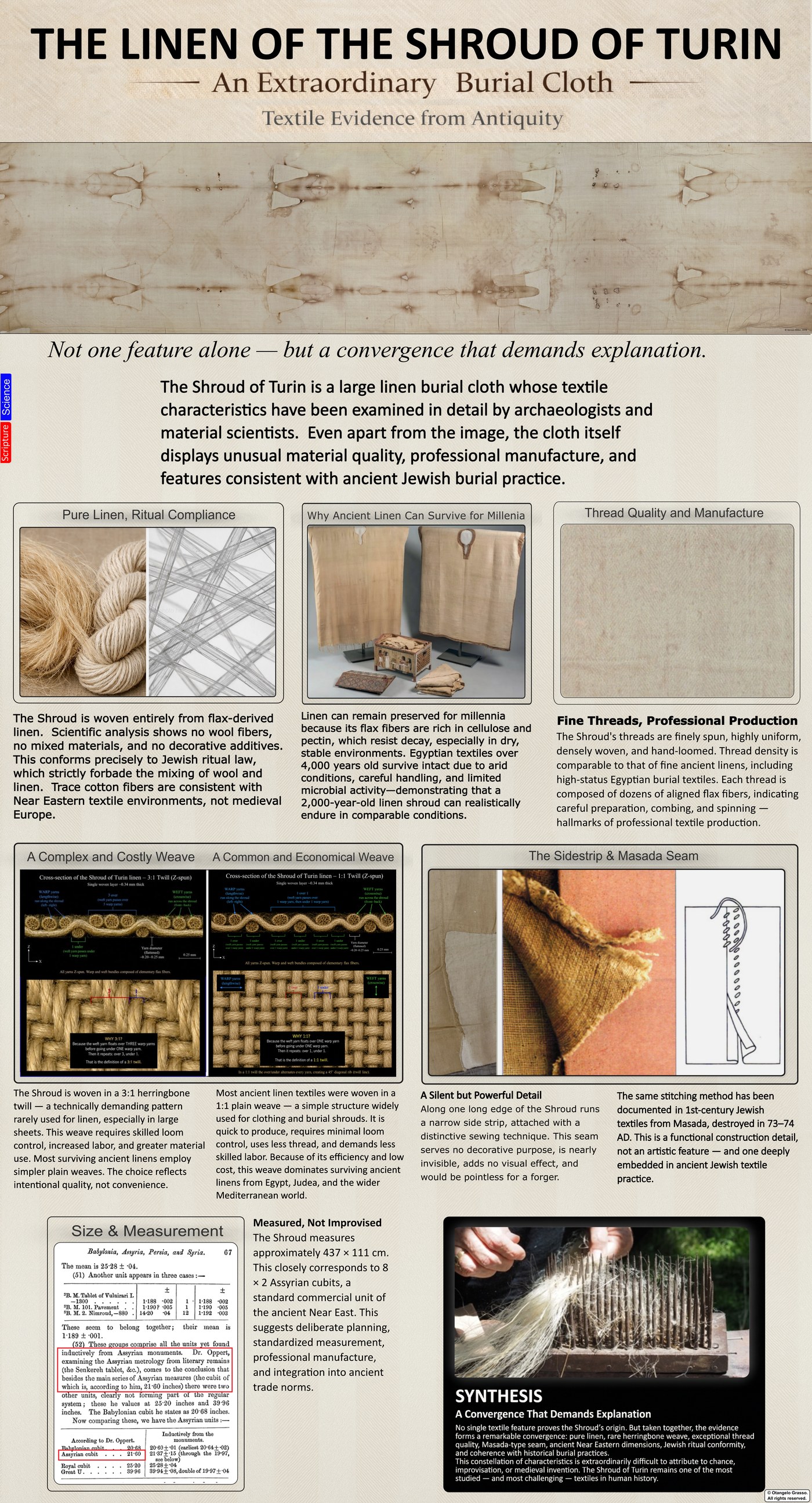
Before the image, before the blood, and before the radiocarbon result, there is the cloth. It is a length of linen about fourteen feet long, woven in a pattern that most ancient and medieval burial textiles do not use. Its fibres, its seams, and its dimensions are the first physical evidence that any explanation of the object has to account for. They are also the least dramatic evidence, and the one most easily overlooked, because they do not look like a miracle or a crime scene. They look like cloth.
This chapter asks what the linen can show. Textile study can describe how a cloth was made, what tools and skills it required, what it shares with cloths of known date, and how it was used and repaired. It can rarely fix a date by itself. The arguments in this chapter turn again and again on comparisons, and on the limits of those comparisons, because the surviving record of ancient and medieval textiles is uneven and fragmentary.1
What the cloth is made of
The fibres are flax, the plant Linum usitatissimum. Flax yields a long, strong bast fibre, rich in cellulose, and linen made from it is durable when kept dry and stable. Ancient linen has survived for thousands of years in favourable conditions. Egyptian linen from more than four thousand years ago is preserved in museums, and the survival of linen across long periods is therefore not, in itself, a reason to doubt the age of the Shroud. The question is whether the Shroud’s own features point to a particular period.2
Microscopic study has reported that the individual fibres are fine. Figures cited in the literature give diameters of roughly ten to twenty micrometres, which is a fraction of the width of a human hair. The yarns are assembled from many such fibres, and the reported thread counts and densities vary between studies, because they depend on the part of the cloth examined and on the method used. The safest statement is that the linen is fine, lightweight, and of a quality consistent with a high-grade textile rather than a coarse utilitarian cloth. That statement is useful for comparison, but it does not give a date.3
In 2010 Rachel Freer-Waters and A. J. Timothy Jull published a photomicrographic examination of a sample split from the 1988 Arizona radiocarbon sample. They found no evidence that contradicts the sample coming from the main part of the cloth, no evidence of coatings or dyes, and only minor contaminants.4 A later report by the same authors, dated 2026 and described in some sources as a direct examination of two Arizona fragments, could not be confirmed, and its findings are not relied on here. The 2010 results bear on the repair and contamination hypotheses discussed in Chapter 19, and they are limited by the size of the sample examined.
The herringbone twill
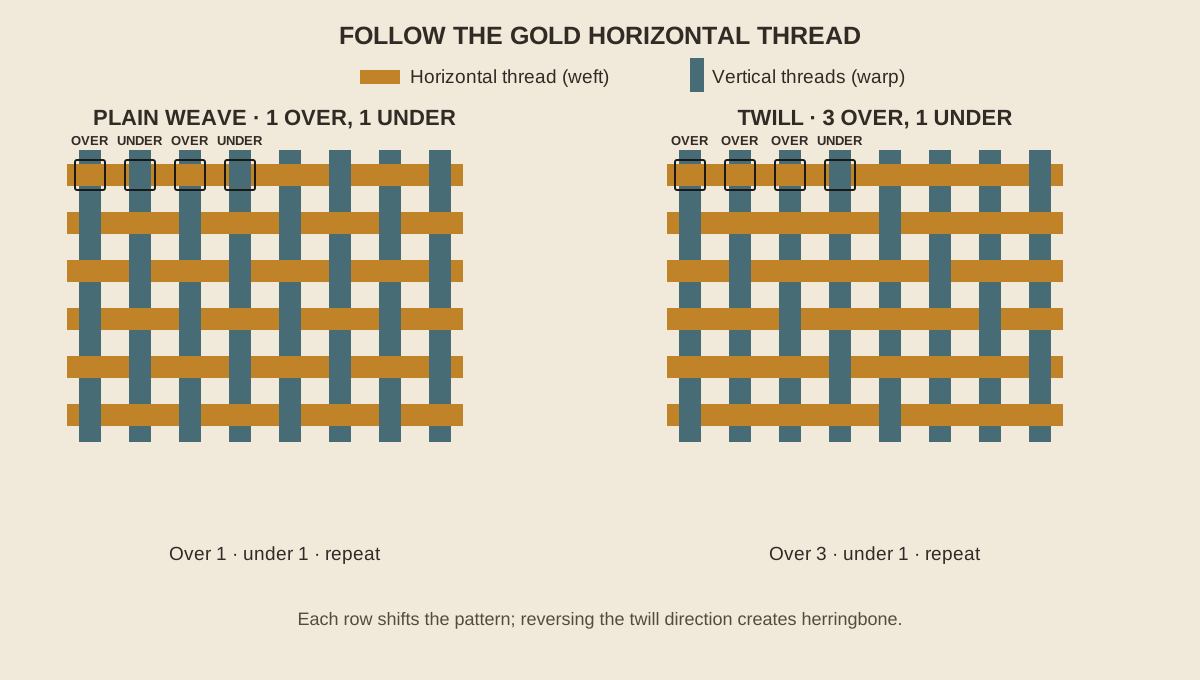
The most distinctive feature of the cloth is its weave. It is a three-over-one herringbone twill: each weft thread passes over three warp threads and then under one, and the direction of the diagonal reverses at intervals, forming a chevron pattern across the surface. A plain weave, one thread over and one under, is the default for most ancient and medieval linen. A twill is more complex, and a herringbone twill is more complex still, because the weaver has to reverse the direction of the twill at regular intervals while keeping the tension and the edges even across the width.
A herringbone of this kind requires a loom with several harnesses. Four harnesses are usually cited, because they are needed to lift the warp threads in the sequence the pattern demands. The weaver cannot produce the pattern on a simple loom. The pattern therefore points to a certain level of equipment and skill, and it also costs more than a plain weave. A twill uses more yarn than a plain weave of the same size, takes longer to weave, and does nothing for the practical use of a burial cloth, since the body beneath it does not see the pattern. The cloth’s weave is a sign of care, and not only of function.5
Twill weaving was known in the ancient Near East and in medieval Europe. In medieval Europe it was used more often for wool and for textiles intended to be seen than for plain linen used in practical contexts. A herringbone linen of medieval date is not impossible. The Victoria and Albert Museum in London holds two medieval linen fragments, museum numbers 8615-1863 and 7027-1860, woven in a three-to-one herringbone. They are the same weave as the Shroud, in a coarser thread count, and they show that the technique was known in medieval Europe.6 Their rarity is also instructive. Only two such examples are known among the many medieval textile specimens in European collections, and neither is a cloth of comparable size. No medieval inventory or textile collection is known to record a linen of the Shroud’s size in this weave.
The question therefore is not whether herringbone linen existed in the Middle Ages. It did. The question is whether a cloth of this size, in this weave, with this spin and this sidestrip construction, is more likely to have been produced in the Roman period in Judea or in medieval Europe. The textile evidence does not answer that question on its own. It shifts the weight of the question, and the rest of the chapter explains how.
Spin and twist
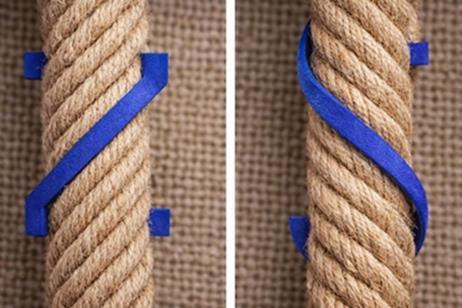
Flax yarn is spun in one of two directions, known as S-twist and Z-twist, from the diagonal of the twist in the yarn. Both are documented in ancient and medieval textiles, and the direction alone does not establish a date or a region. Spinners often worked in a direction that came naturally to them, and a change of direction required deliberate effort. Some reports describe the Shroud’s yarn as Z-spun, and a 2026 report on Arizona fragments, not yet confirmed, describes Z-twisted yarns in the fragments examined.4
The significance of the Z-twist depends on the comparison. Textile writers note that Z-spun linen is uncommon in the excavated corpus of locally produced Roman-period Judean textiles, but it is not unknown in the ancient world. Rare early Egyptian Z-spun linen is acknowledged, and Z-spun Roman-period textiles found in Israel are generally interpreted as imports. Z-twist linen is also well documented in medieval European production. The direction of spin therefore narrows the field of possible origins without fixing a single one. It makes the cloth atypical of an ordinary locally woven Judean burial sheet, and it does not, by itself, make the cloth medieval.4
Continuity of the yarn has also been discussed. Medieval spinning often left visible splices, where one bundle of prepared fibre ended and another began. Some examinations of the Shroud report smoother transitions, which would fit the preparation methods of the ancient Mediterranean. The point is suggestive rather than decisive, since smooth yarn is not confined to one period, and the observation depends on the magnification and the sample examined.
Thread density and the loom
Thread density is often cited as evidence of quality. The Shroud’s density is reported in the literature in the range of the finest linens, and the figures are used to compare the cloth with fine ancient textiles. High density is not a medieval marker in itself. A New Kingdom Egyptian linen in the Metropolitan Museum of Art is recorded with a density of about forty-six warp threads and thirty weft threads per centimetre, which is comparable with the densest figures reported for the Shroud.7 Density is a sign of skill and of the quality of the fibre. It does not identify a period.
The width of the cloth suggests that it was woven on a broad loom. Many surviving European textiles of the medieval period were woven on narrower looms, and the Shroud’s width of about 1.1 metres is more than many. Wide looms were not unknown in medieval Italy and France, so the width does not exclude a medieval origin. It is one more factor that has to be weighed.8
Dimensions and the cubit argument
The cloth measures about 437 centimetres by 111 centimetres. Writers who argue for an ancient origin have noted that these dimensions are close to eight by two cubits of about 54.5 centimetres, using the Assyrian cubit that was used in commerce across the Near East in the first century. Jewish merchants continued to use it under Roman rule. The arithmetic is accurate, and the observation is worth recording. It is weak as evidence, for three reasons.
First, many cloths were made to other dimensions, and a match with one measurement system does not exclude others. Second, the cubit values cited are approximate, and the results depend on the choice of cubit length. Third, the sidestrip complicates the picture. If the loom was slightly narrow, a strip could have been added to reach two cubits, but that explanation is itself a hypothesis, and it does not follow from the measurements. The dimensions are a point to record and to compare with other cloths of known date. They are not a basis for a date on their own.9
The argument about medieval measures is the other side of the same point. In medieval Europe, units of length varied from town to town, and a medieval weaver would have worked with local units. A cloth matching the Assyrian cubit is therefore more naturally explained by a workshop that used that unit. Whether such a workshop existed in the Roman period in Judea, and whether the unit was used there, are questions for the historians of metrology, and the answers are not settled by the cloth.
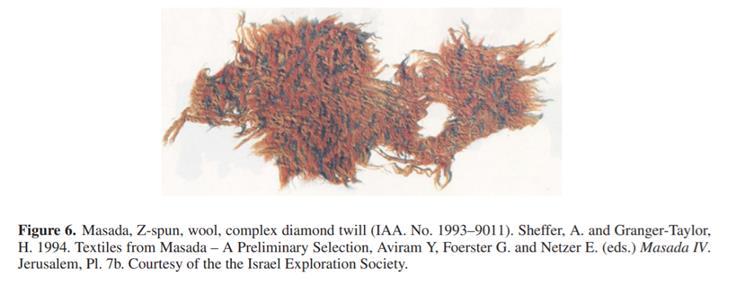
The sidestrip and the Masada comparison
The sidestrip is the second textile question. It is a narrow strip of linen, about eight centimetres wide, sewn along one long edge of the cloth. Its edges are joined to the main body with stitching that is nearly invisible on the front, and the construction on the back has several stages. The strip is the feature that has most directly invited comparison with dated textiles.1
In 2002, while the 1532 repair patches were being removed for study and conservation, the textile conservator Mechthild Flury-Lemberg examined the seam closely. She reported a close similarity between its technique and a seam found in linen fragments excavated from Masada, the fortress above the Dead Sea that fell to Roman forces in AD 73 or 74.1 Masada is a securely dated site, and the textiles recovered there have been published in detail by Sheffer and Granger-Taylor in 1994. Their date rests on the archaeological context of the fortress, which is a first-century destruction horizon. Later work has discussed comparable first-century burial textiles from Jerusalem, and an analysis by Shamir in 2015 compared a first-century burial textile with Roman-period cloth.10
The comparison is significant only if the seam technique is distinctive enough to be unlikely in another period. That question remains open. Several considerations weigh in both directions. The Masada material is small, and the seam technique is known from a limited number of fragments, so it is hard to judge how widely the method was used. A medieval craftsman who had access to an older textile, or who copied an older tradition, could have reproduced the method. The argument that no medieval textile worker could have known the technique depends on how completely the medieval record is known, and that record is incomplete. The sidestrip could also be a later addition, a repair, or a piece joined at another time. Establishing when the strip was attached is a necessary step before the seam can be used as evidence of date.
The sidestrip also matters for the radiocarbon question. The 1988 samples were cut from a corner close to the side strip region, and the relation between the strip, the corner, and the main cloth has been examined by several researchers. Chapter 19 discusses that relation in detail.
The repairs and the patches
The cloth bears the marks of a long and turbulent history. The fire of 1532 burned through the folds in which the cloth had been stored, and the burn holes were covered by triangular patches sewn by the Poor Clare nuns of Chambéry, who also attached a backing of Holland linen in 1534. The patches were removed during the conservation intervention of 2002, which exposed the fire holes and gave textile specialists access to the reverse of the cloth.11 The patches are themselves part of the textile record. Their placement follows the folds of the cloth at the time of the fire, and their stitching is evidence of the repairers’ technique.
The fire also gives the textile study a natural control. The scorches and holes are damage written beside the image in the same linen, and they show how heat and water affect this particular cloth. Later spectral and chemical tests could be compared with the fire damage, which is known to have a different chemical signature from the body image. This is one reason the 1532 fire is considered important in the scientific study of the cloth.11
Water stains cross the cloth in diffuse patterns. Some are associated with the wetting of the reliquary during the 1532 fire, and others may be older. The origin of all the water marks is debated. They do not carry anatomical information, and they must not be confused with the body image or with the bloodstains.11
Repeated small holes, known as poker holes, appear in copies of the cloth made before 1532. Their cause is uncertain, and their presence in earlier copies means that some of the holes existed before the fire. The poker holes are a textile record that the textile study has to account for, and they are one reason the physical history of the cloth cannot be read from the fire damage alone.
Wool, purity, and the law of mixed fabrics
The examined samples of the Shroud contain no wool. That fact has been noted because of a rule in Jewish law, shaatnez, which forbids mixing linen and wool in one garment (Leviticus 19:19; Deuteronomy 22:11).12 The rule was applied in practice, and it was of particular importance for burial clothing, because the dead were thought to meet God in their wrappings. A workshop observing the rule would keep linen and wool processing separate.
Medieval European workshops often handled several fibres on shared equipment, and wool fibres are a common contaminant in medieval linen. A cloth with no wool at all is therefore unusual for a medieval production setting. That observation does not prove Jewish origin. A dedicated flax workshop that never handled wool would produce the same result, and a careful medieval producer could also avoid wool. The absence is one piece of negative evidence, consistent with several origins, and it should be read with that caution.
The radiocarbon sample and the textile
The 1988 radiocarbon measurements dated samples from one corner of the cloth, and that corner has been the centre of the textile debate. The question is whether the corner is representative of the main body of the cloth. Several hypotheses have been advanced. One proposes an invisible medieval reweave at the sampled corner. Another proposes contamination of the sample by carbon from handling, smoke, or microbial growth. A third proposes that the corner differs chemically from the rest of the cloth, with proposed indications of cotton, dye, or degradation products.13
The 2010 photomicrographic study bears on the repair and contamination questions. A 2026 report on Arizona fragments, which describes yarn twist and weave, could not be confirmed and is not relied on here. The 2010 study found no evidence of coatings or dyes, and only minor contaminants.4 These results bear on the repair and contamination hypotheses, but they do not settle the question. The fragments are few and small, and the portion examined under the electron microscope was tiny. The fragments may not represent the whole of the 1988 material, and the relation between the surviving pieces and the exact material consumed in 1988 is uncertain. Chapter 19 sets out the full argument.
What textile evidence can establish
The textile evidence can establish several things with reasonable confidence. The cloth is linen. It is woven in a three-over-one herringbone twill, which requires a loom with several harnesses and skilled operation. Its yarn is Z-twisted, and its fibres are fine. It has a sidestrip of a particular construction, and it carries the marks of a long and turbulent history, including the 1532 fire and the repairs that followed. Its dimensions are consistent with a broad loom and with a unit of measure that the cloth’s makers may have used.
The evidence cannot establish a single date for the linen. The same weave and spin were used across long periods and across regions. The surviving record of ancient and medieval textiles is uneven, and many of the comparisons are with small fragments rather than with complete cloths. The textile evidence can rule some possibilities out, and it can make others more or less likely. It cannot by itself decide between the first century and the medieval period.
Comparisons across the centuries
Three kinds of comparison are used in the literature. The first is with dated ancient linens, such as the Egyptian linens, the Dead Sea scroll wrappings, and the Masada fragments. These comparisons show what fine linen looked like in the ancient world, and they show that some features of the Shroud are found there. They do not show that the Shroud is one of those textiles.
The second is with medieval linens, such as the Victoria and Albert herringbone fragments, and with the medieval textile record more broadly. These comparisons show that the herringbone weave was known in medieval Europe, and that large linen cloths were made there. They also show how rare a cloth of the Shroud’s size and weave is in that record.
The third is with the Shroud itself, through its own internal consistency. A cloth that has a sidestrip, a herringbone weave, and a Z-twist yarn is internally consistent, and its features can be compared with one another. The question is whether the features fit one manufacturing tradition, and whether that tradition is more likely in one period than another. The answer is not yet settled, and the series does not claim that it is.
How textile evidence is dated
Dating a textile is difficult, and the methods available to specialists are of several kinds. The most precise is radiocarbon dating, which measures the decay of carbon-14 in the cellulose of the linen itself. It gives a calendar range, but it requires a sample that is representative and uncontaminated. The Shroud’s radiocarbon result, discussed in Chapter 19, depends on those conditions, and its interpretation has been contested for that reason.13
The second kind of method is typological. A specialist compares the weave, the spin, the fibre, the dye, the stitching, and the finishing of a cloth with other cloths of known date, and asks which group the cloth most resembles. Typology is powerful when the reference collection is large and well dated. It is weak when the collection is small, when a technique persisted for centuries, or when the cloth has no close parallel. The Shroud belongs to the last category in several respects. Its herringbone weave has few documented parallels, its size has none in the surviving medieval record, and its sidestrip has a construction that specialists have compared with a small number of first-century fragments.
A third kind of method is contextual. A textile found in a sealed archaeological deposit can be dated by its context, and this is the basis of the Masada comparisons. The fortress was destroyed in AD 73 or 74, and textiles recovered from its destruction levels can be dated with reasonable confidence. The method works well when the context is secure, and it is much less useful for a cloth whose own history is unknown. A cloth of unknown provenance cannot be dated from the context of another cloth, however similar the two may look.
Each method has its own limits, and the Shroud has been studied by all three. The most reliable conclusions are those on which the three kinds of evidence agree. Where they disagree, the disagreement is a sign that the question is open. Textile specialists have generally been cautious about the Shroud, because the cloth is unlike most of the surviving corpus and because its features can be read in more than one way.
Earlier textile examinations of the cloth
The textile study of the Shroud did not begin in 1978. The Belgian chemist Gilbert Raes examined the cloth in the early 1970s and reported his findings in a 1974 report, whose English version, “The Textile Study of 1973–74”, appeared in 1991.14 His work on the structure of the linen and the sidestrip became part of later discussions of the radiocarbon corner and of its possible repair. The reweave hypothesis, which holds that the sampled corner was repaired with an invisible medieval mend, is associated with his name, although it has been developed and contested by others since.
Mechthild Flury-Lemberg, the Swiss textile conservator, examined the cloth in 1973 and again in 2002, when the patches were removed. Her 1988 book, Das Turiner Grabtuch und der Ursprung seines Bildes, sets out her analysis of the weave, the sidestrip, and the repairs, and it is the most detailed textile study of the cloth in the literature. She argued that the overall construction was more consistent with first-century Levantine practice than with documented medieval European linen. Her view has been influential, although it is not universally shared.1
Later examinations have benefited from new instruments and from access to the reverse of the cloth after the 2002 intervention. The most recent report cited, a 2026 study of Arizona fragments, could not be confirmed and is discussed above.4 Each examination has added information, and each has been limited by the conditions of access and the size of the samples. The cumulative result is a detailed picture of the linen, with questions that the surviving evidence has not yet closed.
Labour, tools, and the making of the cloth
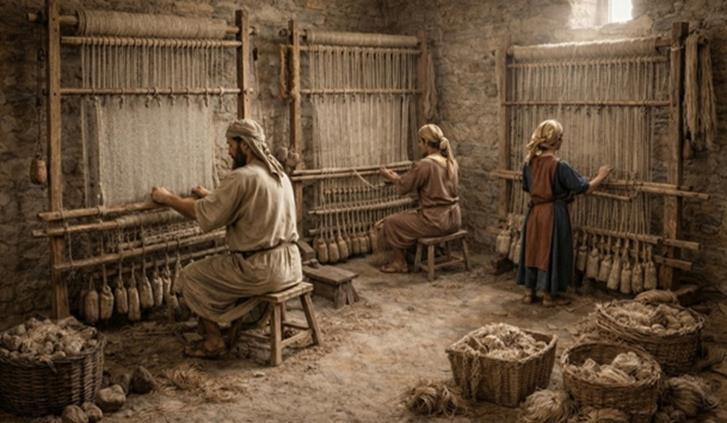
A cloth of this size represents a large investment of labour. The flax had to be grown, harvested, retted in water to loosen the fibres, scutched and hackled to separate them, spun into yarn, and woven on a loom large and strong enough to hold the warp under tension. Each stage required skilled hands and time. Retting alone could take days or weeks, depending on the water and the temperature. A herringbone pattern added the time needed to manage the harness sequence, and the sidestrip added a further stage of weaving and sewing.
The labour also implies a purpose. A cloth of this kind was expensive, and it was not made for casual use. High-quality ancient and medieval linen was used for religious vestments, for the clothing of the wealthy, and for the wrapping of important persons after death. The Shroud’s quality is therefore consistent with a cloth made for someone of means, and it fits the Gospel description of a burial cloth bought for the purpose. It does not identify the buyer or the maker, and it does not decide whether the cloth was made for a Jewish burial in the first century or for a Christian relic in the medieval period.
The tools of the weaver also leave traces. The width of the loom is one. The number of harnesses is inferred from the pattern. The spinning equipment, such as the spindle and the distaff, leaves no trace in the cloth itself, but the direction of the spin records the spinner’s habits. Textile archaeologists use these traces to reconstruct the workshop, and a full reconstruction of the Shroud’s workshop has not yet been published.
The sidestrip in more detail
The sidestrip deserves a closer look, because it is the feature most often used to argue for a date. It runs along one long edge of the main cloth and is about eight centimetres wide. Its edges are joined to the main body by stitching that is almost invisible from the front, and the joint is more complex than a simple overlap. The construction has several stages, with the selvedges of both pieces secured by fine stitches. Seen from the back, the seam shows the structure of the join, and the X-radiograph of the seam made in 1978 shows how the strip was attached.1
Two questions arise. The first is whether the strip was woven with the main cloth or added to it later. If the strip was woven as part of the same warp, the cloth was designed to be wider than the loom’s standard width, or the loom was set up to produce a strip of that width. If the strip was added later, it is a repair or an extension, and its date is a separate question. The second question is what the strip was for. Some writers have suggested that it was added to bring the cloth to a particular width, and others that it was a practical answer to a loom that was slightly too narrow. Neither suggestion has been tested against a close parallel.
The relation between the strip and the radiocarbon corner is also significant. The 1988 samples were cut from a corner near the strip, and whether the strip and the corner share a history is part of the debate about the sample. The strip is therefore not only a textile feature. It is also part of the argument about the date.
Textiles from the Judean desert and their relevance
The Judean desert has yielded textiles from the first century and the centuries before. The caves of the Dead Sea region, including those near Qumran, contained textiles used as wrappings and as clothing, and some have been studied in detail. Those textiles are generally coarser than the Shroud and are usually plain weaves. They show that linen of various qualities was made and used in the region, and that burial wrappings of the period were not uniform. They do not show that the herringbone weave or the Z-twist of the Shroud was common in the region.
The Masada fragments are more directly relevant, because they include textiles with the stitching that Flury-Lemberg compared with the sidestrip. Their date rests on the destruction of Masada in AD 73 or 74, and they give a secure first-century reference for the textile techniques of the time. Their limits are those of any small corpus. Only a few fragments are known, and their range of techniques may not represent everything that was made in the region. The comparison with the Shroud is therefore a comparison with a sample, not with the full production of the period.
Egyptian linens offer a further comparison. Egyptian textiles of the New Kingdom and later periods include fine linens of high thread count, and some show weaves more complex than plain weave. They show that high-quality linen had a long history in the Eastern Mediterranean, and that the techniques used for the Shroud were not unknown in the ancient world. They do not establish that the Shroud was made in Egypt, and they do not exclude other places.
Textile features and the historical record
The textile evidence is one strand of the case. It is strongest when read alongside the historical record and weakest when read in isolation. A cloth with a first-century weave and stitching is more coherent with a first-century context if there is a documented chain of custody from that period. The Shroud has no such chain before the fourteenth century, so the textile evidence has to carry its weight without that support, and the reader has to decide how much weight it can bear.
Conversely, the historical record does not decide the textile question. A cloth found in medieval France could be a copy of an ancient textile, a medieval textile with an ancient style, or a cloth imported from elsewhere. The documents describe the cloth, but they do not describe its manufacture. The two kinds of evidence can be combined, but neither can replace the other.
What the textile evidence cannot say
The linen cannot say who wove it, where, or for whom. It cannot say whether the weaver intended a burial cloth or a relic, and it cannot say whether the cloth was ever used to wrap a body. The stains and the image are not textile features, and the textile study cannot identify their origin. The linen is the surface on which the other evidence lies, and the textile study can describe its age and origin only in part.
Cellulose ageing and the dating methods
Textile dating has tried to measure how the cellulose of a fibre has aged. Cellulose chains break and change over time, and the rate of change depends on temperature, humidity and light. Theodor Kleinert studied the natural ageing of linen over long periods in 1972, and the basis of the method is that older linen has more degraded cellulose.15 Jackson and colleagues used infrared laser heating in 1988 to study the degradation of cellulose.16
Giulio Fanti and colleagues, in a 2013 paper in Vibrational Spectroscopy, reported that the infrared and Raman spectra of flax samples from about 3250 BC to AD 2000 correlate with age, using exponential calibration curves with correlation coefficients above 0.9. The authors state that the method currently gives an uncertainty of centuries, and that more samples and better cleaning would be needed. The paper excludes Shroud samples, so its calibration says nothing about the Shroud directly.17 Silvio Diana and Emanuela Marinelli worked on depolymerisation and racemisation of natural fibres in the 1990s, and their results appear in the same debate.18 These methods can compare cloths, but they are not yet able to settle the Shroud’s age on their own.
The weave debate: medieval or ancient loom
The herringbone twill is at the centre of the textile argument. Writers who place the cloth in the Middle Ages, among them Hugh Farey, Donald King and the historian Andrea Nicolotti, argue that a 3/1 herringbone of this kind is typical of medieval European looms and that comparable fragments are medieval.1920 Writers who place it in the ancient world argue that the weave and its dimensions match Judean and Egyptian practice.21
Antoinette Merete Olsen tested the question practically in 2020, by trying to weave a 3/1 chevron twill on a warp-weighted loom, the kind of loom used in the ancient world. Her work asks how the extra sheds needed for the pattern could be set up, and it compares the result with a control in 2/2 twill.22 It invites a practical test rather than a claim about date. The full text should be read before its conclusions are relied on, because the summary available here does not state whether the 3/1 twill is practical on the loom she used.
Burial textiles from Jerusalem and the Judean desert
Comparisons with Jewish burial textiles are central to the ancient argument. Orit Shamir reported in 2015 a wool burial shroud from a sealed loculus in the Akeldama (Ben Hinnom) area of Jerusalem, and she compared its spin and weave with Roman-period textiles from Israel and with the Shroud. Her paper argues that the wool’s Z-spin points to production outside Israel. Press coverage reports that she concludes the more complex weave of the Shroud does not point to a typical first-century Jerusalem burial shroud. That press summary is not the paper, and its exact claims should be checked in the original.23 Diana Fulbright argued that discussions of the Shroud omit textile evidence from the Judean desert, and Ada Grossi and John Lupia have compared the Shroud with Jewish shrouds and funerary customs.2425
Repairs, the 1973 study and the older textile reports
The textile examinations of the 1970s form part of the record. Gilbert Raes reported a textile study of the cloth in 1973–74, finding traces of cotton fibres in the main cloth but not in the side strip, and Enzo Delorenzi discussed the patches and darns in the Turin Commission report of 1976.2627 Mechthild Flury-Lemberg published a detailed study of the linen in 2001, and in 2003 she reported an ancient fabric with a herringbone pattern, which she compared with the Shroud.28 Silvio Curto’s archaeological observations, published in the Turin Commission report, are cited in the same literature.29 These sources show that the repairs and the weave were recorded long before the radiocarbon test, and they form the baseline for later claims.
Radiocarbon and textile contamination
The radiocarbon result depends on whether a textile sample is representative, and textile scientists have studied how a cloth’s apparent age can be shifted. Remi van Haelst and Mario Moroni discussed environmental influences on the radiocarbon age of textiles in 1991 and 1997.3031 Andre Verhecken studied the relation between age and dyes in first-millennium textiles from Egypt, and Benford and Marino argued in 2002 that the textile evidence supports a skewed radiocarbon date. They proposed that the dated corner was a later patch, and that a mixture of roughly 60 per cent later and 40 per cent original linen would give a date near the 1988 result. Critics dispute the calculation, and the textile expert Mechthild Flury-Lemberg has denied that any reweaving is visible.3233 These papers bear on the sampling and reweaving questions in Chapter 19, and their conclusions are contested.
What remains open
Several textile questions remain open. The first is whether the sidestrip was part of the cloth from the beginning or was added later. The second is whether the Masada comparison holds, and how widely the stitch technique was used. The third is whether the surviving Arizona fragments are representative of the whole 1988 sample. The fourth is whether the cloth was woven in a workshop that followed the cubit or in one that used other measures. Each question has evidence on both sides, and each is a question for further study rather than one that can be answered by argument alone.
The chapters that follow move from the linen to the blood it carries. The cloth is the surface on which all the other evidence was recorded, and it is the first object that any account has to explain.
References
- Flury-Lemberg, M. (1988). Das Turiner Grabtuch und der Ursprung seines Bildes. Bern: Abegg-Stiftung. The 2002 examination of the sidestrip, and its comparison with Masada, as reported in the textile literature.
- Egyptian linen and the survival of ancient textiles, as discussed in the textile and conservation literature. Publication details to be confirmed before publication.
- Fibre diameter and thread density of the Shroud linen, as reported in the scientific literature on the cloth. Publication details to be confirmed before publication.
- Freer-Waters, R. A., & Jull, A. J. T. (2010). Investigating a dated piece of the Shroud of Turin. Radiocarbon. Volume and pages to be confirmed before publication.
- Herringbone twill and loom requirements, as discussed in the textile literature. Publication details to be confirmed before publication.
- Victoria and Albert Museum, London, medieval linen herringbone fragments, museum numbers 8615-1863 and 7027-1860.
- Metropolitan Museum of Art, New Kingdom Egyptian linen, thread counts as recorded in the museum’s documentation. Publication details to be confirmed before publication.
- Loom width and the medieval textile record. Publication details to be confirmed before publication.
- Assyrian cubit and first-century metrology, as discussed in the historical literature on ancient measurement. Publication details to be confirmed before publication.
- Sheffer, A., & Granger-Taylor, H. (1994). Textiles from Masada: a preliminary selection. In Y. Aviram, G. Foerster, & E. Netzer (Eds.), Masada IV. Jerusalem: Israel Exploration Society. Shamir, O. (2015). A burial textile from the first century CE in Jerusalem compared to Roman-period textiles. Publication details to be confirmed.
- Conservation history of the cloth: the 1532 fire, the 1534 repairs, and the 2002 intervention. Reported in the historical and conservation literature on the cloth.
- Leviticus 19:19; Deuteronomy 22:11. Leviticus 19:19; Deuteronomy 22:11.
- Rogers, R. N. (2005). Studies on the radiocarbon sample from the Shroud of Turin. Thermochimica Acta, 425(1–2), 189–194. Damon, P. E., et al. (1989). Radiocarbon dating of the Shroud of Turin. Nature, 337, 611–615. doi:10.1038/337611a0
- Raes, G. (1991). The textile study of 1973–74. Shroud Spectrum International, 9(38/39). The 1974 original report is not separately verified.
- Kleinert, T. N. (1972). Ageing of cellulose: natural ageing of linen over long periods of time. Holzforschung, 26, 46–51.
- Jackson, J. P., et al. (1988). Infrared laser heating for studies of cellulose degradation. Applied Optics, 27(18), 3937–3943.
- Fanti, G., Baraldi, P., Basso, R., & Tinti, A. (2013). Non-destructive dating of ancient flax textiles by means of vibrational spectroscopy. Vibrational Spectroscopy, 67, 61–70. doi:10.1016/j.vibspec.2013.04.001
- Diana, S., & Marinelli, E. (1995). Natural textile fibres: optical activity, racemization and epimerization. In L’Identificazione Scientifica dell’Uomo del Lenzuolo, Rome 1993 symposium, pp. 55–56 (publisher to be confirmed). A reprint is on shroud.com. The 1990 Cagliari depolymerisation paper is listed in the bibliography but not verified.
- Farey, H. (2019). The medieval weave. medievalshroud.com. King, D. (1989). A parallel for the linen of the Turin Shroud. CIETA Bulletin, 67, 25–26.
- Nicolotti, A. (2019). The Shroud of Turin: The History and Legends of the World’s Most Famous Relic. Waco: Baylor University Press, pp. 71–72.
- Textile comparisons with ancient Judean and Egyptian weaves, as listed in the textile bibliography (Part III). Publication details to be confirmed before publication.
- Olsen, A. M. (2020). The Shroud of Turin and the extra sheds of warping threads. EXARC Journal, 2020/4.
- Shamir, O. (2015). A burial textile from the first century CE in Jerusalem compared to Roman textiles in the land of Israel and the Turin Shroud. SHS Web of Conferences, 15, 00010. doi:10.1051/shsconf/20151500010
- Fulbright, D. (2010). Akeldama repudiation of Turin Shroud omits evidence from Judean Desert. In Proceedings of the International Workshop on the Scientific Approach to the Acheiropoietos Images, ENEA Frascati, pp. 79–85.
- Grossi, A. (2012). Jewish shrouds and funerary customs: a comparison with the Shroud of Turin. Valencia: Centro Español de Sindonología. Lupia, J. N. (2010). The Ancient Jewish Shroud at Turin. Regina Caeli Press, pp. 38–78.
- Raes, G. (1991). The textile study of 1973–74. Shroud Spectrum International, 9(38/39), 3–6.
- Delorenzi, E. (1976). Observations on the patches and darns in the Holy Shroud. In Report of the Turin Commission on the Holy Shroud, pp. 108–123.
- Flury-Lemberg, M. (2001). The linen cloth of the Turin Shroud: some observations on its technical aspects. Sindon N.S., Quad. 16, 55–76. Flury-Lemberg, M. (2003). Ritrovamento di tessuto antico con disegno a spina. Sindon N.S., 19–20, 121–124.
- Curto, S. (1976). The Turin Shroud: archaeological observations concerning the material and the image. In Report of the Turin Commission on the Holy Shroud, p. 61.
- Van Haelst, R. (1991). Environmental influences on textile radiocarbon dating. Shroud News, 64, 3–4.
- Moroni, M., & van Haelst, R. (1997). Natural factors affecting the apparent radiocarbon age of textiles. Shroud News, 100, 69–71.
- Verhecken, A. (2005). Relation between age and dyes of 1st millennium AD textiles found in Egypt. In De Moor, A., & Fluck, C. (Eds.), Methods of dating ancient textiles of the 1st millennium AD from Egypt, pp. 206–213.
- Benford, M. S., & Marino, J. G. (2002). Textile evidence supports skewed radiocarbon date of Shroud of Turin. Available as a PDF on shroud.com; the journal and page details are not confirmed.