The Shroud of Turin · Chapter 1 of 21
What Is the Shroud of Turin?
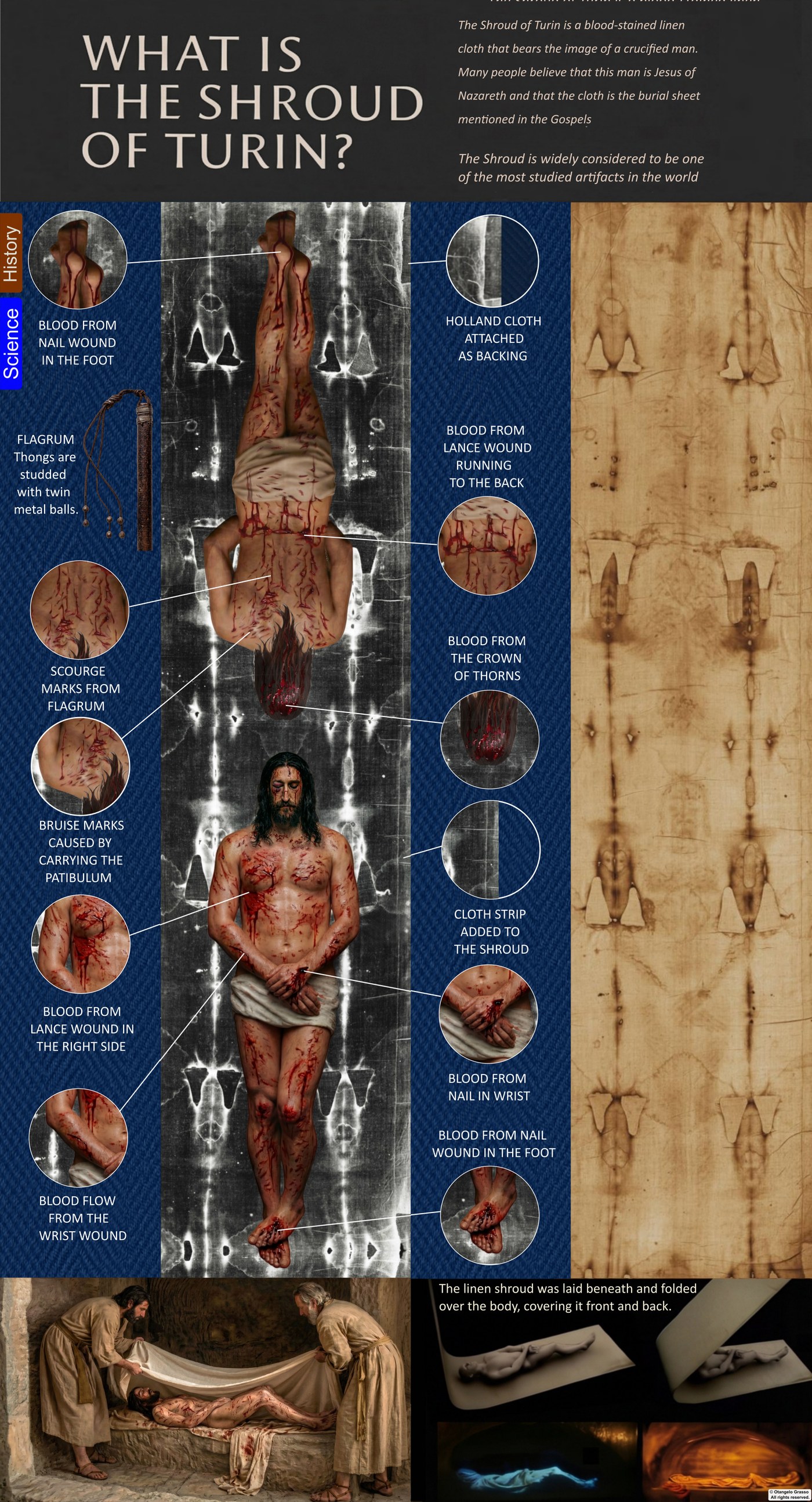
A visitor who sees the Shroud for the first time may be disappointed. The cloth is long, narrow, yellowed with age, crossed by fold lines, scarred by fire, and marked by water. The body image is so faint that it can disappear into the background when viewed too closely. Nothing about the first impression resembles a brightly painted icon or a finished religious portrait. And yet the cloth has been studied more intensively than almost any other textile, and the questions it raises have occupied scientists, historians, theologians, and sceptics for more than a century.
The cloth is kept in the Cathedral of Saint John the Baptist in Turin, Italy. Its figure is that of a naked adult male, shown twice, front and back, with the two heads nearly meeting at the middle. Many Christians believe it is the burial cloth of Jesus of Nazareth, the linen that the Gospels describe as wrapped around his body after his death. That belief is part of why the cloth is famous. This chapter does not decide the question of belief. It sets out what the cloth is, what has been measured on it, how its study developed, and which questions the rest of the series examines.
A cloth that does not look like a masterpiece
The first discipline of any serious study is to describe the object before explaining it. The Shroud is more than a picture. It is a length of linen that carries several overlapping records, and the description has to say what each record is before any cause is proposed. A visitor who expects a painting will find a textile, and a visitor who expects a textile will find an image that does not behave like a textile pattern. The cloth is neither a conventional painting nor an ordinary piece of cloth, and it is the gap between those two descriptions that makes it hard to explain.1
From several metres away the form coheres. A face emerges, and the shoulders, chest, arms, thighs, lower legs, and feet become intelligible. Step closer and the image begins to break apart. The eye no longer sees a continuous portrait but a distribution of slightly darker linen fibres. The effect resembles a newspaper photograph viewed from too near, except that the Shroud is not made of printed dots. Its tonal pattern comes from variations in the number and distribution of discoloured surface fibres.1
This is the first paradox of the cloth. It is unmistakably an image of a human body, yet it does not behave like a picture made to be admired at close range. That observation does not make the cloth authentic, and it does not make it a forgery. It does mean that the right descriptive question is harder than the question “who painted it?” Before a cause can be proposed, the thing that needs explaining has to be defined, and the definition has to be exact.
Dimensions, weave, and form
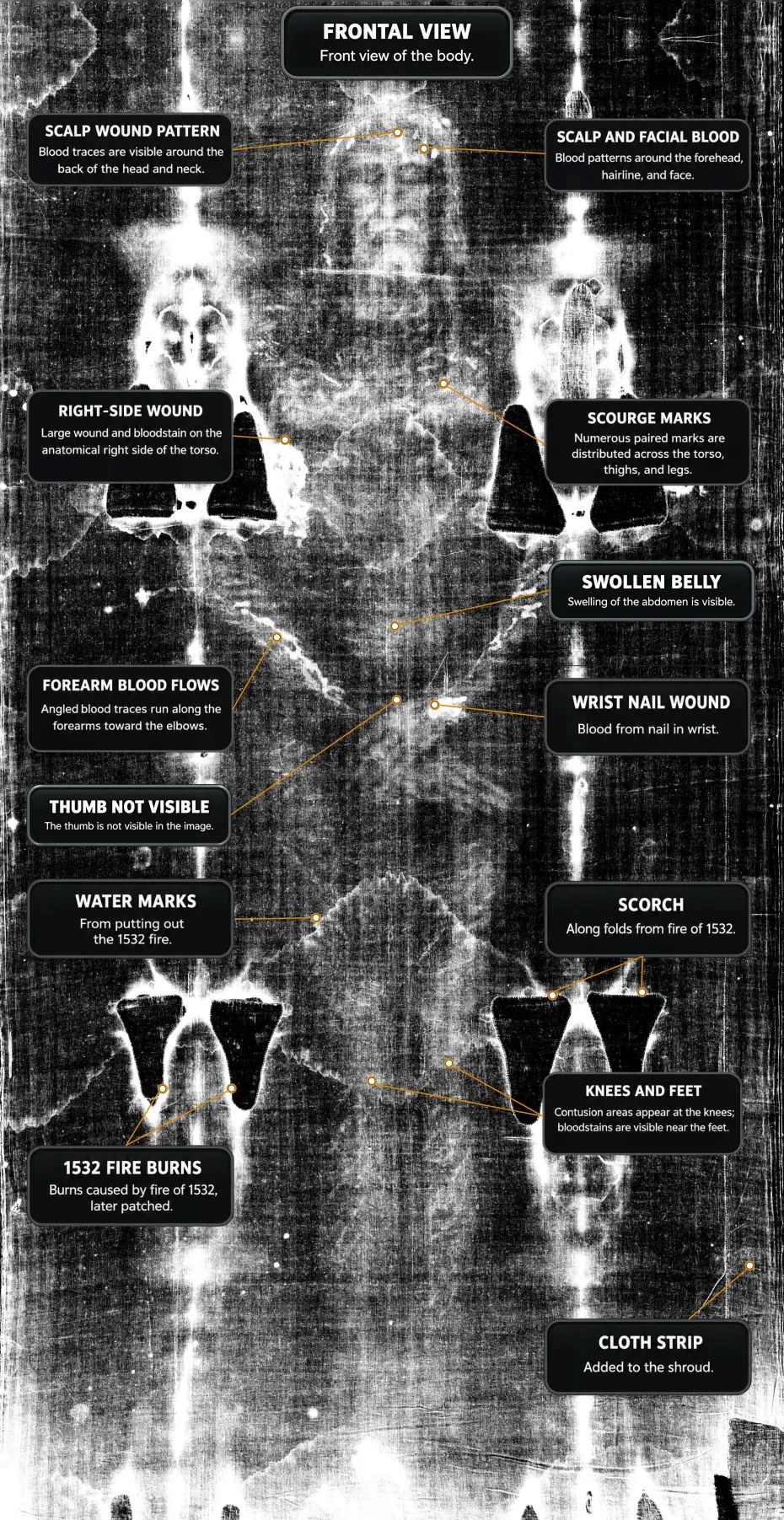
The linen measures a little more than four metres in length and a little more than one metre in width. The exact modern dimensions depend on the points chosen for measurement and on the changes made during conservation, so the familiar description of a cloth roughly fourteen feet long is adequate for orientation rather than for precise comparison. The cloth is one long piece, woven on a loom, with a narrow strip called the sidestrip joined along one edge. Chapter 2 discusses the sidestrip and its place in the textile argument.2
The weave is a three-to-one herringbone twill. The threads form repeated diagonal chevrons rather than a simple square grid. A twill of this kind needs a loom with several harnesses, and it uses more yarn and more time than a plain weave. Its appearance does not prove a date or a place of manufacture. It is simply the textile structure of the object that survives, and it is one of the features that the textile specialists have examined most closely.2
Across the cloth lies the pale imprint of the body. The two images are arranged so that the head of the dorsal figure meets the head of the frontal figure near the middle, as though the linen had been placed beneath a body, drawn over the head, and extended down the front. The hands rest across the lower abdomen, and the feet appear at opposite ends. There is no painted background, landscape, cross, inscription, or halo. The visual field is the linen itself. That absence matters, because it means that the image cannot be explained by a composition with a setting or a symbolic frame. Whatever formed the image formed it on the cloth alone.1
Four records written on one sheet
New readers often treat every mark on the Shroud as part of a single image. The cloth actually carries several overlapping records, formed at different times and, almost certainly, by different processes. Keeping them separate is the first discipline of the investigation. Four records can be distinguished, and each has a different evidential meaning.1
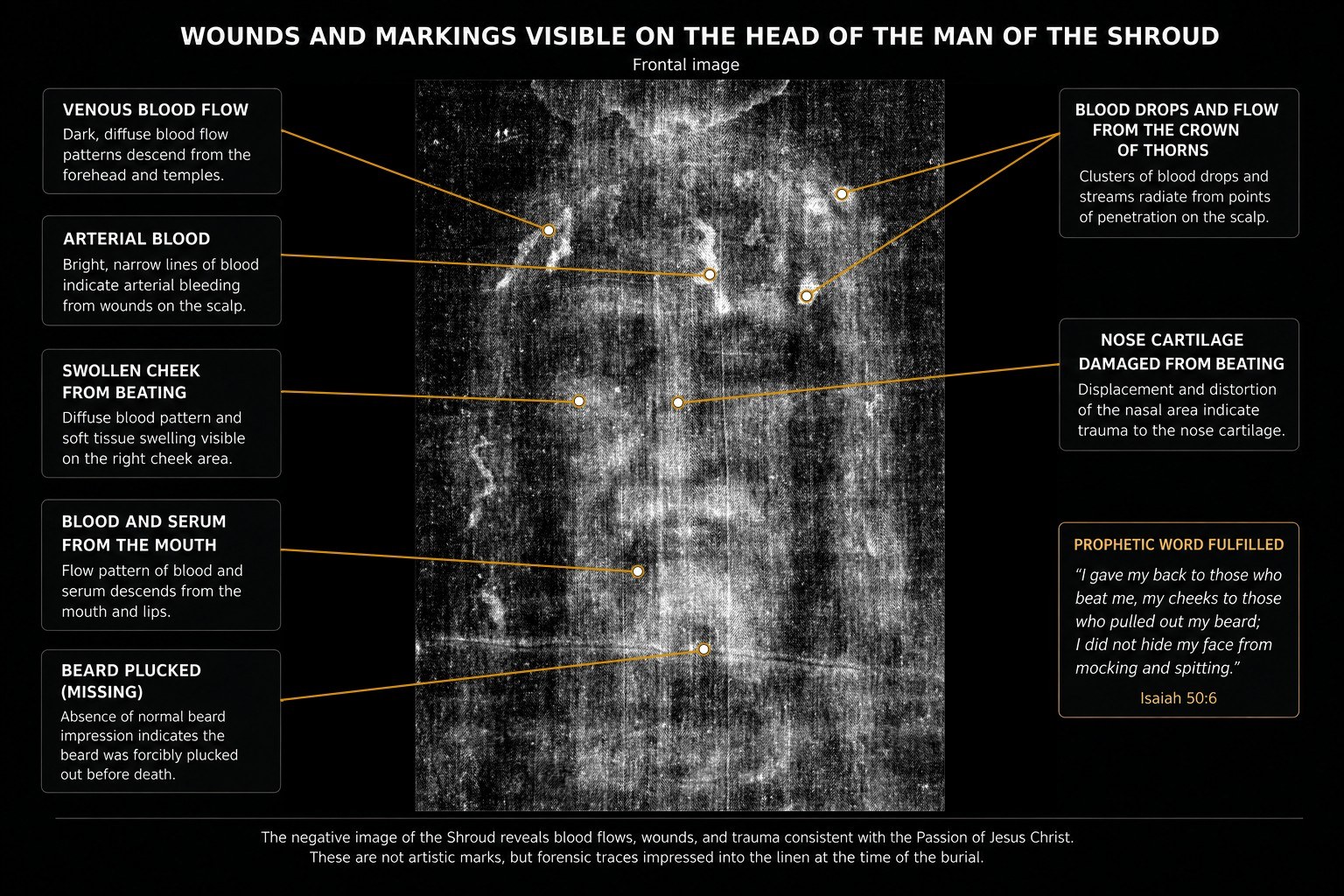
The first record is the body image: the faint straw-yellow frontal and dorsal form. Its colour is not concentrated in a visible paint film. Under magnification the discolouration is associated with the upper surfaces of selected linen fibres. Exactly how shallow the alteration is remains debated, because the strongest depth estimates depend on the condition of the sample, the microscopy, and the definition of the fibre coating. The cautious conclusion is nonetheless significant. The image is extremely superficial compared with ordinary liquid staining, dye penetration, or a thick layer of pigment.3
The second record consists of reddish-brown marks associated with wounds. These include stains at the scalp, the wrists or hands, the feet, the side, the lower back, and numerous small marks across the body. Chemical investigators have reported blood-derived compounds in samples from the cloth, including proteins, haem-related products, albumin, and serum effects. Walter McCrone argued instead that the red particles were artistic pigments, and the disagreement became one of the defining controversies of Shroud science. The series examines the methods and limits on both sides, and it does not treat the word “blood” as a conclusion beyond dispute.4
The third record is water. Large, diffuse boundaries cross the linen in repeated patterns. Some probably arose when water entered the reliquary during the fire at Chambéry in 1532, when the metal container was doused. Other water marks may predate that event. They are not anatomical features, and they must not be confused with the body image or with the blood flows.5
The fourth record is damage. In 1532 the Shroud was stored folded in a silver reliquary when fire heated and partly melted the metal. The folded cloth was burned through at corresponding places, producing a repeated pattern of holes and scorches. Poor Clare nuns repaired the damage in 1534 with patches and attached a backing cloth. The patches were removed during the conservation intervention of 2002, which left the fire holes exposed. A smaller group of repeated holes, commonly called the poker holes, appears in copies of the cloth made before 1532. Those holes therefore belong to an earlier event whose cause is uncertain.5
These four layers occupy the same sheet but do not carry the same evidential meaning. A theory that explains the burns does not explain the body image. A theory about the body image does not automatically explain the wound stains. A historical date for one repair does not date the original linen. Much confusion disappears as soon as the records are separated, and the rest of this chapter keeps them apart.
The linen and its physical history
Linen is made from flax fibres, and flax is a durable material when it is kept dry and stable. The fibres of the Shroud have survived in the condition the cloth shows, although the cloth has been folded, handled, displayed, damaged, and repaired. Each of those events left traces. Some of the traces are on the image, some on the blood, and some on the linen itself. A careful study has to identify which traces belong to the original making and which were added later.2
The 1532 fire is the most visible event in the physical history. The cloth was kept folded, and the folds determined where the fire struck. The result is a pattern of scorches and holes that repeat in a symmetrical arrangement on the front and back, and that record the way the cloth was folded when the fire broke out. The scorches are useful for dating the damage, and they are also useful for showing that the body image was not produced by heat. A heated image would be expected to show gradations of colour that follow the heat, and the body image does not do so in the same way. The comparison is a strong argument against heat as the agent of the image, and the chapter on image formation returns to it.5
The Poor Clares who repaired the cloth in 1534 added patches and a backing of Holland linen. The backing covered the reverse of the cloth, and it has to be considered in any study of the back image. The 2002 conservation intervention removed the patches and the backing, and it allowed the reverse of the cloth to be examined for the first time since the repairs. That examination is one of the reasons the modern understanding of the reverse image has improved.5 The fire at the Guarini Chapel in Turin in 1997 is a further event in the record. The cloth was then kept in the chapel, and it was rescued and later conserved.6
The poker holes are a different case. They appear in copies made before the 1532 fire, which means that the holes were already present on the cloth, or on a model of it, before the fire. Their cause is uncertain, and the series treats them as a separate record that predates the fire. Their existence is one reason the physical history of the cloth cannot be read from the fire damage alone.7
A documented custody
The documented history of the cloth follows a series of stages. It first appears in the historical record at Lirey, in north-central France, in the 1350s, where a knight named Geoffroi de Charny founded a collegiate church and showed the cloth to pilgrims.8 The evidence for the Lirey exhibitions includes pilgrim badges of the period, which show the figure of a man with arms crossed, and documents from the church and the family.
In 1389 Bishop Pierre d’Arcis of Troyes wrote a memorandum to the papal court. It claimed that an earlier bishop, Henri de Poitiers, had investigated the cloth around 1355 and found it to be a painting, and that the artist had confessed. The memorandum is the source of that claim, and its editing, dating, and address are disputed in the scholarly literature. A confession of forgery would ordinarily leave administrative records, and none survives from the mid-fourteenth century.9 The chapter on the history discusses the memorandum in detail, and the reader should treat the claim as an allegation with a complicated documentary history rather than as established fact.
The cloth passed to the House of Savoy in 1453, when Margaret de Charny, a granddaughter of Geoffroi, gave it to the family. The Savoy family kept it in Chambéry, in a chapel built for the purpose, until the fire of 1532. It was moved to Turin in 1578, and it has been kept there since. In 1983 Umberto II, the last king of Italy, bequeathed the cloth to the Holy See. Its custody today rests with the Archbishop of Turin, and it is shown to the public only on rare occasions.8
The record before Lirey is much less certain. Some historians link the cloth to a cloth in Edessa, which was venerated as an image of the face of Christ, and which was taken to Constantinople in 944. Others link it to a cloth displayed in Constantinople in the early thirteenth century, before the city was sacked in 1204. These links are discussed in Chapter 16, and they depend on identifications that the documents do not state directly.10 The chapter notes them here so that the reader knows the question exists and that the gap between the Byzantine record and the Lirey record is real.
The body image: superficial, negative, and not paint
The body image has four properties that have made it the centre of scientific debate. Each is discussed in a later chapter, and each is stated here in its basic form.
The image is superficial. The colour lies on the outer surface of the linen fibres, and it does not penetrate the thread in the way paint or dye would. Microscopy and chemical tests have found that the colour is confined to the outermost layer of the fibres, and that the inner fibres are essentially untouched. The 1978 team described that layer in terms of depth measured in fractions of a micrometre.3
The image contains no pigment of a kind known to have been used in painting. The 1978 examination detected no pigment, dye, or binder in the image fibres, and the image does not sit on the fibres the way paint would. The majority of the examining team concluded that the colour was an alteration of the linen itself, and not an applied layer.3 McCrone argued that pigment particles were present, and his view was a dissenting one within the team. The dispute is discussed in Chapter 18.4
The image is a negative. Light areas of the body appear dark on the cloth, and dark areas appear light. That property was unknown until May 1898, when Secondo Pia, a lawyer from Asti who was also an amateur photographer, photographed the cloth during a public exhibition in the cathedral. He received permission to photograph the cloth, and he found that his developed plates showed a strikingly natural positive face. The faint figure on the linen gained contrast and coherence when its tones were reversed. Pia was initially accused of error or manipulation, and the photographs were not accepted at once.11
In 1931 Giuseppe Enrie, a professional photographer in Turin, made a new photographic campaign with better equipment, and confirmed the negative quality that Pia had recorded. The observation became reproducible, and it has been repeated many times since. Whatever one believes about the cloth, an adequate explanation has to account for why its faint surface discolouration becomes more intelligible when its tones are reversed. The photographic discovery also changed the status of the relic. The Shroud could no longer be discussed only as a devotional picture. Its image contained information that is not easily seen by ordinary sight, and photography made that information available to analysis.12
The image is also not a photograph in the modern sense. The linen is not a film, and the image does not reproduce every property of photography. The expression “photographic negative” is useful, but it can mislead. The image is a negative in the tonal sense, and the question of how that tonal reversal was produced remains one of the central open problems of the subject.11
Brightness and distance
A second surprise came in the twentieth century. An ordinary photograph contains brightness, but brightness does not usually correspond in a simple way to the distance between a subject and the camera. When a normal portrait is processed by an instrument that converts light and dark into vertical relief, shadows rise and highlights sink, and the result is a distorted landscape.
In 1976 John Jackson and Eric Jumper examined Shroud photographs with a VP-8 Image Analyzer, a device developed to translate image intensity into height. The Shroud face produced a recognisable relief rather than the distortions expected from an ordinary photograph or a painting. The later work interpreted this as evidence that the image intensity contains information related to the distance between the cloth and the body.13
The claim requires careful limits. The most frequently cited quantitative correlation was based on a limited set of facial points, and it has not been independently replicated across the whole body with modern full-resolution data. It is therefore safer to say that the image has been interpreted as containing distance-related intensity information, and not that a complete three-dimensional map has been conclusively demonstrated. Chapter 6 sets out the measurements and the objections in detail.13
Even in its cautious form, the observation matters. A conventional artist normally controls brightness to create the appearance of volume from one viewing position. A distance-related image would encode geometry by a different rule. The VP-8 result does not identify that rule, but it adds another condition that any candidate explanation must satisfy.
The blood and the wounds
The stains are the second record, and they have been studied as chemistry and as forensic evidence. Heller and Adler, using spectroscopy and immunological tests, reported a spectral signature characteristic of heme, the iron-containing molecule of haemoglobin, together with serum proteins and other components consistent with blood.14 Baima Bollone and colleagues reported human blood markers in similar tests in 1981.15 Later work reported a blood group of AB. That result has been debated, because the antibodies and methods used in the early tests have known limits, and Chapter 3 explains them.
Two findings about the stains matter for the whole series. The first is sequence. The blood lies on the cloth before the body image formed. Where blood saturates the linen the image stops, which suggests that the blood was deposited first and that it shielded the fibres beneath it from whatever formed the image. The second is serum. Under ultraviolet light, many of the bloodstains show pale halos, which are the clear fluid expelled when a clot contracts. Halos of that kind are read as evidence that the blood clotted while it was still moving in a living body, although that reading depends on assumptions discussed in Chapter 3.14
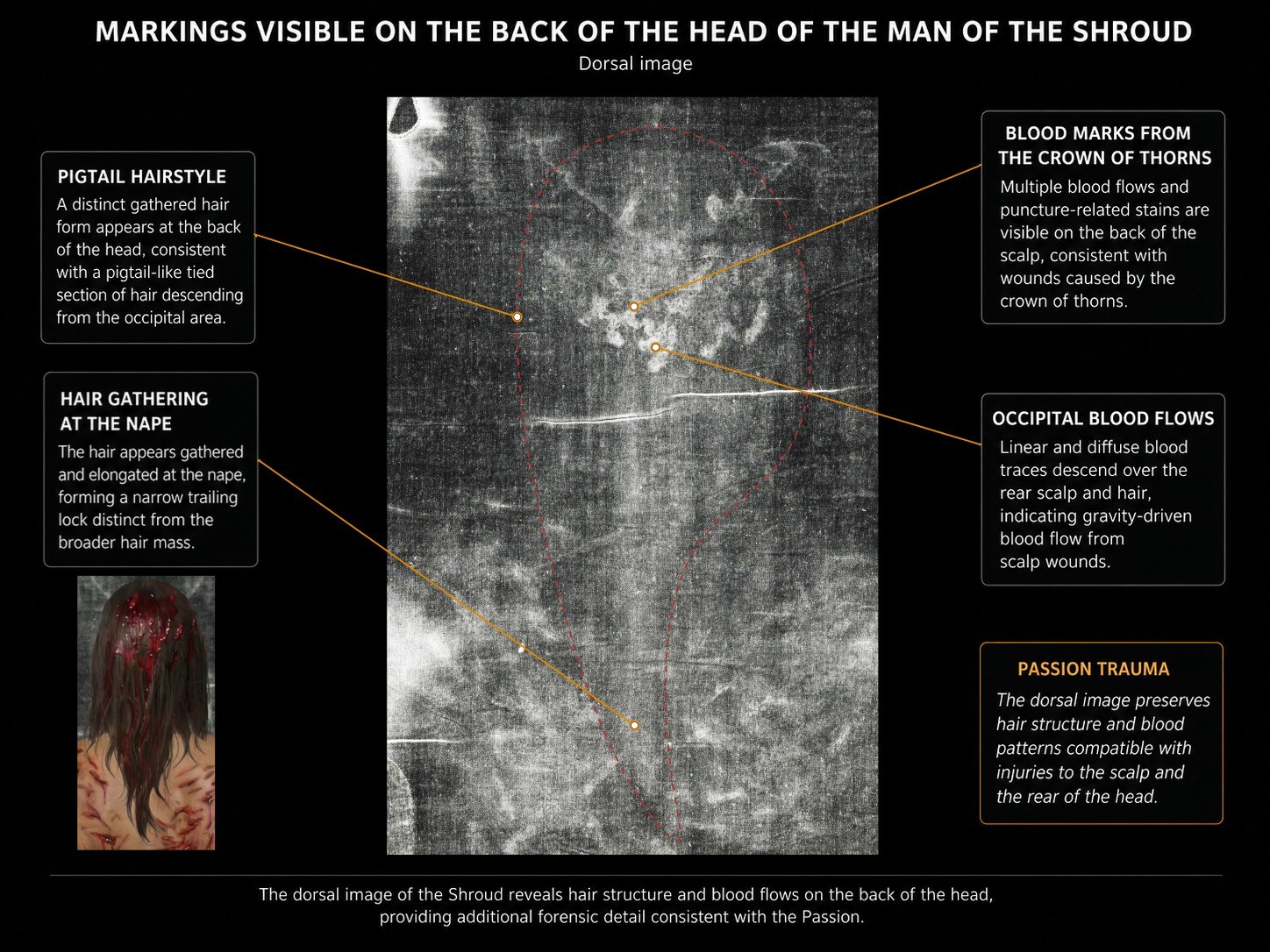
The stains are read as wounds, and the wounds as the traces of an execution. The principal features are listed here, and each has its own chapter. The scalp bears punctures across the top and back of the head, with flows that run down the forehead and into the hair; Chapter 9 discusses them. The back and legs bear many small, dumbbell-shaped marks, read as the impacts of a Roman multi-thonged whip with weighted tips; Chapter 8 discusses their number and distribution.16 The wrists bear stains rather than palm wounds, and Barbet argued that the wrist was the anatomically sound site for a nail; Chapter 12 sets out that argument and its critics.17 The hands show four fingers and no visible thumbs. The feet appear overlapped, which has been read as consistent with a single nail. The side bears an elliptical wound with a stain that has been read as blood and serum separated by gravity; Chapter 13 discusses it against the Gospel account of blood and water.
These are readings of marks, not measurements of a body. They are useful because they are specific and can be tested against medical knowledge and the Gospel accounts. They are not proof of identity, and the series treats them as evidence to be weighed.
The man on the linen
The body image presents an adult male with a beard, shoulder-length hair, and a body bearing signs commonly interpreted as severe trauma. The image is not anatomically complete. Some regions are faint, distorted by the drape of the cloth, interrupted by stains, or obscured by the crossing of the hands. Forensic interpretation begins with visible patterns and then moves, cautiously, toward reconstruction. Chapter 7 discusses the limits of reconstruction in detail.18
The cloth does not identify its subject. It carries no name and no inscription linking the image to Jesus of Nazareth. Identification rests on convergence. The unusual combination of scourging, scalp wounds, crucifixion injuries, a side wound, and apparent burial in linen resembles the Passion narratives. That correspondence may be historically meaningful, or it may have been constructed deliberately, or it may be partly imposed by interpretation. Scientific instruments can examine chemistry, anatomy, and image structure. They cannot read a name that is not there.
This distinction protects the investigation from two opposite errors. The believer must not convert resemblance into proof. The sceptic must not assume that resemblance is irrelevant merely because it has religious implications. The correct question is narrower. How detailed, internally consistent, and historically plausible is the wounded-body record, and what kind of process could have produced it? The chapters on the Passion and the burial try to answer that narrower question with the evidence available.
The 1978 examination
The most extensive direct scientific examination of the Shroud took place in October 1978. The Shroud of Turin Research Project, known as STURP, brought a multidisciplinary team and several tons of equipment to Turin. During about one hundred and twenty hours of access, researchers used controlled photography, ultraviolet and infrared imaging, reflectance and fluorescence spectroscopy, X-ray fluorescence, thermography, microscopy, adhesive-tape sampling, and other non-destructive or minimally invasive methods.3
The team was not religiously uniform. It included believers, sceptics, and participants whose personal views were not central to their technical roles. Barrie Schwortz, the documenting photographer, approached the relic without Christian devotional commitment. Ray Rogers, the chemist who directed the chemical research, expected scientific testing to expose an ordinary artistic process. Walter McCrone, who later examined the tape samples, concluded that pigment particles supported a painting hypothesis. The investigation was not a single-minded campaign for authenticity, and it did not proceed as one.19
The team reported that it found no evidence of a conventional painted image sufficient to account for the body figure. X-ray fluorescence did not detect heavy-element pigments at concentrations expected in an ordinary painted layer. The spectral behaviour distinguished the body image from the known scorches of the fire. Microscopy and chemistry associated the yellow body image with alteration of the linen surface rather than with a binder carrying pigment through the threads.3 At the same time, the team did not discover the mechanism that formed the image.
That last sentence is the centre of the modern problem. The examination narrowed the range of explanations without supplying a replacement. “Not an ordinary painting” does not mean “therefore miraculous.” It means only that any successful model, natural or artificial, must reproduce the measured properties more adequately than the ordinary painting model did. The 1978 team issued a careful public summary in 1981, and its wording is discussed in Chapter 18.20
The 1988 radiocarbon date
Ten years after STURP, the Shroud was subjected to the most direct chronological test yet performed on it. In 1988 samples cut from one corner of the linen were divided among laboratories in Arizona, Oxford, and Zurich. Accelerator mass spectrometry measured the remaining carbon-14 in each sample. The combined result, published in Nature in 1989, placed the tested material within AD 1260 to 1390 at the reported level of confidence.21
This result remains the strongest single scientific argument for a medieval date for the cloth. It cannot responsibly be dismissed because other evidence appears ancient or difficult to explain. A reader unfamiliar with the controversy should understand its force from the start. If the sample was representative of the main cloth and the measurements were not affected by a significant unrecognised problem, the linen is medieval.
Challenges have been raised about the choice of a single corner, about statistical variation between the subsamples, about possible contamination, and about claims that the corner differed chemically from the rest of the cloth or had been repaired. Later analyses have complicated the discussion, but they have not produced a new direct radiocarbon date for the main body of the cloth. Some textile studies of surviving fragments from the Arizona laboratory have reported characteristics consistent with the main cloth and have found no evidence of a repair in the examined fragments, while acknowledging the small size and the uncertain representativeness of what survives.22 The responsible position is therefore uneven. The medieval date is established for the tested material. Whether that material represents the whole cloth is disputed, and it has not been disproved. Chapter 19 treats the evidence in full.
Dating and image formation must also be kept apart. A medieval linen would locate the problem in the Middle Ages, but it would not identify the process that formed the image. An ancient linen would enlarge the historical problem, but it would not explain the image either. The date of the material, the date of the image, the means of production, the purpose of the object, and the identity of the body are separate questions, and each has to be answered on its own evidence.
What is not known
Four points are often assumed about the cloth without good evidence. The first is the date. The radiocarbon result places the sampled linen in the medieval period, and the representativeness of that sample is disputed. The date of the cloth as a whole is therefore open.
The second is identity. The cloth shows the marks of a crucifixion, but it carries no name. The identification with Jesus of Nazareth rests on tradition and on the fit between the marks and the Gospel accounts. The series keeps identity separate from the forensic evidence, and Chapters 14 and 15 discuss the Gospel burial accounts without treating them as physical proof.
The third is the mechanism of the image. The body image is superficial, non-pigmented, a negative, and distance-related. No known process has been shown to produce all of these properties at full scale. The candidate mechanisms are discussed in Chapter 20. The honest position is that the image has not been reproduced.
The fourth is the relation between the cloth and the Edessa or Constantinople images. The documents describe a face cloth in those cities, and the Shroud shows a full-length body. Scholars have argued both ways about whether the cloths are the same, and that question is taken up in Chapter 16.
How this series examines the evidence
The series follows a few principles, and they are worth stating before the detailed chapters begin.
First, primary physical data takes precedence. The chemistry of the blood, its relation to the image, the anatomy of the wounds, and the sequence of clotting and flow are weighed before any historical or devotional reading. Historical material is treated as context. It is informative where it agrees with the physical findings, and it is not decisive where it does not.
Second, an explanation is judged by whether it accounts for all the constraints at once. An explanation that fits one kind of evidence and contradicts another is treated as incomplete. This matters because a single striking feature is often used to support a conclusion that the rest of the evidence does not support.
Third, explanations that require knowledge or techniques unavailable at the time of the cloth’s presumed origin receive particular scrutiny. Anachronism is one of the most reliable indicators of error in historical reconstruction, and each claim of that kind is tested against the known history of the relevant technology.
Fourth, the language is kept restrained. Consistency is not proof. Improbability is not impossibility. A best-fitting explanation is not an established fact. Where the evidence is silent, the series says so, and it does not supply an answer to fill the gap.
Reading the cloth as evidence
A cloth that has been handled, displayed, damaged, and repaired for centuries is not a clean specimen. Each of those events can leave a mark, and some marks look like features of the original. The first task of any careful study is to separate what was made in the first place from what was added or changed later. That task is harder for the Shroud than for most artefacts, because the image and the stains are so unusual that it is tempting to read every mark as meaningful.
Forensic scientists approach physical evidence by asking what each mark is, how it was made, when it was made relative to the other marks, and whether an explanation accounts for the whole pattern. A bruise, a burn, and a stain can look alike in an ordinary photograph, and they are separated by their edges, their colour under different light, their chemistry, and their relation to the marks around them. The Shroud has been studied this way for more than a century, and most disagreement about it concerns which tests should count and how much weight each should carry.
The historian asks what the documents say, who wrote them, why, and whether the identifications they make can be checked. The historical record of the Shroud is thinner before the fourteenth century than many readers expect, and it contains gaps that are often filled with tradition. A historian who treats tradition as documentation will reach conclusions the record does not support, and a historian who ignores tradition altogether may miss real evidence. The series tries to keep the two methods separate, and to say when a claim comes from one and when from the other.
The textile specialist approaches the cloth as a made object. The weave, the spin of the yarn, the width of the loom, the stitching of the sidestrip, and the repairs all record decisions made by people with particular tools and skills. Textile evidence can rule some possibilities out and make others more or less likely. It rarely gives a single date, because the same techniques were used across long periods and regions, and because the surviving record of ancient and medieval textiles is uneven.
No single approach is sufficient, and the Shroud is best examined by combining them. The combination is also where the most serious disagreements arise. A scientist may find a physical feature striking, while a historian finds it unsupported by the documents. A textile specialist may read a seam as ancient while a radiocarbon specialist reads the same cloth as medieval. Those disagreements are not failures of the evidence. They are the normal result of examining a complicated object from several directions, and the series records them as they stand.
The cloth and the Gospels
The Gospels describe the burial of Jesus in some detail. Joseph of Arimathea, a respected member of the council, asked Pilate for the body, bought linen, took the body down from the cross, wrapped it, and laid it in a new tomb cut in rock.23 John adds that Nicodemus brought a mixture of myrrh and aloes, and that the body was bound in linen cloths with the spices, according to Jewish burial custom. The Gospels use several Greek words for the linen. The Shroud is a single large sheet, and it is sometimes identified with the sindon, the sheet in which Joseph wrapped the body. John also mentions a separate face cloth, the soudarion, which was folded apart from the other linens.23
The Shroud is not named in any Gospel, and it is not mentioned in the earliest Christian writings that survive. The identification with the Gospel burial linen therefore rests on tradition, on the match between the cloth’s marks and the Gospel descriptions, and on the cloth’s documented history. Each supports the identification to a different degree. The match between the marks and the Gospel accounts is the most specific, and the series examines it in the chapters on the Passion. The documented history is the most uncertain before the fourteenth century, and Chapter 16 discusses the gap.
Readers who hold the Gospels as true history and readers who do not both have reason to ask the same questions of the cloth. Are the marks consistent with a flogging, a crown of thorns, a crucifixion, and a burial? Are they consistent with what the Gospels describe? And could a medieval maker have produced them? Those questions can be examined without settling the religious question, and the series tries to do so.
The cloth in worship and art
The Shroud has been an object of devotion for centuries, and its image has been copied in paintings, prints, and devotional objects. Many of the copies are faithful to the cloth’s appearance, and many are not. Artists working from the Shroud in the early modern period often idealised the face or added features that the cloth does not show. The copies are themselves a historical record, because they show what viewers believed the cloth showed at each date.
The House of Savoy displayed the Shroud on a small number of occasions in the nineteenth century. The exhibitions of 1898, 1931, 1978, and later years drew large crowds, and each brought new photographs, new scientific attention, and new public interest. The modern exhibitions were also occasions for devotion, and the series treats the devotional life of the cloth as part of its history without allowing it to decide the physical questions.
The image has also served as a model for images of Christ. The face of the Byzantine Pantocrator icon at St Catherine’s Monastery in the Sinai has been compared with the Shroud face in the scholarly literature, and Chapter 17 examines that comparison and its limits. Whether the Shroud influenced the icon, or the icon the Shroud, or whether both share a model, is not settled.24
How to look at the images
The Shroud is best examined in good photographs, under controlled light, and at several scales. The body image resolves only from a distance, and the stains become clearer under ultraviolet light, so a reader learns more from the photographs in the chapters than from a single view. The 1978 photographs by Vernon Miller, the 1931 photographs by Enrie, and the 1898 plates by Pia offer different views of the same cloth, and each has its own strengths and limits.
When looking at the images, four questions help. What is the mark? Where is it relative to the other marks? How does it change between the positive and negative views? And what would have to be true for the mark to have been made in the way an explanation suggests? These questions are simple, and the later chapters ask them of each feature.
Every image of the Shroud is also a representation. Photographs are processed, negatives are inverted, colours are adjusted, and digital renderings add their own assumptions. Chapter 7 discusses the limits of digital reconstruction, and the series uses a photograph as evidence only when its processing is known.
Where to look further
Much of the primary material on the Shroud is available to anyone who wants to check the claims in this series. The sources below are the main ones for the photographs, the archives, and the scientific papers. They are sources to consult, not endorsements of every position they contain.
- shroud.com, the archive built by Barrie Schwortz, the STURP documentarian, with the 1978 archive, technical papers, and a photographic library.
- sindone.org, the International Center of Sindonology in Turin, with academic resources and official updates from the custodians of the cloth.
- museosindone.it, the official museum site, with material on the history and conservation of the cloth.
- sturp.org, the archive of the 1978 Shroud of Turin Research Project.
- shroudphotos.com, Vernon Miller’s STURP photographs, the primary photographic reference for much of the research.
The three questions
Three questions organise the rest of the series. This chapter does not answer them. It states them, so that the reader knows what the physical evidence is being asked to decide.
- Who was the man? The wounds, stains, posture, and burial traces are read as the record of a particular execution. The chapters on the Passion follow that record from Gethsemane to the tomb, and they keep the identification separate from the forensic reading.
- How did the image form? The image is superficial, non-pigmented, a negative, and distance-related. Any explanation has to account for each property, and the chapters on image formation test the candidate mechanisms against them.
- When did the cloth exist? The radiocarbon result places the sampled linen in the medieval period. The documentary history, the textile evidence, the pollen and mineral traces, and the image itself have been read by some researchers as pointing to an earlier date. This is the most contested of the three questions.
None of these questions has a settled answer, and none can be dismissed. The series treats each as open. It follows the evidence layer by layer and discipline by discipline, and it says where the evidence is firm and where it is not. The first layer is the linen itself, and the next chapter takes it up.
References
- Image book, Part I, “A Cloth That Does Not Look Like a Masterpiece”; the description of the cloth’s form, the front and dorsal figures, and the absence of a painted setting. See the source volume for the documentary reproduction and the illustrative infographic credits.
- Textile structure, dimensions, and the sidestrip. Flury-Lemberg, M. (1988). Das Turiner Grabtuch und der Ursprung seines Bildes. Bern: Abegg-Stiftung. Raes, G. (1974). Rapport d’analyse du tissu de la sainte sindone. Sindon, 23, 79–83.
- Schwalbe, L. A., & Rogers, R. N. (1982). Physics and chemistry of the Shroud of Turin: A summary of the 1978 investigation. Analytica Chimica Acta, 135, 3–49. The depth of the image layer and the absence of pigment are reported there and in the STURP documentation.
- McCrone, W. C. (1990). The Shroud of Turin: Blood or artist’s pigment? Accounts of Chemical Research, 23(3), 77–83.
- The 1532 fire at the Sainte-Chapelle, Chambéry; the 1534 Poor Clare repairs and Holland backing; and the 2002 conservation intervention, as described in the historical and conservation literature. See the image book, Part II, section V, “The Fire of 1532: Catastrophe as Chemical Control.”
- Fire at the Guarini Chapel, Turin, 1997, and the subsequent conservation of the cloth. Reported in the historical literature. Publication details to be confirmed before publication.
- Poker holes in pre-1532 copies of the cloth. Discussed in the historical literature on the cloth’s physical record. Publication details to be confirmed before publication.
- Wilson, I. (1978). The Turin Shroud. London: Victor Gollancz. The Lirey record, the pilgrim badges, and the Savoy custody.
- d’Arcis, P. (c. 1389). Memorandum, edited by Chevalier, U. (1900). Étude critique sur l’origine du Saint-Suaire de Lirey–Chambéry–Turin. Paris.
- Mandylion and the Image of Edessa, and the Constantinople record. See Chapter 16 and its references.
- Pia, S. (1898). The first photograph of the Holy Shroud. The original plates and the reports of the 1898 exhibition are discussed in the historical literature. See the image book, Part I, section IV.
- Enrie, G. (1931). Photographic survey of the Holy Shroud, Turin.
- Jackson, J. P., Jumper, E. J., & Ercoline, W. R. (1984). Correlation of image intensity on the Turin Shroud with the 3-D structure of a human body shape. Applied Optics, 23(14), 2244–2270. doi:10.1364/AO.23.002244
- Heller, J. H., & Adler, A. D. (1981). A chemical investigation of the Shroud of Turin. Canadian Society of Forensic Science Journal, 14(3), 81–103.
- Baima Bollone, P., Jorio, M., & Massaro, A. L. (1981). La dimostrazione della presenza di tracce di sangue umano sulla Sindone. Sindon, 30, 5–8.
- Fanti, G., Cardin, M., Cinquetti, V., et al. (2025). Shroud of Turin: Reverse engineering to reconstruct the tools that produced the scourge marks. Medical and Clinical Case Reports Journal, 3(4), 1487–1494. doi:10.51219/MCCRJ/Giulio-Fanti/417
- Barbet, P. (1953). A Doctor at Calvary. New York: P. J. Kenedy & Sons.
- Image reconstruction and its limits. See Chapter 7 and its references.
- Shroud of Turin Research Project team composition and roles, as described in the STURP documentation and the image book, Part I, section VI.
- STURP consensus statement, 1981, as reported in the scientific and popular literature. See Chapter 18.
- Damon, P. E., et al. (1989). Radiocarbon dating of the Shroud of Turin. Nature, 337, 611–615. doi:10.1038/337611a0
- Textile study of surviving fragments from the Arizona laboratory, as discussed in the image book, Part I, section VII. Publication details to be confirmed before publication.
- Mark 15:42–46; Matthew 27:57–60; Luke 23:50–53; John 19:38–42; John 20:7. John 19:38–42.
- Icon of Christ Pantocrator, St Catherine’s Monastery, Sinai, and the comparisons in the scholarly literature. See Chapter 17.