The Shroud of Turin · Chapter 21 of 21
The forgery question: could the image have been made by hand?
The first charge that the Shroud was a forgery was made in 1389, in a memorandum written by Pierre d’Arcis, bishop of Troyes, after the cloth had been shown in the church at Lirey. The bishop wrote that the cloth had been painted, and that the painter had confessed to the act. The charge was made more than a century before the first clear record of the Shroud’s display in France, and it has been repeated, refined and contested ever since. The question it raises is simple to state and difficult to answer: could a medieval artist have made an image like the one on the Shroud? The question divides into several smaller ones. What would the artist have needed to know, to have, and to do? Which of those requirements can be shown to have been met, and which cannot? And what would an answer to the question need to show, to be convincing? This chapter sets out the forgery charge and its history, the requirements a forger would face, the arguments on each side, the proto-photography and radiation hypotheses, and the limits of the debate.
The charge of 1389
The memorandum of 1389 is the first document to accuse the Shroud of being a painting. Pierre d’Arcis wrote that the cloth had been shown as the burial linen of Christ, and that it was a false claim. He wrote that an artist had painted it, that the artist had confessed to the painting when the matter was investigated, and that the display was a means of gain for the canons of the church. The bishop asked the pope to suppress the display.1
The memorandum is a polemical document, written by an opponent of the display, and its claims must be weighed with that in mind. The confession is reported second-hand, and the document does not give the name of the painter or the terms of the confession. The charge therefore rests on the bishop’s word, and on the presumption that a bishop would not invent such a claim. The series treats the memorandum as an important source for the history of the cloth, and as a source whose evidential value for the forgery question is limited.
Anonymus Medievus
The forgery question is often framed by imagining a forger, and this chapter follows that practice, with the forger called here by the name of a hypothetical master, Anonymus Medievus. The framing is useful because it forces the argument to specify what the forger knew, what he had, and what he did. Without such a specification, the claim that a forgery was possible is too vague to test. With it, each step can be assessed.
The framing also has a risk. A forger imagined in detail can be made to do anything, and a sufficiently clever imagined forger can meet any objection. The series therefore asks that the forger be constrained by the evidence of the period, including the skills, materials and knowledge that are documented, and not by the ingenuity of the author.
What the forger would have needed
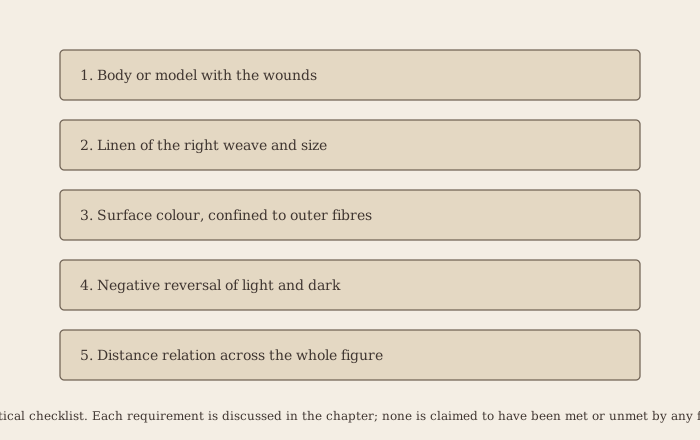
A forger who wished to produce the image would have needed several things. He would have needed a body or a model, from which the image could be taken. He would have needed a linen cloth of the appropriate size and weave. He would have needed a means of colouring the surface of the linen in a way that matched the image, with the depth, the distance relation and the absence of binder. He would have needed to produce the photographic negative, the reversal of light and dark, without a camera or a photographic process. And he would have needed to produce the wounds and the stains of blood in a way consistent with the forensic readings.
Each of these requirements can be examined. The body and the cloth are the most straightforward, because a medieval artist could have used a model and a linen cloth. The colouring and the negative are more difficult, because no documented medieval technique produces the depth and the reversal. The blood is difficult in a different way, because the blood chemistry and the flow patterns would have to be reproduced, and the reproduction would have to match the forensic readings.
The body and the model
The forger could have used a living model, a dead body or a sculpture. The image shows a man of adult size, with a long beard and hair, and with wounds consistent with a flogging and a crucifixion. A model with those features would have been difficult to find, but not impossible, and the wounds could have been produced by a skilled artist. A sculpture would have provided the form, but the image’s surface colour and its distance relation would still need explanation. The body requirement is therefore achievable in principle, and it does not by itself explain the image.
The wounds are a distinctive part of this requirement. A forger who made the scourge marks, the crown wounds and the nail wounds would have needed to know the forms of these injuries, and to place them consistently across the figure. The forensic readings have argued that the wounds are consistent with the Roman instruments and with the crucifixion, and a forger who knew those readings would have needed to know the medical and historical literature of the period. The evidence for such knowledge in the Middle Ages is limited, and it is one of the arguments in the debate.
The cloth
The cloth is a linen of a particular weave and size, with a herringbone twill and a length of about four and a half metres. A medieval forger could have obtained such a cloth, and the weave is consistent with cloths of the period. The cloth is also consistent with the Gospel burial linen as it might have been imagined by a medieval artist. The cloth requirement is therefore not an obstacle, though it may be an indicator, if the weave is shown to be of a later or earlier type.
The cloth carries marks of its history, including the fire damage and the repairs. A forger who made the image on a new cloth would have had to age it, or to use an old cloth. The forensic readings of the cloth’s wear have been used in both directions, and the question is whether the wear is consistent with the cloth’s claimed history.
The colour and its depth
The colour of the image is the most demanding requirement. A forger using paint would have had to apply a pigment to the surface without a binder, and the surface colour would have needed to be confined to the outer fibres. A forger using a stain would have produced spread, which is absent. A forger using a heated object would have needed to control the heat and the contact to produce the distance relation, which is difficult. No documented medieval technique is known to produce the full set of properties, and this is the main reason that the forgery hypothesis has been judged difficult.
The argument is strong, though not conclusive. The absence of a documented technique does not prove that no such technique existed, and the medieval record of technical knowledge is incomplete. The argument is that the required technique would have been unknown to the artists of the period, and that a technique unknown to them could not have been used by them. That is a reasonable inference, but it depends on the completeness of the surviving record.
The negative
The Shroud image is a negative, and a forger would have had to produce a negative to produce it. The photographic negative was invented in the nineteenth century, and no medieval artist had the means to produce a photographic negative directly. A forger could have produced the reversal by hand, by painting the image as a negative, but then the image would need to show the reversal consistently across the whole figure, and that would be difficult without a model of the reversal. The negative character therefore raises the forgery requirement, and it is one of the strongest arguments in the debate.
The wounds and the blood
The blood on the Shroud has been studied in detail, and it has been reported as consistent with blood. A forger would have needed to produce blood stains with the chemistry of blood, and with the flow patterns that the forensic readings describe. Medieval artists did use red pigments for blood, and they painted wounds with realism in devotional images. The Shroud’s blood, however, is not paint, according to most of the STURP results, and its chemistry is consistent with blood. A forger who used real blood would have needed a source, and a forger who used an imitation would have had to match the chemistry.
The blood argument is one of the strongest against forgery in the simple form, and it is weaker in the detailed form. The question of whether the stains are blood is itself disputed, and the chemistry is contested. The argument therefore depends on the outcome of the chemical debate.
The indictment, reconsidered
The indictment of 1389 says that the cloth was painted and that the painter confessed. If the indictment is correct, the forgery hypothesis is supported by a contemporary claim. If it is not, the claim rests on the bishop’s word alone. The indictment cannot decide the question, because it is a claim about the cloth made by an opponent, and the cloth itself must be examined for evidence of the process the indictment describes. The examination has not found the marks of a painter’s process, but it has not excluded them either.
The proto-photography hypothesis
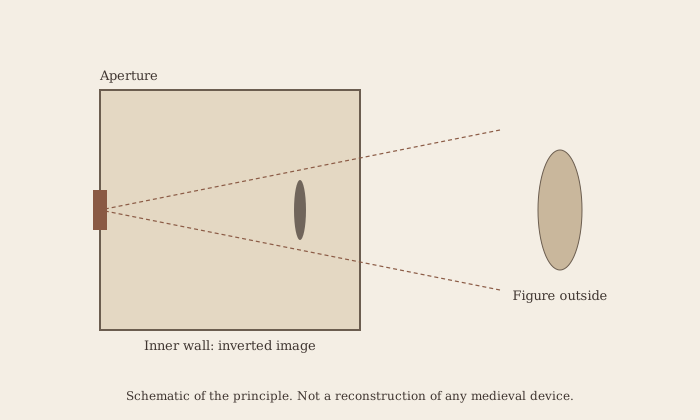
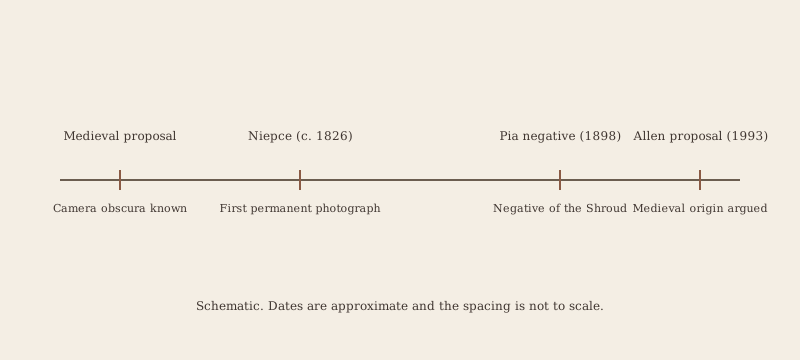
In 1993 the South African art historian Nicholas Allen proposed that the image was formed by a medieval camera obscura, a device that projects an image through a small aperture. In his proposal, a sensitised cloth was placed inside a darkened room or box, and the light from a bright figure outside projected the image onto the cloth. The photographic process was then completed by a chemical treatment that fixed the image. The hypothesis explains the negative character and the distance relation, because the camera obscura records the figure as a negative and the distance affects the focus and the intensity.2
The hypothesis has been criticised on several grounds. The camera obscura does not produce a sharp image of a figure at close range without a lens, and the cloth would have had to be placed at a precise distance and orientation. The chemistry of the sensitised cloth would have had to produce the surface colour without the metallic residues that silver-based photography normally leaves, and there is no evidence of a medieval photographic chemistry of this kind. The hypothesis also requires a medieval artist to have conceived of and used a photographic process centuries before the first permanent photograph of 1826 to 1827, and no record of such a process survives.
The argument from the photograph
The proto-photography hypothesis is an argument from the photograph. Its proponent argues that the Shroud is a photograph, and that the process that formed it must have been a photographic one. The argument is strong if the image is a photographic record, and it is weaker if the image is a surface colouring of another kind. The distinction between the two is therefore central, and the physics of the image bears on it directly, as Chapter 20 shows.
The radiation hypothesis as a forgery
The radiation hypothesis, discussed in Chapter 20, has been proposed as a natural process that formed the image, and it has also been proposed, in a different form, as a technique a medieval artist could have used. The second form is less plausible, because the radiation sources required are not known to have existed in the period. The radiation hypothesis as a forgery technique therefore fails on the same grounds as the other technical proposals, and its strength lies in its explanation of the physics, not in its historical possibility.
The argument from impossibility
Some writers have argued that the image is beyond human making, and that no known technique of any period could have produced it. The argument has been put in several forms. The image is too fine, too systematic and too well-preserved for painting. Its depth and its negative character cannot be reproduced without modern tools. Its blood is too consistent with the forensic readings for a medieval artist to have produced. The argument is that the requirements of the forgery exceed the capacity of any medieval maker.
The argument has force, but it depends on the completeness of the knowledge about medieval technique. A reader who accepts the argument should ask whether the knowledge of the period was complete enough to exclude every possible method, and whether the methods excluded are the ones that were actually available. The argument is a claim about a lack of evidence, and its strength depends on the strength of that evidence.
The argument from forgery
Other writers have argued that the image was made by a medieval artist, and that the impossibility argument is an illusion produced by the limits of present knowledge. They point out that many medieval techniques are poorly documented, that artists of the period had skills that are not fully recorded, and that the image could have been produced by a combination of methods that are individually known. The argument is that the impossibility is a product of ignorance, and that a skilled artist with patience could have produced the image.
The argument from forgery has been criticised for its lack of specific proposals. A general claim that a medieval artist could have done it is not a demonstration, and the specific proposals that have been made have run into the problems set out above. The argument is therefore weak in its present form, though it is a reasonable reminder of the limits of the record.
The Dead Sea Scrolls comparison
The Dead Sea Scrolls were the subject of forgery charges in the twentieth century, and some of the charges were made by scholars who believed that the scrolls could not have survived from the period they claimed. The scrolls were later shown to be ancient, through palaeography, radiocarbon and the comparison of the writing with other documents. The comparison is useful for the Shroud, because it shows that a claim of impossibility can be overturned by the accumulation of independent evidence, and that the evidence must be assembled before the claim is decided.
The comparison also shows the difference between the Shroud and the scrolls. The scrolls are written documents whose age can be checked by their script, their language and their context. The Shroud is an image whose age cannot be checked in the same way, and whose chemistry is the main object of study. The analogy is therefore instructive about method, though the material is different.
What the debate can and cannot settle
The forgery debate can settle some questions. It can show that certain techniques are excluded by the observations, or that certain requirements are not met by any known method. It can show which proposals are consistent with the evidence and which are not. It can show where the evidence is thin and where the knowledge of the period is incomplete. It cannot, by itself, show that the image was or was not made by a human hand, because that requires a demonstration that a particular method produced the particular image, or an exclusion of all methods.
What an answer would need to show
A convincing answer to the forgery question would need several things. For the forgery hypothesis, it would need a specific technique, documented or reproducible, that produces the image with all its properties: the surface colour, the depth, the distance relation, the negative character, the absence of spread and the blood. For the authenticity hypothesis, it would need an account of the image that does not depend on an unknown process, or an exclusion of all known and plausible processes for a medieval maker. Neither has yet been provided.
A convincing answer would also need to reconcile the forgery question with the other evidence. The radiocarbon date, discussed in Chapter 19, bears on the question, and it must be assessed with its sampling problems in view. The history of the cloth, discussed in Chapter 16, bears on it, and its gaps must be accounted for. The physics, discussed in Chapter 20, bears on it, and its open problems must be stated. The question cannot be answered by any one line of evidence alone.
Forgery and the relics of the Middle Ages
The medieval period was full of relics, and many were copies, fakes or doubtful objects. The relic trade was active, and the demand for objects connected with the Passion was high. Some relics were revealed as forgeries by contemporaries, and others were accepted for centuries before they were challenged. The Lirey cloth must be placed in this context, because the bishop’s charge of 1389 was a claim within a world of competing relics and competing claims of authenticity.
The context cuts both ways. It shows that forgeries were made and that they were believed, which is a reason to take the forgery hypothesis seriously. It also shows that the bishop’s charge might have been part of a rivalry between the church at Lirey and the diocese, and that the charge might have been motivated by competition for pilgrims. The reader should note both points, and should not assume that the bishop’s charge was disinterested.
Medieval technical knowledge
The technical knowledge of the medieval period was wide, and it was recorded in treatises on painting, glass-making, dyeing and the preparation of materials. The treatises describe the use of pigments, binders, varnishes and stains, and they show a sophisticated understanding of the reactions of materials. A medieval workshop could produce a wide range of effects, and its skills were passed on through apprenticeship. The forgery hypothesis assumes that such knowledge was sufficient, and that no technique unknown to the treatises was needed.
The treatises are also incomplete. They record the methods that were thought worth writing down, and they do not record the secret methods of particular workshops or the experiments that failed. The record of technique is therefore a partial one, and an argument that a technique was unknown because it is not recorded is weaker than it appears. The historian has to decide how much weight to give the silence of the record.
Painting and the Passion image
The painting of the Passion in the fourteenth century included scenes of the flogging, the crowning and the crucifixion, and the wounds were shown with growing realism. Painters used red for blood, and they showed the wounds in detail. The Shroud image differs from these paintings in its tonal character, its negative reversal and its surface quality. A painter working in the style of the period would not normally produce those features, and the difference is one of the reasons the Shroud has been considered unusual.
The difference is also a matter of intent. A painter of the period was working for devotion, for teaching or for display, and the style of the period reflects those purposes. A forger working for the Lirey church would have had a different purpose, and the style might have been different too. The argument from style therefore depends on assumptions about the forger’s aims, which are not known.
How a forgery claim could be tested
A forgery claim can be tested by producing a specific forgery, documented in its method, and comparing it with the image. The test would need to state the materials, the methods, the time taken and the skills required. It would then compare the result with the image at each of the levels discussed in the earlier chapters: the surface colour, the depth, the distance relation, the negative, the spread, the blood and the wounds. A test that reproduces all of these, under documented conditions, would be a strong demonstration. A test that reproduces some of them would show which features are within reach of medieval methods, and which are not.
Such tests have been attempted in a limited way, and they have produced images that resemble the Shroud in some respects. None has produced the full set of features at once. The series reports this as the current state of the evidence, and it notes that a convincing forgery demonstration would need to meet the full set of requirements.
The scholarly positions
The scholarly positions on the forgery question vary. Some historians and scientists hold that the image is beyond medieval capacity, and they argue for an unknown process or for authenticity. Others hold that the image could have been made in the Middle Ages by methods that are not fully documented, and they argue that the impossibility claim is premature. A third group holds that the question cannot be decided on the present evidence, and that the best course is to state what is known and what is not. The series takes the third position, and it does so because the evidence does not yet support the first two.
The positions are also shaped by commitments. A reader who believes in the Gospel account may find the authenticity hypothesis attractive, and a reader who doubts the supernatural may find the forgery hypothesis more natural. The series asks that these commitments be stated and separated from the evidence, so that the reader can see which parts of an argument rest on the evidence and which on belief.
The ethics of the charge
The charge of forgery has a moral dimension, because it accuses someone of deception. The bishop’s charge accused the canons of Lirey of deceit, and modern charges accuse scientists of bias or the Church of defending a relic. A charge of forgery should be made only on evidence, and it should be stated with its limits. A reader who meets a charge should ask whether it names the forger, the method and the evidence, and whether it has been tested against the alternatives.
The defence of the Shroud has similar obligations. A defence that treats every doubt as an attack, or that treats the absence of a known method as proof of a miracle, does not meet the standard of evidence. The series asks for the same care from both sides, and it treats the moral weight of the question as a reason for precision, not for rhetoric.
Reading the forgery literature
A reader who wants to follow the forgery literature should begin with the requirements, and should ask, for each proposal, which requirements it meets and which it does not. The reader should then look at the evidence for each requirement, and should ask whether the evidence is observed or inferred. The reader should also ask what the proposal predicts that could be checked, and whether any such check has been carried out. The answers will show how far each proposal has been tested.
The blood as a test of forgery
The blood is the feature of the image that could most directly test a forgery claim, because blood has a specific chemistry and its flow leaves specific patterns. If the stains are shown to be real blood, with the protein and iron signatures and the flow of a wound, a forger would have needed a source of human blood, and the blood would have had to be applied before the image was formed. If the stains are shown to be a pigment or an imitation, the forgery hypothesis gains ground. The chemistry is therefore a test with a clear outcome in principle.
The chemistry is not yet settled. The STURP tests and later work have reported the markers of blood, but the markers are not always specific, and the interpretation has been disputed. A test that could decide the question would need to show the presence of human blood proteins, without ambiguity, in the stains of the wound areas, and to exclude imitations. The series treats the blood as the most promising route to a decisive test, and it notes that the present evidence falls short of one.
Why the question matters
The forgery question matters for several reasons. It bears on the claim that the image is the burial linen of Christ, and so on the value of the cloth to those who venerate it. It bears on the history of art and of technique, because a medieval forgery would be a remarkable achievement, and its demonstration would change the record. It bears on the integrity of the scientific record, because the question has been argued in both directions by people who have stated their commitments. And it bears on the moral question of deception, which is part of any charge of forgery.
The question also matters because it has been argued with more heat than evidence in some quarters. A reader who has followed the series will know that the evidence is partial and that the arguments are complex. The most useful thing the series can do is to make the complexity visible, and to show what would be needed to resolve it.
A closing reflection on the series
The Shroud of Turin is an object that has been studied for more than a century, and its image has been read in many ways. The series has tried to separate what is observed from what is inferred, and to state the limits of each argument. It has not claimed to settle the question of origin, and it has not claimed that the cloth is the burial linen of Christ. It has presented the evidence, the arguments and the open questions, and it has asked the reader to judge them with care. The question of forgery is the last of those questions, and it is perhaps the one on which the reader will most want a clear answer. The honest answer is that the evidence does not yet allow one, and that the most useful work is to state exactly what would be needed to give one.
The evidence that would change the picture
Several kinds of evidence could change the picture substantially. A medieval document that described the making of the image, with its method, would be the strongest possible evidence for a forgery, and no such document has been found. A demonstration that a documented medieval method reproduces the image in full would have the same force. A decisive blood test showing that the stains are not human blood, or are a pigment, would weaken the authenticity hypothesis. A radiocarbon result from an unambiguously original and uncontaminated sample, if it fell in the medieval period, would strengthen the forgery hypothesis, and a result from the first century would strengthen the other. Each of these could be obtained, and each would be a decisive step. None has yet been obtained with the required clarity.
The reader should note that the absence of such evidence is not neutral. It leaves the question open, and it means that claims on either side go beyond what is known. The honest course, while the evidence is missing, is to state the claims with their limits, and to say which of the decisive tests would settle them.
The series has tried to do that throughout. It has presented the evidence for and against each part of the argument, and it has marked the points on which the evidence is decisive and those on which it is not. The reader who has followed the chapters will have seen that most of the questions about the Shroud are questions of degree, of probability and of the quality of the methods, and that a single conclusion requires a judgement that the evidence does not fully support. Some readers will want the series to say which judgement is correct. The series has not done so, because a verdict that outruns the evidence would misstate what is known. What it offers instead is a clear account of the questions, the tests that could answer them, and the places where the answers are still missing. That account is the most accurate summary of the present state of knowledge that can honestly be given, and it is the basis on which any future verdict must be built, and it is the standard against which the claims of the next generation of work should be measured. The series ends where the evidence ends, and it leaves the remaining judgement to the reader, who is now equipped to make it with the questions in view.
References
- Pierre d’Arcis, memorandum to Pope Clement VII, dated 1389 or 1390 in different sources. Text published by Ulysse Chevalier in 1900; its status as a sent letter is disputed. See Chapter 16, reference 5.
- Allen, N. P. L. (1993). Is the Shroud of Turin the first recorded photograph? Port Elizabeth Technikon. Available in the University of Pretoria repository. Peer-review status to be confirmed.