The Shroud of Turin · Chapter 20 of 21
The physics of the image: colour, depth and the radiation hypotheses

Ray Rogers, a chemist who had taken part in the 1978 investigation of the Shroud, did not begin from belief in its authenticity. He spent many years examining the fibres, the colour and the chemistry of the image, and he came to the view that the image had properties that no known painting or staining process could produce. He also came to doubt several of the claims that had been made about the cloth, and he was willing to say so. His work illustrates the central problem of the physics of the image. The image is superficial, it is a record of contact or of proximity rather than of paint, it has a particular relation to the distance of the cloth from the body, and it has no clear halo of spread at its edges. Any account of its formation has to explain these features, and most of the accounts that have been offered explain some of them and leave others unexplained. This chapter sets out the physical properties of the image, the criteria by which any theory of its formation is judged, the radiation hypothesis and the experiments that have tested it, and the reasons the question remains open.
What the image is
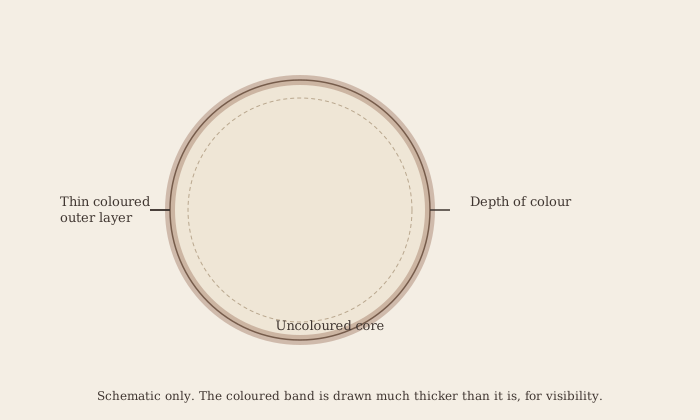
The image is a discoloration of the linen. The colour is yellowish to brown, and it is carried by the outermost fibres of the cloth, the walls of the fibrils that make up each thread. The colour does not penetrate deeply into the fibre, and it does not sit in a layer of applied material. The image is most clearly seen from a distance, where the eye integrates the coloured fibres into a figure. At close range the image breaks into a field of separate threads, each with its own degree of colour. The relation between the local colour and the local distance from the body is the key to the physics.
The image is also very fine. The colour of individual fibres is faint, and the contrast between adjacent threads is small. The eye and the photograph resolve the image because many fibres are coloured in a systematic way. The fineness has been noted by every investigator who has examined the cloth, and it is among the features that any theory has to account for.
The depth of the colour
The colour is confined to a thin surface. The STURP investigators and later workers estimated the depth of the coloured layer at a few hundred nanometres, which is a fraction of the thickness of a single fibre. Rogers and others examined cross-sections of the threads, and they reported that the colour lay in the outer walls of the fibrils, and not in the core. The depth is the most important single feature of the image, because it rules out many simple methods of colouring, such as dipping, brushing or dyeing, which would put the colour throughout the thread.1
The depth is also consistent with a process that acts only on the outermost layer of a material. Such a process could be a chemical reaction with the surface, an oxidation, a dehydration, or the action of radiation that is absorbed in the first layer. Each of these would produce a colour that is limited to the surface, and each would need a further explanation of how the surface was affected. The depth therefore narrows the field of candidate processes without identifying the one that operated.
Colour without binder
The image contains no evident binding medium. Paint consists of pigment and a binder, and the binder holds the pigment to the surface. The Shroud image shows no sign of such a binder, and the fibres do not show the layered build-up of paint. The absence of binder has been used as an argument against painting, and it has been the basis of the claim that the image is not a paint layer.
The argument is not conclusive. The binder could be present in a small amount, or it could have been removed or degraded over time. The argument from absence is strongest when the sampling is extensive and the controls are reliable, and it is weaker when the samples are few. The STURP sampling and the later analyses have been argued both ways, and the question has not been settled by a single decisive test.
The distance relation
The colour of the image varies with the distance between the cloth and the body. Areas of the cloth that were nearest the body, such as the tips of the nose, the forehead and the knuckles, are darker than areas that were further away, such as the sides of the face and the folds of the cloth. The relation has been studied with the VP-8 analyser and with later methods, and it has been reported as a broadly consistent correlation between image intensity and distance. The correlation is the basis of the three-dimensional encoding discussed in Chapter 6.
The relation is important because it is hard to reproduce by ordinary means. A painter can make an image darker where the form is nearer, but a painter must decide the value of each area by hand, and the decision is not guided by a fixed physical law. The Shroud’s relation between intensity and distance appears to be systematic across the whole figure, and that systematic character is one of the features that argue against a painter working freehand.
The absence of halo and spread
Many coloured or stained surfaces show a halo or spread at their edges, where the colouring agent has diffused into the surrounding material. Blood stains spread in this way, and so do many dyes and inks. The Shroud image does not show a halo of this kind. Its edges are soft but sharply bounded, and the colour does not spread beyond the outline of the figure. The absence of spread has been noted by many observers, and it has been argued that it reflects a process that does not depend on diffusion.
The argument is strong, but it depends on the chemistry of the colouring. A substance that binds rapidly to the surface and does not diffuse would not spread, and such substances exist. The absence of halo therefore tells us that the process was not diffusive, and it does not identify the process.
The properties any theory must explain
Several properties of the image can be used as criteria for any theory of its formation. The first is the surface colour, which is confined to a thin layer. The second is the absence of binder. The third is the systematic relation between intensity and distance, which is a property of the whole figure. The fourth is the absence of halo and spread. The fifth is the presence of blood stains that were applied before the image was formed in some areas, and that show different fluorescence from the image. The sixth is the negative character of the image, which means that the darkest areas correspond to the lightest ones in a photograph.
A theory that explains all six properties would be a strong candidate. A theory that explains some and not others is weaker. The criteria can be used to test the proposals in the literature, and they have been used to reject some of them. The series applies them as a checklist, and it asks each theory to state which properties it explains and which it does not.
Painting, scorching and staining
Three ordinary processes are often considered as candidates for the image: painting, scorching and staining. Painting is ruled out by the absence of binder and the surface colour, though not conclusively. Scorching, the production of colour by heat, would produce a colour that depends on the temperature and the time, and it would tend to spread into the fibre if the heat were applied for a long time. Staining, the application of a coloured solution, would spread and would penetrate the thread. None of the three ordinary processes produces the full set of properties. The question has therefore been whether a process outside these categories could have produced the image.
Scorching has been considered in detail. A heated object pressed against the linen could produce colour by thermal decomposition of the cellulose, and some experiments have produced a coloured surface by heat. The experiments have not reproduced the depth, the distance relation and the absence of halo together. The scorching hypothesis therefore explains some features but not others, and it has been set aside by most investigators.
The radiation hypothesis
The radiation hypothesis proposes that the image was formed by a burst of radiation emitted from the body, or from a source associated with it, which coloured the surface of the cloth in proportion to the distance from the body. The hypothesis was advanced in the twentieth century, and it has been developed in several forms. It has the attraction that a radiation field from a body would colour the nearest parts most strongly, and would not spread, because radiation travels in straight lines and is absorbed at the surface.
The hypothesis has a clear problem. No known natural process emits radiation of the required intensity and wavelength from a human body in the required pattern. The hypothesis therefore has to propose a mechanism, and the mechanism is the point on which most criticism has focused. The hypothesis has not been demonstrated, and the experiments that have tested it are the subject of the next section.
The Di Lazzaro laser experiments
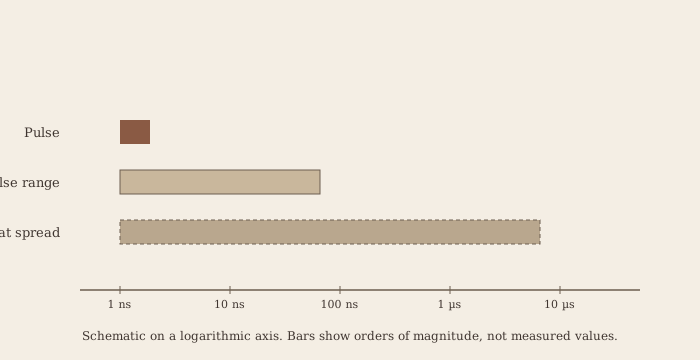
In the 2010s, a group led by the physicist Paolo Di Lazzaro at the ENEA laboratory in Frascati carried out experiments to test whether deep ultraviolet radiation could produce an image of the kind found on the Shroud. The group used an excimer laser, a type of high-power ultraviolet source, to fire nanosecond pulses at samples of linen. The pulses were of wavelengths around 193 to 248 nanometres, and their duration was between about ten and fifty nanoseconds. The samples showed a coloured surface whose spectroscopic signature was close to that of the Shroud image.2
The experiment was significant because it showed that a short pulse of deep ultraviolet radiation could colour the surface of linen with a chemistry resembling the image. It showed that the colour could be limited to the outer fibres, because the pulse was absorbed before it penetrated far. It did not, however, show that the body could emit such radiation, and it did not reproduce the full image.
The timing argument
The timing argument is the central physical point of the experiments. A pulse that lasts tens of nanoseconds delivers its energy before heat can spread far into a fibre. The fibre is only a few micrometres thick, and heat diffusion through such a distance takes much longer than the pulse. The colour is therefore confined to the surface by the speed of the pulse, not by any special property of the linen. A longer pulse would heat the whole fibre and would produce a different colour distribution.
The argument has been accepted by many physicists as a valid demonstration of the principle. It shows that a particular kind of radiation can produce the surface colour, and that the timing of the radiation matters. It does not show that the radiation came from a body, and it does not show that the image was formed in this way.
The scaling problem
The experiments raise a second problem, which is one of scale. To colour the whole Shroud image at once with a pulse of deep ultraviolet light would require a source of enormous power, spread over the whole area of the figure. The calculations made by the experimenters suggested that a single pulse capable of colouring the image would need an array of many excimer sources, operating together, and that the total power would be far beyond any single source then available. Di Lazzaro himself was direct about the practical limits of the approach.2
The scaling problem does not refute the principle. It shows that the principle, if it operated in the formation of the image, would need a source that is not known to exist in nature or to have existed in the Middle Ages. The hypothesis therefore requires either an unknown natural process, or an unknown artificial one, and neither has been identified.
The source problem
The source problem is the most serious objection to the radiation hypothesis. A human body does not emit ultraviolet radiation in any biologically significant quantity, and it does not emit collimated, wavelength-specific radiation in any quantity. The radiation that the body does emit is in the infrared, and it is not of the kind that the experiments require. The source of the radiation must therefore be explained, and the explanation must account for the distance relation and the systematic character of the image.
Some proposals have suggested that the radiation was associated with the resurrection, or with an event of unknown physical nature. Such proposals go beyond physics, and they cannot be tested by the methods of physics. The series treats them as theological or speculative, and it does not treat them as evidence.
Other radiation proposals
Other radiation proposals have considered neutrons, gamma rays and electron beams, and each has been examined in the literature. Neutron flux would produce a different chemistry, and gamma radiation would damage the cellulose more widely. The proposals have each run into difficulties, and none has been shown to reproduce the image in full. The series reports them as proposals with stated limits.
What the Fanti study adds
Giulio Fanti published a study in 2010 proposing that the image could have been formed by a corona discharge, an electrical discharge in the air around the body. The proposal accounts for some features, including the depth, and it has been discussed in the literature as a possible physical mechanism. The proposal is not a complete account, and it has been criticised for its assumptions about the chemistry and the conditions.3
What the tests can and cannot show
The experiments show that certain radiation sources can produce a surface colour with a chemistry close to that of the image, and that the timing of the radiation determines the depth of the colour. They do not show that the image was formed by radiation, and they do not identify the source. They show that the radiation hypothesis is physically possible in principle, and that it has to meet the source and scaling problems in practice.
The experiments also show the limits of the chemical comparison. A chemical signature is a set of spectra and reactions, and many processes can produce similar signatures. The match between the laser-treated linen and the image is therefore a match at the level of a few properties, not a proof of identity.
Testing the proposals
The proposals can be tested in several ways. A proposal must state the source of the energy, the mechanism of its delivery, the spatial pattern it would produce and the chemistry it would leave. It must then be tested against the image at each of those levels. A proposal that cannot state its source is incomplete, and a proposal that explains the chemistry but not the spatial pattern is only partly successful.
The tests should also include the controls. An experiment that produces a surface colour with a laser should be compared with an experiment that produces a similar colour with heat, and the comparison should show which features distinguish them. The series asks that such controls be reported, and that the proposals be judged on the full comparison, not on a single match.
The image and the cloth as a record
The physics of the image also bears on the cloth as a record of an event. If the image is a record of contact with a body, the physical properties of the image should reflect the body’s surface, its temperature, its moisture and its chemistry at the moment of contact. The properties of the image do not reveal these directly, but they set limits on what the body could have been like. A theory that requires a body of unusual temperature or chemistry would have to explain how the body reached that state.
The record is also a record of the cloth. The fibres carry a history of handling, storage, repair and display, and the image may have been altered by any of these. The physics of the image has to be understood in the context of the cloth’s history, and the series treats the two as connected.
The chemistry of the fibre
Linen is made of cellulose, a long chain of sugar units that forms the walls of the flax fibre. Cellulose is a stable material under ordinary conditions, but it changes when it is heated, oxidised or exposed to ultraviolet light. The changes produce new groups in the chain, including carbonyl groups and carboxyl groups, and the new groups absorb light differently from the original cellulose. The yellowing of old linen is one visible result of these changes, and the image colour is consistent with a similar kind of oxidation or dehydration confined to the surface.
The chemistry gives a way of testing proposals. A process that oxidises the surface should produce a particular set of carbonyl groups, and their infrared signature can be measured. A process that dehydrates the cellulose should leave a different signature. The spectroscopic work of the STURP period and the later infrared studies have been compared with the expected signatures, and the results have been reported as consistent with a surface oxidation or dehydration. The comparison is useful, but it does not identify the agent of the change, because many processes give similar products.
Negative character and the reversal
The image is a negative in the photographic sense. The lightest parts of the body, such as the highlights of the face and the parts nearest the cloth, correspond to the darkest parts of the image, and the shadows of the body correspond to the lightest parts of the linen. The reversal is a property of the image as a record, and it has been noted since Pia’s photograph of 1898 revealed the figure in its positive form. The negative character is important for the physics, because a process that colours the cloth in proportion to nearness to the body would produce a negative, and a painting from life would not normally do so.
The negative character has also been used in the argument about the medieval period. The photographic negative was not known in the Middle Ages, and an artist who wished to produce a negative image would have had to conceive of the reversal and apply it by hand. The argument is that the reversal is a feature that a medieval painter would have had difficulty producing consistently across a whole figure. The argument has force, but it depends on assumptions about what a painter could conceive and how a painter would work, and those assumptions are open to debate.
Heat, temperature and the body
The colouring of linen by heat depends on the temperature and the time. A hot object pressed onto the cloth for a short time would colour the surface, and a cooler object for longer would colour more deeply. The image shows colour confined to a thin surface, which would be consistent with a brief high-temperature contact, but the image also shows a systematic gradation that depends on distance. A heated body would need to be heated in a particular pattern, and the pattern would need to be consistent with the distance relation.
The temperature of the body at death, and of the body in the tomb, is itself a matter of inference. A body that had been dead for some time would be at ambient temperature, and a body that had just died would be warm. The image, if it was formed by heat, would have required a body at a specific temperature for a specific period, and the physical evidence for such a body is not present. The argument from heat therefore depends on conditions that cannot be checked, and it has been set aside by most investigators for that reason.
Moisture and the image
Moisture affects the chemistry of linen. A wet cloth reacts differently to heat and to light from a dry one, and the reactions can change the colour and the depth. The image may have been formed in a damp environment, or on a cloth that was moistened by the body, and the moisture would have affected the outcome. The question of moisture is therefore part of the physical account, and any theory must state the moisture conditions under which it operates.
The moisture also bears on the blood. Blood on the cloth would be wet at the time of contact, and it would dry over time. The drying of the blood changed its chemistry and its colour, and the interplay of blood and image is one of the complicated features of the cloth. The series treats the two as distinct in the analysis, though they are physically related in the cloth.
Reproducing the distance relation
The distance relation is the most demanding feature to reproduce. A process that colours the cloth by contact would colour the nearest parts most strongly, but it would need to colour the more distant parts in exact proportion to their distance, across the whole figure. Experiments with heated objects have produced a colour that is darker at the contact points, but they have not reproduced the continuous gradation of the Shroud.
The distance relation has been reproduced in model experiments with radiation and with other processes, but the models have used simplified bodies and idealised geometry. The reproduction of the relation across a full-length figure, with its folds and its foreshortening, has not been achieved by any published experiment. The series reports this as an open problem, and it notes that a convincing reproduction would be a strong result.
How many variables
A theory of the image has many variables: the source, the energy, the pulse or contact time, the moisture, the temperature, the geometry of the body and the cloth, the chemistry of the linen and its history. Each variable can be set in many ways, and the set of possible combinations is very large. A theory that matches the image under one set of values may fail under another. The reader should ask which values were chosen, why they were chosen, and whether the match survives variation.
The number of variables is also a warning. A theory that has been fitted to the image by adjusting several variables has less force than one that predicted the image with values chosen in advance. The series asks that predictions be stated before the test is run, and that the variables be reported with their ranges.
Limits of the physics
The physics cannot tell us who made the image or when. It cannot tell us whether the body was that of a crucified man, or whether the event that produced the image was a natural or a supernatural one. It can tell us which processes are physically possible, which are unlikely, and which are excluded by the observations. It can state what a theory must explain, and it can test whether a theory explains it. Those limits are important, because the physics of the image has been used to support claims that go beyond it.
Rogers and the fibre chemistry
Ray Rogers spent much of his later career studying the fibres of the Shroud, and his analyses are among the most detailed chemical studies of the cloth. He examined the image fibres and the blood-stained fibres, and he reported that the image colour was confined to the outer walls, with no detectable binder and no sign of a dye. He also reported that the chemistry of the image fibres differed from that of the background linen in ways that suggested a surface oxidation or dehydration of the cellulose.1
Rogers did not conclude that the image was produced by any specific process. He stated that the chemistry set limits on the possibilities, and that the image was not a paint in the ordinary sense. His later work on the radiocarbon sample, discussed in Chapter 19, was a separate line of enquiry, and the two should not be confused. A reader who finds Rogers’ chemical observations persuasive should note that his conclusions on the image did not extend to the date or the origin of the cloth, and that his authority in one area does not transfer automatically to the other.
The controls in the laser experiments
The laser experiments are only as strong as their controls. A fair test of the radiation hypothesis would compare the laser-treated linen with linen treated by heat, by chemical oxidation, by ordinary light and by the other processes proposed for the image, all under matched conditions. The comparison would show which processes produce the features of the image, and which do not. The experiments reported so far have compared the laser-treated linen with the image, and in some cases with the STURP spectra, but they have not always included the full set of controls.
The matching of conditions is also important. A laser pulse produces a very different thermal history from a heated plate, and the depth of colour depends on that history. A comparison that uses a different thermal history for the control would not show which mechanism produced the image. The series asks that such comparisons be designed with the thermal and chemical histories matched, and that the results be reported with the conditions stated.
The physical argument in summary
The physical argument can be summarised in five steps. The image is a surface colouring of the linen, confined to a thin layer of the fibres. The colouring has a chemistry consistent with oxidation or dehydration of the cellulose. Its intensity varies systematically with the distance from the body, and it has no halo or spread. Ordinary painting, dyeing and staining do not produce the full set of these properties. The only class of process considered so far that matches the surface depth is one that delivers its energy faster than heat can spread into the fibre, and no such process has been shown to act on a human body.
Each step is contested in part, and the summary is therefore a statement of the argument, not a proof. The reader who accepts the first four steps will still have to decide whether the fifth is a limit of present knowledge or a reason to reject the argument, and that decision is a matter of judgement.
Reading the claims about the image
A reader who meets a claim about the physics of the image should ask several questions. What property of the image does the claim explain? Is the explanation tested against the full set of properties, or against one? What is the source of the energy or the chemistry, and is that source known to exist? Were controls run under matched conditions? Were the predictions stated before the test? And does the claim distinguish the proposed process from the alternatives? The answers will show whether the claim is a demonstration or a suggestion.
What the physics contributes to the series
The physics of the image narrows the field of possible explanations. It rules out simple painting and staining, and it shows that scorching does not account for the full set of properties. It shows that the radiation hypothesis is physically possible in principle, but that it faces serious problems of source and scale. It does not decide the question of origin, and it does not identify the maker. The next chapter takes up the question of forgery directly, and it considers the arguments of those who believe the image could have been made by a medieval artist, and those who argue it could not.
The physics of the image therefore leaves the question open in an informative way. It excludes several explanations that were once popular, it constrains the rest, and it poses a precise challenge to any account that would explain the image by a natural process of known kind. Rogers, who began from doubt, came to think that the image had properties that present methods could not reproduce, and the experiments of the last decades have shown that some of those properties can be approached in the laboratory while others remain beyond reach. The honest position is that the image is well described, only partly explained, and not yet attributed to any cause. The next chapter turns from the physics to the arguments about whether the image could have been made by a human hand, and what the answer depends on.
References
- Schwalbe, L. A., & Rogers, R. N. (1982). Physics and chemistry of the Shroud of Turin: a summary of the 1978 investigation. Analytica Chimica Acta, 135, 3–49. doi:10.1016/s0003-2670(01)85263-6. For the fibre-depth observations; see also Rogers, R. N. (2005), Thermochimica Acta, 425, 189–194.
- Di Lazzaro, P., Murra, D., Santoni, A., Fanti, G., Nichelatti, M., & Baldacchini, G. (2010). Deep ultraviolet radiation simulates the Turin Shroud image. Journal of Imaging Science and Technology, 54(4). Also Di Lazzaro, P., et al. (2012). Superficial and Shroud-like coloration of linen by short laser pulses in the vacuum ultraviolet. Applied Optics, 51(36), 8567–8578.
- Fanti, G. (2010). Can a corona discharge explain the body image of the Turin Shroud? Journal of Imaging Science and Technology, 54(2). Title and details to be checked against the original before publication.